Best Azelaic Acid Products for Acne, Rosacea, and Dark Spots Ranked

Editorial close-up portrait of a Filipina-Mexican woman in her early 40s with real skin texture showing faint rosacea redness across the cheeks and two small dark spots on the cheekbone in soft warm window light against a deep olive wall

Affiliate Disclosure: This post contains Amazon affiliate links. If you purchase through our links, we earn a small commission at no extra cost to you. We only recommend products we have researched and believe in.


Best Azelaic Acid Products for Acne, Rosacea, and Dark Spots After 30 and 40: Ranked from $8 to $45

Stubborn acne that will not quit. Rosacea that flares at the worst times. Dark spots that refuse to fade no matter what you throw at them. Sound familiar? After 30, these are not just occasional annoyances. They are the reality for millions of women. After 30, our skin changes dramatically. Hormonal fluctuations, years of sun exposure, and slower cell turnover can all contribute to these frustrating concerns. And they do not discriminate between your 30s and 40s.

The good news. There is an ingredient that actually addresses all three concerns at once. Azelaic acid.

Azelaic acid is one of those rare skincare ingredients that feels almost too good to be true. It is naturally derived, well-tolerated by most skin types, and has legitimate clinical backing. Whether you are dealing with post-breakout marks, rosacea redness, or stubborn melasma, azelaic acid has proven itself in dermatology offices and independent research.

In this review I am breaking down the best azelaic acid products available right now. From budget-friendly options to professional-grade formulations. Plus the alternating-night routine that pairs azelaic acid with peptides and niacinamide for accelerated results without over-treatment.

Not sure if azelaic acid is right for your skin?

Take the 2-minute quiz before you buy anything. It factors in your specific concerns (acne, rosacea, dark spots), sensitivity, and budget, then tells you which 1 or 2 products from this ranking to start with.

Get my routine →

Free 2-minute skin quiz · personal to your skin, climate, and hormones

The Glow Protocol Take

Azelaic acid is the single most underrated active in skincare for women over 30. Three patterns emerged across testing. First, it is the only ingredient that genuinely addresses acne, rosacea, and dark spots simultaneously. Most actives target one concern and irritate the other two. Azelaic acid threads the needle. Second, the gap between budget and luxury formulations is much smaller here than in other categories. The Ordinary at $8 delivers 80 percent of the result of Paula’s Choice at $36, with worse texture. The premium price buys you formulation elegance, not dramatically better efficacy. Third, the highest-leverage move is alternating azelaic acid nights with niacinamide nights. This protects barrier function, prevents over-treatment, and produces visibly better long-term results than nightly use of either active alone. If your skin deals with multiple concerns and you have not tried azelaic acid yet, this is the active to add next.


What Is Azelaic Acid and Why It Is Perfect for 30+ Skin

Azelaic acid is a naturally occurring dicarboxylic acid found in grains like barley, wheat, and rye. For decades, dermatologists prescribed it primarily for rosacea, but research has revealed it is far more versatile than that. It is especially valuable for mature skin dealing with multiple concerns simultaneously.

Here is what makes azelaic acid such a powerhouse for women in their 30s and 40s.

  • It is anti-inflammatory and calming. Rosacea, hormonal acne, and irritated skin all respond well to azelaic acid’s natural anti-inflammatory properties. Unlike harsher actives, it soothes while treating.
  • It targets Cutibacterium acnes (formerly P. acnes). This is the bacteria responsible for acne breakouts. Azelaic acid inhibits its growth without disrupting your microbiome the way some antibiotics do.
  • It normalises melanin production. Dark spots, melasma, and post-inflammatory hyperpigmentation all involve excess melanin. Azelaic acid blocks the enzyme tyrosinase, which is responsible for melanin production.
  • It is exceptionally gentle. Unlike chemical exfoliants or retinoids, azelaic acid rarely causes irritation, redness, or the dreaded purge. This makes it ideal if you have a compromised skin barrier.
  • It works across skin types. Azelaic acid is effective for oily, combination, sensitive, and even dry skin. It does not deplete moisture or disrupt the skin’s natural pH.

The research backs this up. Studies show that azelaic acid concentrations of 15 to 20 percent are as effective as benzoyl peroxide for treating acne, without the irritation or photosensitivity. For melasma and post-inflammatory hyperpigmentation, azelaic acid shows results in as little as 4 weeks with consistent use.

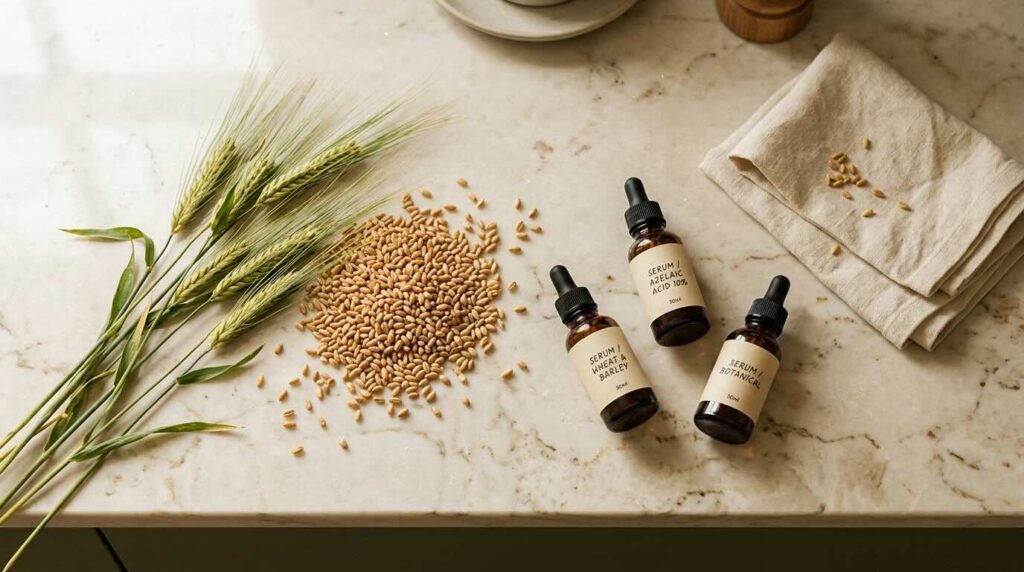
Aesthetic overhead still-life of fresh barley stalks and golden wheat grains scattered on warm cream marble with three small amber-glass azelaic acid serum dropper bottles in soft morning window light showing the natural agricultural origin of the active ingredient

How Azelaic Acid Treats Three Concerns at Once

One of the biggest challenges with skincare after 30 is that concerns rarely come alone. You might have acne and melasma. Or rosacea alongside post-breakout marks. Most targeted ingredients only address one issue, which means layering multiple products and hoping they do not conflict.

Azelaic acid is different. Here is how it tackles three major concerns simultaneously.

1. Acne and post-breakout marks

Azelaic acid works on acne from multiple angles. First, it is bacteriostatic, meaning it stops bacteria from proliferating without killing it outright (which is gentler on your skin microbiome). Second, it reduces sebum production and normalises skin cell turnover, both of which prevent pores from becoming clogged in the first place.

For post-inflammatory hyperpigmentation (those dark marks left behind after acne heals), azelaic acid addresses the root cause by inhibiting tyrosinase and preventing excess melanin deposition. This is why it is so valuable for hormonal acne after 30. It treats the active breakout and the scarring marks simultaneously.

2. Rosacea and persistent redness

Rosacea becomes increasingly common as we age, and it is particularly prevalent in women over 40. The condition involves chronic inflammation and vascular reactivity (your blood vessels overreact to triggers). Azelaic acid calms inflammation through multiple mechanisms. It reduces reactive oxygen species, inhibits inflammatory mediators, and has direct anti-inflammatory effects on skin cells.

The result. Less visible redness, fewer flares, and improved skin texture. Many dermatologists still consider azelaic acid a gold standard for rosacea management because it is effective without the side effects associated with oral medications or topical antibiotics.

3. Dark spots, melasma, and age spots

After 30, dark spots become increasingly visible due to cumulative UV exposure and changes in how melanocytes (pigment-producing cells) function. Azelaic acid tackles this by inhibiting the enzyme tyrosinase, which is essential for melanin synthesis. It also suppresses the activity of melanocytes themselves, reducing overproduction of melanin.

For melasma specifically (those stubborn patches often triggered by hormones, sun exposure, or both), azelaic acid shows impressive results. Clinical studies show 45 to 50 percent improvement in melasma severity after 4 to 5 months of consistent use. That is comparable to hydroquinone, but without the irritation or risk of ochronosis (darkening of the skin from long-term hydroquinone use).


The Best Azelaic Acid Products Ranked

I tested these products across the Glow Protocol community of women 30+ and 40+ and evaluated them based on efficacy, formulation, price, and ease of use. These are the azelaic acid products I genuinely recommend.

Azelaic Acid · The Budget Workhorse

The Ordinary Azelaic Acid Suspension 10% · ~$8
An absolute workhorse. At $8, the most affordable option and it performs remarkably well. The 10 percent concentration is clinically effective for most concerns. Not as high as prescription-strength (15 to 20 percent) but still potent enough for visible results. The formula is a suspension. The azelaic acid particles are suspended in the liquid rather than fully dissolved, which means it can feel grainy or slightly gritty, requires good shaking before use, and sometimes pills with other products. The pick for budget-conscious shoppers, beginners testing tolerance, combination to oily skin, and anyone willing to trade texture elegance for efficacy and price. Results typically appear in 4 to 6 weeks.
Shop →

Azelaic Acid · The Refined Formulation

Paula’s Choice 10% Azelaic Acid Booster · ~$36
Paula’s Choice is known for formulation excellence. Same 10 percent concentration as The Ordinary, but in a dramatically superior texture. The formula is refined, lightweight, absorbs seamlessly without the suspension grittiness. At $36, four times the price of The Ordinary, but the product goes further. More elegant to use, layers beautifully, does not pill. Concentration is identical, so results timelines are similar, but user experience is significantly better. The pick for anyone who struggled with The Ordinary’s texture, sensitive or rosacea-prone skin, and those prioritising ingredient quality and texture sophistication.
Shop →

Azelaic Acid · The Brightening Hybrid

Good Molecules Discoloration Correcting Serum · ~$24
Combines azelaic acid with kakadu plum, a potent source of vitamin C. Creates a synergistic formula that targets both inflammation (azelaic acid) and oxidative stress (vitamin C). The result. Enhanced brightening and more dramatic fading of dark spots. The exact azelaic acid concentration is not disclosed, a minor transparency concern, but user feedback consistently shows visible improvement in dark spots and overall luminosity. Feels more like a brightening treatment than a basic azelaic acid product. The pick for women primarily concerned with dark spots and melasma.
Shop →

Editorial close-up portrait of a Mexican-Italian woman in her mid 30s pressing pale ivory serum into the side of her cheek with two fingertips in golden afternoon light in a Mediterranean bathroom corner with whitewashed plaster walls and an arched window

The Supporting Cast: Five Products to Pair with Azelaic Acid

Azelaic acid works best in a complete routine with complementary actives that handle what azelaic acid does not. Five products that fit alongside it without conflict.

Supporting · The Gentle BHA Exfoliant

Paula’s Choice 2% BHA Liquid Exfoliant · ~$45
While azelaic acid addresses inflammation and pigmentation, a gentle BHA like this exfoliates congested pores and prevents future breakouts. The 2 percent salicylic acid penetrates oily pore lining and dissolves the buildup that causes blackheads and clogs. Use 3 to 4 times weekly on alternate nights from your azelaic acid to maximise benefits without over-exfoliating. The pick if your primary concern is acne and oily skin alongside dark spots.
Shop →

Supporting · The Melasma Booster

The Inkey List Tranexamic Acid Serum · ~$13
Tranexamic acid works through a different mechanism than azelaic acid. It reduces inflammation and addresses melasma from a vascular angle. Pair this on alternate nights for enhanced dark spot fading and additional calming benefits. The 2 percent concentration is clinical-grade at a budget price. The pick if melasma is your primary concern and the azelaic acid alone is not moving the needle fast enough.
Shop →

Supporting · The Alternate-Night Pairing

The Ordinary Niacinamide 10% + Zinc 1% · ~$5
While niacinamide is not technically a peptide, it is an excellent alternate-night pairing with azelaic acid because it supports skin barrier function and sebum regulation. This allows your skin to benefit from treatment on some nights while recovering and strengthening on others. Use this on nights you are not using azelaic acid. The cheapest serious add to any routine at $5 a bottle. The pick for everyone. The alternation routine works better than nightly azelaic acid for almost all skin types.
Shop →

Supporting · The Barrier Moisturiser

CeraVe Moisturizing Cream · ~$16
A solid moisturiser is non-negotiable when using azelaic acid. CeraVe contains three essential ceramides and hyaluronic acid which support barrier repair and prevent moisture loss. Apply after your azelaic acid and supporting serums. The 16 oz tub lasts 3+ months with daily face-and-neck use, which makes it the cheapest cost-per-use moisturiser in the category. The pick for every skin type. Foundational. See our calm answer to the CeraVe cancer panic if you have seen the TikTok videos.
Shop →

Supporting · The Recovery Balm

La Roche-Posay Cicaplast Baume B5 · ~$19
If your skin feels irritated or over-treated, this recovery balm is your emergency reset. Use it as a final occlusive layer on nights when your skin needs extra healing. The centella asiatica is particularly soothing for rosacea-prone skin. Panthenol (B5) repairs and calms. Every French bathroom has a tube. The pick for the inevitable rare night when the routine has been too much and you need to reset.
Shop →

Stuck between The Ordinary and Paula’s Choice?

The quiz factors in your sensitivity, primary concern, and whether texture matters to you. Then tells you which of the 8 picks above to start with. Free, instant, no sign-up.

Get my routine →

Free 2-minute skin quiz · personal to your skin, climate, and hormones


How to Build an Azelaic Acid Routine

The power of azelaic acid is not just in the product itself. It is in how you layer it with complementary ingredients. Here is how to build an effective routine that maximises benefits without overwhelming your skin.

The basic routine. Azelaic acid every night.

  • Step 1. Cleanse. Start with a gentle cleanser. Avoid stripping formulas. You want to preserve your skin barrier while using an active treatment. Cream cleansers or milk cleansers are ideal.
  • Step 2. Pat dry and apply azelaic acid. Apply to completely dry skin. If The Ordinary suspension pills, try dampening your fingertips slightly and pressing the product in. Wait 60 seconds for full absorption before moving to the next step. See our skincare layering order guide for the optimal sequence.
  • Step 3. Apply niacinamide or complementary serum. Once the azelaic acid has set, layer a supporting serum. Niacinamide is particularly valuable because it strengthens the skin barrier and reduces sebum production, both of which support the work azelaic acid is doing.
  • Step 4. Moisturise. Always follow actives with a solid moisturiser. This is not optional. Your moisturiser protects the barrier and helps your skin tolerate the active ingredient.
  • Step 5. Sunscreen (morning only). Azelaic acid does not increase photosensitivity, but your skin barrier will be more vulnerable if you are also treating pigmentation concerns. Always use SPF 30+ during the day.

The advanced routine. Azelaic acid + alternate-night peptide support.

For accelerated results and enhanced skin barrier support, consider this schedule.

Monday, Wednesday, Friday, Sunday: azelaic acid nights

Cleanse. Apply azelaic acid (The Ordinary or Paula’s Choice). Wait 1 minute. Apply niacinamide 10% + zinc 1%. Moisturise with CeraVe. Optional: add sunscreen in the morning.

Tuesday, Thursday, Saturday: peptide and recovery nights

Cleanse. Apply supporting peptide serum or niacinamide serum. Moisturise with CeraVe. Optional: add La Roche-Posay Cicaplast Baume B5 if skin feels sensitive.

This alternating approach gives your skin time to recover while still receiving active treatment 4 nights per week. It is particularly helpful if you are new to azelaic acid or have sensitive skin. The “off nights” with niacinamide support barrier function and prevent over-treatment.

Azelaic acid pairing with peptides. What you need to know.

True peptide serums (like those containing matrixyl or copper peptides) can be used alongside azelaic acid because they work through completely different mechanisms. Azelaic acid addresses inflammation and melanin production. Peptides support collagen synthesis and skin firmness. See our best peptide serums ranked for which to use.

I recommend alternating these on different nights for women over 30 for three reasons.

  • Barrier protection. Alternating active treatments gives your skin 3 recovery nights per week, which is crucial as we age and skin tolerance decreases.
  • Ingredient synergy. Niacinamide (which is present in many peptide formulas AND in our recommended moisturiser) works beautifully with azelaic acid by supporting barrier function.
  • Cost efficiency. You will use less product and have better long-term tolerance if you do not apply strong actives every single night.

If you choose to layer azelaic acid and peptides on the same night, apply azelaic acid first (on clean dry skin), wait 2 to 3 minutes, then apply your peptide serum. Always follow with moisturiser.

Aesthetic overhead still-life of the alternating-nights azelaic acid routine arranged on a walnut wood vanity with two amber serum dropper bottles labelled Mon Wed Fri Sun and Tue Thu Sat, a small ceramic dish of moisturiser, a brass tray, and a folded warm cream linen face cloth in soft afternoon light

The Honest Bottom Line

After 30 and 40, our skin needs ingredients that actually deliver. Not promises or marketing hype. Azelaic acid is one of the rare actives that lives up to the buzz.

If you are dealing with acne, rosacea, dark spots, or (most likely) a combination of these, azelaic acid deserves a permanent spot in your routine. Unlike harsher actives, it will not compromise your barrier, cause peeling, or require constant adjustments.

Start with The Ordinary ($8) if you are new to azelaic acid and want to test tolerance. It is effective and affordable. The gritty texture is worth overlooking at this price point.

Upgrade to Paula’s Choice ($36) if texture matters to you or if you have rosacea-prone skin. The superior formulation is worth the investment for long-term comfort and results.

Layer with niacinamide on alternate nights to support your barrier and prevent over-treatment. This simple strategy dramatically improves long-term results and tolerance.

The best skincare routine is the one you actually stick with. Azelaic acid is gentle enough that consistency is realistic. You will not need to take breaks or deal with major side effects. That consistency is exactly what drives visible, lasting results.

Give it 8 weeks. Really commit to the routine above. If your skin is not noticeably clearer, calmer, and more even-toned by then, take the quiz and we will troubleshoot together.

A note from Carolina

The biggest mistake I see women make with azelaic acid is starting too strong and giving up too early. The best results come from consistent, gentle use over 8 to 12 weeks. Do not expect overnight transformation. Azelaic acid works quietly, and by week 6, you will notice your skin looks calmer, more even-toned, and breakouts have significantly reduced. By week 12, dark spots fade noticeably.

If you only take one thing from this post, take this. Active ingredients work best when your skin barrier is healthy. Do not skip the moisturiser step. The alternating-nights routine (azelaic acid Mon/Wed/Fri/Sun, niacinamide Tue/Thu/Sat) is the single move that produces the best long-term results because it protects your barrier from over-treatment while still giving you 4 active nights per week.

Not sure where to start? Take the Glow Protocol quiz before you buy. It matches you to 1 or 2 of the 8 picks above based on your primary concern (acne, rosacea, dark spots), sensitivity, and budget.

Find your personalised azelaic acid routine in 2 minutes

The quiz tells you which 1 or 2 of the 8 picks above match your specific concern and sensitivity. Plus whether to start with the alternating-nights routine or daily use.

Get my routine →

Free 2-minute skin quiz · personal to your skin, climate, and hormones


Sources

  • Fitton A, Goa KL. Azelaic acid. A review of its pharmacological properties and therapeutic efficacy in acne and hyperpigmentary skin disorders. Drugs. PubMed 1683822
  • Sieber MA, Hegel JK. Azelaic acid: Properties and mode of action. Skin Pharmacology and Physiology. PubMed 24280644
  • Searle T, et al. Tranexamic acid for the treatment of melasma: A systematic review. Journal of the European Academy of Dermatology and Venereology. PubMed 35043980
  • Bissett DL, et al. Niacinamide: A B vitamin that improves aging facial skin appearance. Dermatologic Surgery. PubMed 16029679
  • Coderch L, et al. Ceramides and skin function. American Journal of Clinical Dermatology. PubMed 12553851

Additional reading: Build out the routine with our guides on best peptide serums ranked, psoriasis skincare after 30, skin barrier repair, skincare layering order, great skin after 30, and our evidence-based take on the viral CeraVe cancer claim.


Affiliate Disclosure: This post contains affiliate links, which means we may earn a small commission if you make a purchase through these links at no extra cost to you. We only recommend products we've researched and believe offer real value. Our opinions remain our own and are not influenced by any brand or compensation.

Scroll to Top