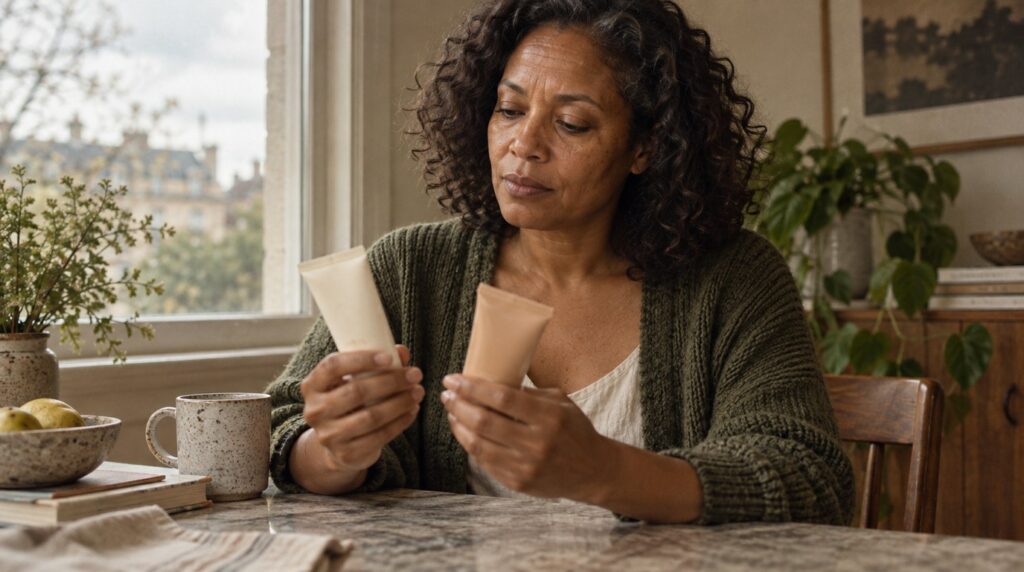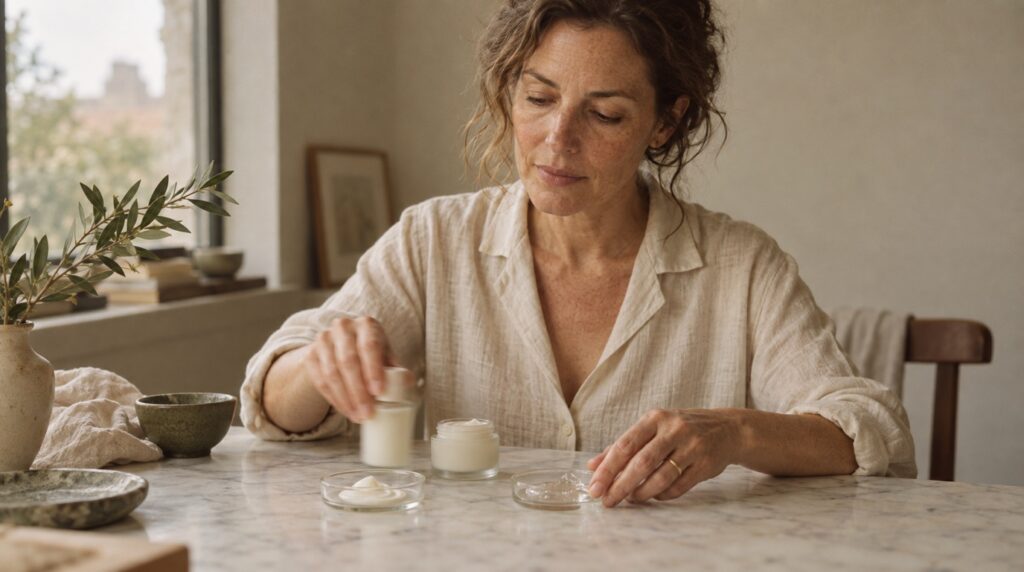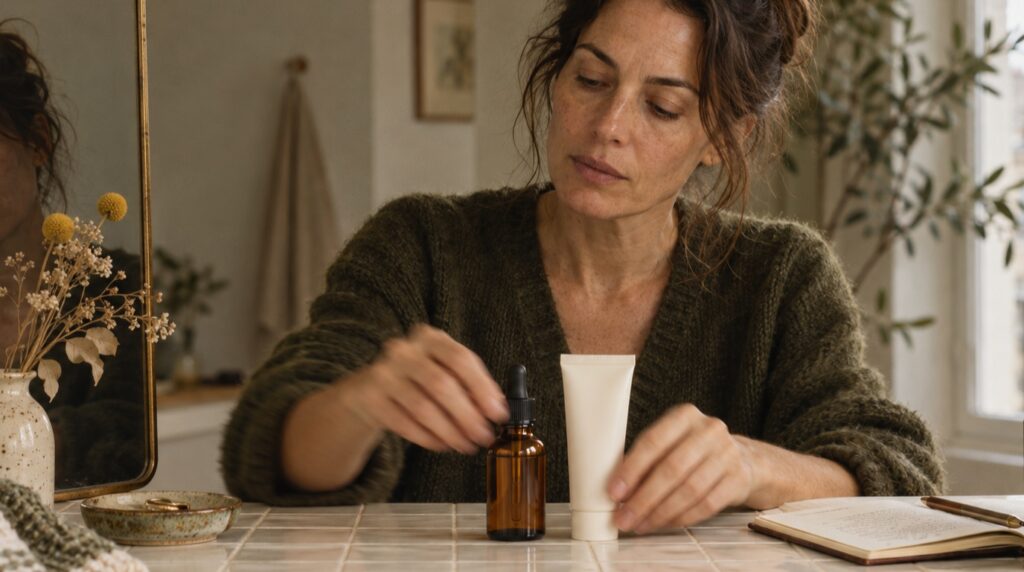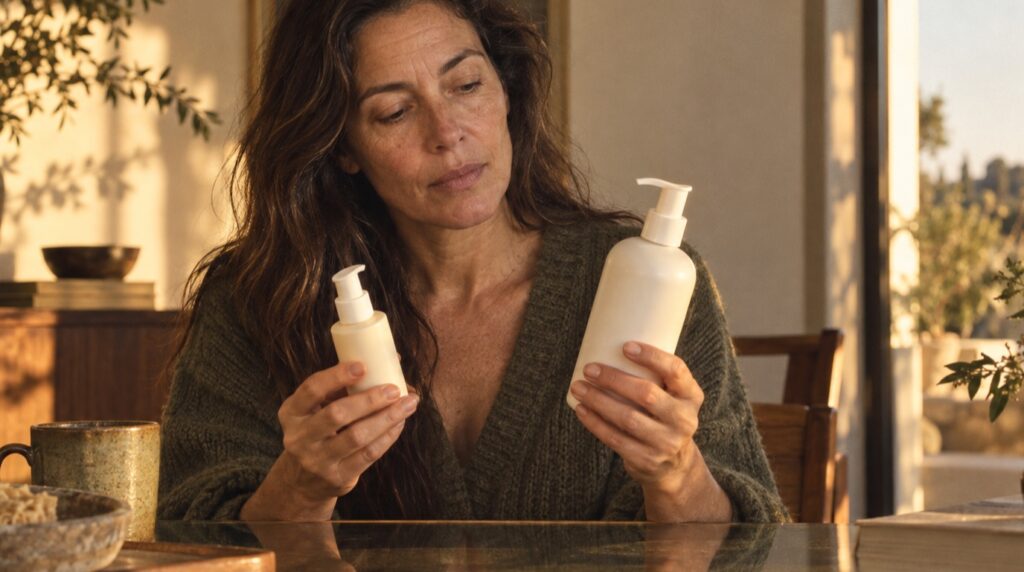
Editorial three-quarter portrait of a Puerto Rican woman in her early 30s standing at her bathroom mirror in the soft warm dawn light of very early morning, framed from mid-chest to just above the top of her head. She wears a soft warm cream cotton robe with the collar slightly askew, one hand pressing a droplet of azelaic acid serum onto her cheekbone with her ring finger. Real postpartum skin texture preserved with quiet honesty, visible melasma patches across the tops of her cheekbones and forehead in soft warm brown, a hint of hormonal breakout along the jawline, mild barrier reactivity showing as light warmth on the nose bridge, faint dark circles under her eyes. Dark hair pulled back loosely into a low bun with baby-hair strands falling forward. No makeup. Her expression is quiet and focused, not tired-looking-sad but present-caring-for-herself in a stolen five-minute window. On the pale warm cream marble counter beside her, a small folded muslin swaddle cloth in oatmeal, a half-empty ceramic mug of coffee gone lukewarm, and two small dropper bottles of skincare. Behind her, softly out of focus, a folded stack of pale cotton towels. Warm cream tile wall in soft focus. The mirror frame is warm brass, catching soft dawn light. Shot on 35mm film with beautiful natural grain, fine to medium grain structure, organic and atmospheric, not digital noise. 1970s analog photography aesthetic. Warm film color palette reminiscent of Kodak Portra 400. No lens flares, no light leaks, no digital sharpness. Rich shadow detail with soft highlight rolloff. Shallow depth of field with her cheekbone and the fingertip in sharp focus, everything else falling gently soft. 16:9 horizontal, 1376 × 768.
After 30

Postpartum Skin Recovery: The 3-Phase Routine After Baby

Almost no one is prepared for what happens to their skin after giving birth. During pregnancy, many women experience the “glow” people talk about: clear, hydrated, luminous skin driven by surging estrogen and increased blood flow. Then, sometime between weeks four and eight postpartum, that glow disappears. In its place, women in our community report dark patches across the cheeks that look like textbook melasma, inflamed acne breakouts along the jawline and chin, and a background dryness that makes trusted products sting.

Editorial three-quarter portrait of a Japanese-Brazilian woman in her late 30s sitting on the edge of her linen-dressed bed at night in soft warm tungsten bedside lamp light applying a final occlusive layer with a small ceramic tub of petroleum jelly visible on the nightstand against a shadowed deep olive wall
Ingredients

SPF Myths Debunked for Women 30+: What Sunscreen Actually Does

Most of what women 30+ believe about sunscreen is wrong, and the cost of that misunderstanding shows up on the face by 40 as fine lines, hyperpigmentation, and loss of firmness that could have been prevented. SPF myths persist because they are convenient. Higher number equals double protection. Windows block UV. Dark skin does not need SPF. Chemical filters are dangerous. Mineral leaves a white cast. Foundation with SPF is enough. Each of these is either flatly wrong or wrong in the way that matters most for your skin.

Editorial three-quarter portrait of a Korean-Chilean woman in her early 40s at her vanity holding a small pale-pink frosted dropper bottle of PDRN serum in soft warm morning window light against a deep olive wall with real skin texture preserved
Ingredients

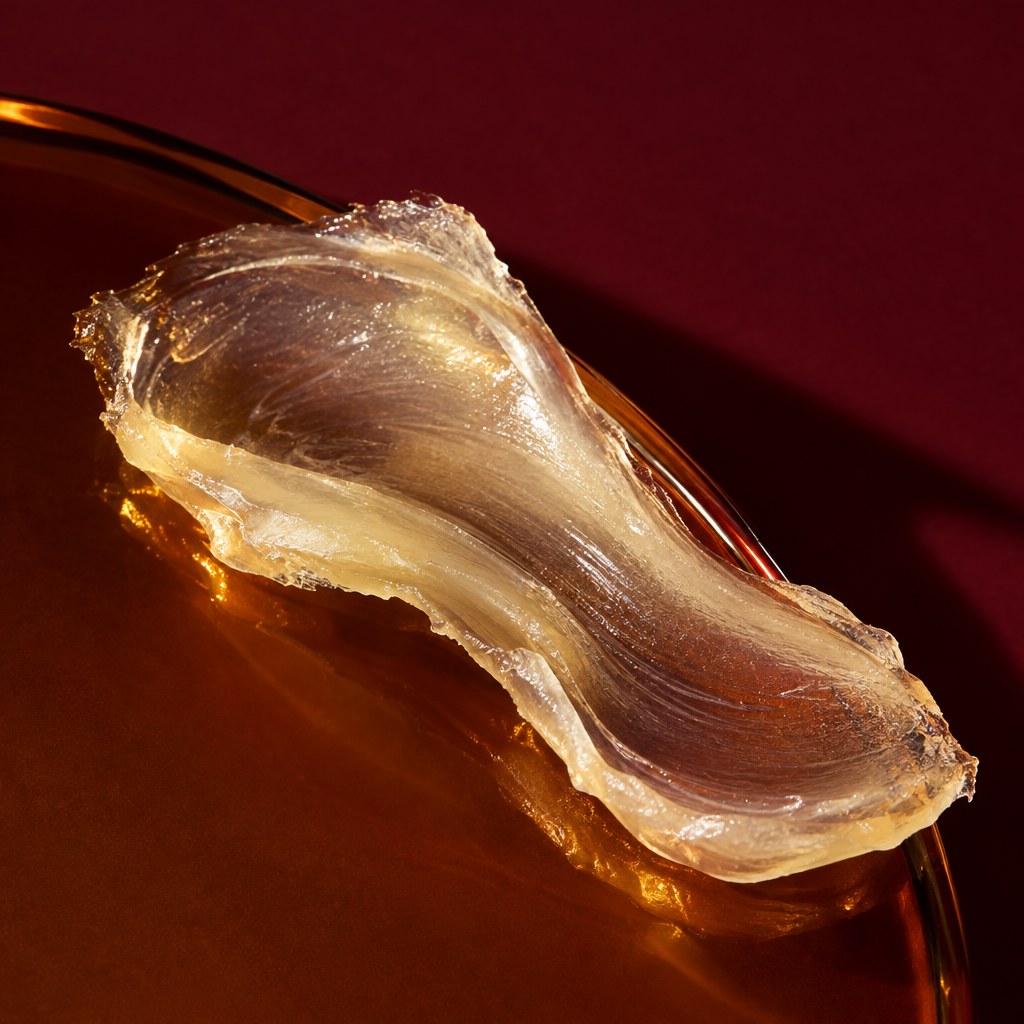
PDRN Skincare for Women 30+: What Salmon DNA Actually Does for Your Skin

If you have been paying attention to skincare online in the last six months, whether on Reddit, TikTok, or Vogue’s beauty desk, you have probably heard the acronym PDRN. It is the ingredient trending harder than peptides, more talked about than retinol, and generating more conversation than hyaluronic acid has since the early 2010s. But unlike most trending skincare ingredients that fade after a season, PDRN is backed by legitimate research, active dermatological adoption, and consistent clinical results.

Editorial three-quarter portrait of a South Sudanese American woman in her late 30s applying tinted mineral sunscreen to her cheekbone with the formula blending seamlessly into deep warm brown skin proving the no-ghost-cast point in soft warm morning light against a warm cream wall
Reviews

Zinc Without the Ghost Cast: The Mineral Sunscreens That Blend on Every Skin Tone

Ghost cast is the reason most women who tried mineral sunscreen in 2015 gave up on it. A visible white or grey film that no amount of blending solved. Ten years later the formulations have caught up. Modern zinc oxide is often micronised, the vehicles are more elegant, and the tinted mineral category has genuinely solved the cast for medium and deep skin tones with iron oxides that also happen to block visible light. This is the ranking of the ten mineral sunscreens that work for real skin.

Editorial three-quarter portrait of a Chilean-Italian woman in her mid 40s seated at her morning vanity with real skin texture preserved showing the natural characteristics of perimenopausal skin and silver strands visible in her dark hair pulled loosely back in soft warm morning window light against a deep olive wall
Ingredients

The Skincare Shift Nobody Warns You About Before Menopause

Somewhere between 40 and 45, a lot of women notice their skin changes in a way that does not match anything the beauty industry prepared them for. The moisturiser that worked for a decade suddenly feels like it does nothing. Fine lines around the mouth appear overnight. Melasma that faded years ago reactivates. Skin dries out in ways that hyaluronic acid alone cannot fix. This is not you doing something wrong. This is perimenopause, the four-to-ten-year hormonal transition that ends at menopause. Estrogen levels start to decline, and estrogen is one of the primary drivers of skin health.

Editorial three-quarter portrait of a Korean-American woman in her early 40s seated at her vanity in soft morning light with multiple K-beauty bottles arrayed in front of her her cheekbone catching the characteristic glass-skin luminosity against a warm cream wall
Reviews

Best K-Beauty Anti-Aging Products with Peptides for 30+

Snail mucin was a punchline in American beauty media in 2018. By 2023 it was the fastest-growing serum category at Sephora. PDRN peptide serums (the salmon-derived nucleotide complex that Medicube popularised) sat in Seoul dermatology clinics for a decade before they reached the Western mainstream in 2024. Fermented essences, ginseng-extract eye creams, cica barrier-repair toners. Korean brands were quietly perfecting these formulations while Western skincare was still debating whether to add retinol to anything.

Editorial three-quarter profile portrait of a South Indian Tamil woman in her late 30s seated at her bathroom vanity at night with four small amber dropper bottles labelled Night 1 through Night 4 arrayed in front of her and her hand reaching to select Night 2 in soft warm tungsten light against a deep olive wall
After 30

Skin Cycling with Peptides After 30 and 40: The 4-Night Rotation Guide

In 2022 Dr Whitney Bowe, a New York dermatologist, started posting short videos on TikTok explaining a routine she called skin cycling. Four nights, one rotation, then repeat. Exfoliate one night, retinol the next, peptides on night three, and a recovery night to close. Within months the term went mainstream, the cycling concept spread across skincare media, and dermatologists who had been quietly recommending versions of this approach for decades suddenly had a name for it.

Aesthetic overhead still-life of an open scientific journal article on a warm cream marble countertop with round reading glasses, a brass magnifying glass, and a small CeraVe-sized white moisturiser bottle in soft morning window light
Ingredients

Does CeraVe Cause Cancer? The Honest Evidence-Based Answer

If you have been on TikTok or Instagram in the last 18 months, you have probably seen the videos. A dermfluencer in their bathroom, holding up a tub of CeraVe Moisturizing Cream, voice urgent. “Stop using this. It contains [ingredient]. It is linked to cancer.” Cut to a scrolling INCI list with three or four ingredient names highlighted in red. Caption: “I cannot believe this is still on shelves.”

Editorial close-up portrait of a Filipina-Mexican woman in her early 40s with real skin texture showing faint rosacea redness across the cheeks and two small dark spots on the cheekbone in soft warm window light against a deep olive wall
Dark Spots

Best Azelaic Acid Products for Acne, Rosacea, and Dark Spots Ranked

Stubborn acne that will not quit. Rosacea that flares at the worst times. Dark spots that refuse to fade no matter what you throw at them. Sound familiar? After 30, these are not just occasional annoyances. They are the reality for millions of women. After 30, our skin changes dramatically. Hormonal fluctuations, years of sun exposure, and slower cell turnover can all contribute to these frustrating concerns. And they do not discriminate between your 30s and 40s.

Editorial portrait of an auburn-haired woman in her 40s at her testing desk holding a small ceramic dish with three pale peptide swatches, focused on comparison, with product bottles softly out of focus on warm walnut wood against a deep olive wall
Reviews

Best Peptide Serums Ranked for Women 30+ and 40+

Peptides were not on my radar until I started researching what actually builds collagen from the inside out. I had been relying on retinol and vitamin C (the usual suspects) but I kept reading about these tiny amino-acid chains that signal your skin to produce more collagen and repair damaged cells. The more I dug into the science, the more I realised peptides deserved a serious place in any anti-aging routine after 30. So I did what I always do. I tested everything I could get my hands on, tracked the results, and ranked them honestly.

Mineral water cascading from an antique brass spigot in a saturated crimson wall, with a porcelain-skinned hand and three French pharmacy skincare bottles arranged like fetish objects beneath the flow, photographed in painterly editorial style
Reviews

French Pharmacy Skincare: Best Peptide-Rich Picks for Women 30+

There is a reason French women have a reputation for effortless skin, and it is not genetics. It is the pharmacy. While the rest of the beauty world chases viral trends, French pharmacy brands have been quietly perfecting science-backed skincare for decades. The philosophy is refreshingly simple. Effective formulations, minimal fuss, dermatologist-developed ingredients. And the best part. Most of these products cost between $15 and $45.

Gentle ceramide cleanser and rich barrier moisturiser on a soft cream surface in diffused morning light
Barrier Repair

Psoriasis Skincare After 30: The Gentle Evidence-Backed Guide

Most skincare advice for psoriasis assumes you are 19 and have nothing else going on. After 30, that advice falls apart. Your barrier is thinner. Your hormones are shifting. Your stress is higher. The same cream that worked through your twenties starts feeling abrasive, and the routines dermatologists give you have nothing to say about perimenopause or about the fact that you also want to address fine lines on the parts of your face that are not currently flaring.

Nine dark spot corrector serums arranged in three price-tier rows on a clean white surface
Dark Spots

Best Dark Spot Correctors Ranked: From $6 to $182, What Actually Works

Twenty different dark spot serums. Three years of testing. One spreadsheet with twelve columns tracking percentage fade, days of consistent use, irritation episodes, cost per month, and texture notes. That is what it actually took to sort the dark spot correctors that work from the ones that just market well to women in their late twenties and early thirties who are starting to panic about their first cluster of hyperpigmentation.

Brightening serum and mineral sunscreen on a soft taupe surface in diffused morning light
Dark Spots

Melasma After 30: The Complete Guide to Actually Managing It

I remember the moment I turned 30. Not the actual birthday. The moment came about three weeks later, at a coffee shop bathroom mirror in the unforgiving afternoon light. That is when I really saw the changes. The fine lines around my eyes had deepened overnight, or so it felt. My skin looked thinner. Duller. Like someone had slowly turned down the brightness on my face and I had just noticed.

Best anti-aging ingredients after 40 guide
Ingredients

Best Anti-Aging Ingredients After 40: What Actually Works

I remember the moment I turned 30. Not the actual birthday. The moment came about three weeks later, at a coffee shop bathroom mirror in the unforgiving afternoon light. That is when I really saw the changes. The fine lines around my eyes had deepened overnight, or so it felt. My skin looked thinner. Duller. Like someone had slowly turned down the brightness on my face and I had just noticed.

Double cleansing guide for women over 30
After 30

Double Cleansing After 30: The Complete Guide

I remember the first time someone told me I should double cleanse. I was thirty-two, standing in a Sephora with my dermatologist’s prescription for tretinoin in one hand and a mounting skincare crisis in the other. My skin was congested. My pores looked like tiny craters. And no matter how much expensive serum I layered on, nothing seemed to help.

Reviews

Budget Skincare Under 50 Dollars: The Real Luxury Comparison

There is a moment that happens to every woman who starts taking her skin seriously. You are standing in front of a shelf. The drugstore cleanser is sitting next to the $80 cleanser. They are both, technically, cleansers. They both have water and a surfactant and a few stabilising ingredients. And you are trying to work out, in real time, whether the $80 version actually does something the $8 version does not.

best ceramide moisturiser cream being spread on hand showing rich texture in warm light
Barrier Repair

The Best Ceramide Moisturiser at Every Budget: An Honest Guide

I noticed around 31 that my face felt tight. Not just dry. Tight. I’d apply my same moisturiser from my 20s and it would sit on my skin like it couldn’t sink in. My barrier was genuinely compromised. It took a dermatologist to explain: your natural ceramide production decreases by roughly 2-3% annually after 30. By 31, I was already down 5%. My barrier wasn’t just dehydrated. It was structurally compromised. Finding the best ceramide moisturiser for my skin fixed what no luxury serum could.

Split frame editorial showing unmarked clear glass bottles on white marble beside slender frosted vessels on dark walnut wood, the layered korean versus minimal japanese skincare comparison
Reviews

Korean vs Japanese Skincare: The Honest Comparison After 30

I spent three years ping-ponging inside the korean vs japanese skincare debate before I realised the rivalry was pointless. I’d buy a Korean 10-step routine, feel overwhelmed by step five, abandon it for a Japanese minimalist cleanser and one ‘perfect’ cream, and then spiral into wanting more targeted treatments again. The battle consumed my bathroom and my budget.

Unmarked amber apothecary jar opened on Calacatta marble beside tortoiseshell reading glasses and ivory envelopes in soft morning light, the editorial hero for a 2847 la mer reviews analysis
Reviews

2,847 La Mer Reviews Analysed: The Honest Verdict

I need to be honest about something. For years, I thought La Mer was pure luxury theatre. A $222 jar of seawater and marketing. I’d see women using it and assumed they were either very rich or very gullible. Then I sat down and read 2,847 la mer reviews on Sephora, and realised the conversation was more complicated than I’d thought.

glass skin routine result showing luminous dewy face in warm morning light
After 30

The Glass Skin Routine: 47 Products Tested, 7 Winners

I have been chasing glass skin for years. Not the Instagram version. The real version. Skin that catches light, that feels smooth when you touch it, that looks like you are glowing from inside. I tried the “simplify your routine” advice. Did not work. I tried expensive serums. Worse. Then I realised: glass skin is not about minimalism or luxury. It is about understanding how hydration actually works.

Three heritage apothecary jars side by side on Carrara marble in warm afternoon light, the editorial hero for a luxury moisturiser comparison
Reviews

Luxury Moisturiser Comparison: 3 Products, 1 Winner

If you have ever stood in a department store skincare hall, or spent too long on Net-a-Porter at midnight, you have probably found yourself comparing these three names. La Mer, Augustinus Bader, Dr. Barbara Sturm. They are the apex of mainstream luxury skincare. Each costs between $150 and $400 for a single moisturiser. Each has legions of devoted users and a carefully constructed mythology.

la mer review crème de la mer jar on marble surface
Reviews

La Mer Review: Is It Worth $400? The Honest Answer

La Mer has held a particular place in luxury skincare for decades. The Crème de la Mer, that heavy, rich, beautifully packaged moisturiser in the jade-green jar, has been sold as transformative for women who want extraordinary skin. It costs around $395 for 60ml. It is aspirational, it is beautiful, and for a very specific type of skin, under specific conditions, it genuinely delivers results.

woman with luminous skin sitting at bathroom vanity with simple skincare routine, morning light, seen from behind
After 30

What Every Woman With Great Skin After 30 Has in Common

There is a woman in your life with effortlessly good skin. You know the one. She is 42, or 50, or maybe 35, and something about her complexion just looks… settled. Luminous in a way that has nothing to do with youth and everything to do with intention. You have probably assumed it is genetics. Or money. Or that she somehow found the perfect product at age 25 and just stuck with it forever.

Scroll to Top