Created using AI; curated by Glow Protocol. AI tools support research, product comparisons and writing. Our recommendations are editorial selections. How we work.
Quick answer
Dark spots have different causes, so start by identifying the pattern and reducing ongoing irritation and sun exposure. Fading often takes patience, and not every mark responds to the same cosmetic. Have a new, changing or uncertain spot assessed rather than assuming it is routine pigmentation.
Background guidance: AAD: dark spots and pigmentation.
Updated : Opening answer clarified and its supporting references checked; jump navigation added. Check current price, size and seller on the retailer listing.
Affiliate Disclosure: This post contains Amazon affiliate links. As an Amazon Associate, Glow Protocol earns from qualifying purchases. If you purchase through our links, we earn a small commission at no extra cost to you. We only recommend products we have researched and believe in.
Dark Spots After 30: Pigmentation and Skincare Options
Dark spots can have different causes, and the right approach depends on what is causing them. This AI-supported guide brings together published information and curated product examples. It is not based on personal product trials or interviews with dermatologists.
This is the dark spots after 30 guide I wish I’d had when those spots first appeared.
Why Dark Spots Get Worse After 30
Dark spots aren’t random. They’re the result of a very specific biological process. Your melanocytes (the cells that produce pigment) decide to throw a party and overproduce melanin in certain areas. The reason this tends to accelerate after 30 is multifactorial.
Cumulative sun damage is the primary culprit. Every unprotected minute in the sun adds up over decades. UV exposure activates melanin production as a protective mechanism, but in certain areas of your face (usually where sun exposure is most intense) this protection goes into overdrive. Your skin has been collecting these UV hits since childhood. Road trips, summer days at the beach, that week in Cancun at 22 when sunscreen felt optional.
By 30, your skin’s ability to repair UV damage is also declining. Your cell turnover slows. Your antioxidant defences weaken. The cumulative effects of oxidative stress start visibly manifesting. Dark spots are essentially permanent reminders of sun damage from the past decade.
Hormonal shifts also play a role. If you’ve ever noticed darker patches on your face after a life event (pregnancy, new birth control, perimenopause) you’ve experienced hormone-driven hyperpigmentation. This type tends to appear on the cheeks, forehead, and temples, and it’s particularly common in women with darker skin tones. Hormones amplify melanin production, which is why the same sun exposure that caused minimal pigmentation at 25 might cause noticeable spots at 35.
Chronic inflammation makes everything worse. If you have a compromised skin barrier, active acne, rosacea, or any ongoing skin inflammation, you’re essentially signalling your skin to produce more melanin as a response. It’s your skin’s way of trying to protect itself. Ironically, this “protection” creates the very problem we’re trying to fix.
The good news is that understanding the cause means understanding the solution. We can’t undo sun damage from 1997, but we can absolutely influence the melanin being produced today.
Types of Hyperpigmentation (And Why It Matters)
Not all dark spots are created equal. The type of hyperpigmentation you have determines which ingredients will actually work for you, and which ones you’ll waste money on.
Solar lentigines (sun spots) are the brown spots that appear on sun-exposed areas like your face, hands, and shoulders. They’re usually flat, irregular in shape, and fairly localised. These are caused by increased melanin production in response to UV exposure. They’re incredibly common after 30 because by then, you’ve accumulated years of sun exposure.
Post-inflammatory hyperpigmentation (PIH) develops after your skin experiences trauma. Acne, eczema flares, aggressive treatments, even aggressive manual exfoliation. Your skin responds by producing excess melanin in the affected area. For many people, this is why that breakout three months ago left a dark mark long after the bump disappeared. PIH is more common in people with darker skin tones.
Melasma presents as larger patches of hyperpigmentation, usually symmetrical across both cheeks. It’s deeply connected to hormones and sun exposure, which is why it’s so common during pregnancy (sometimes called “chloasma” or the “mask of pregnancy”) and in people taking hormonal contraceptives. Melasma is notoriously stubborn. It often requires clinical treatments because topical ingredients alone struggle with it.
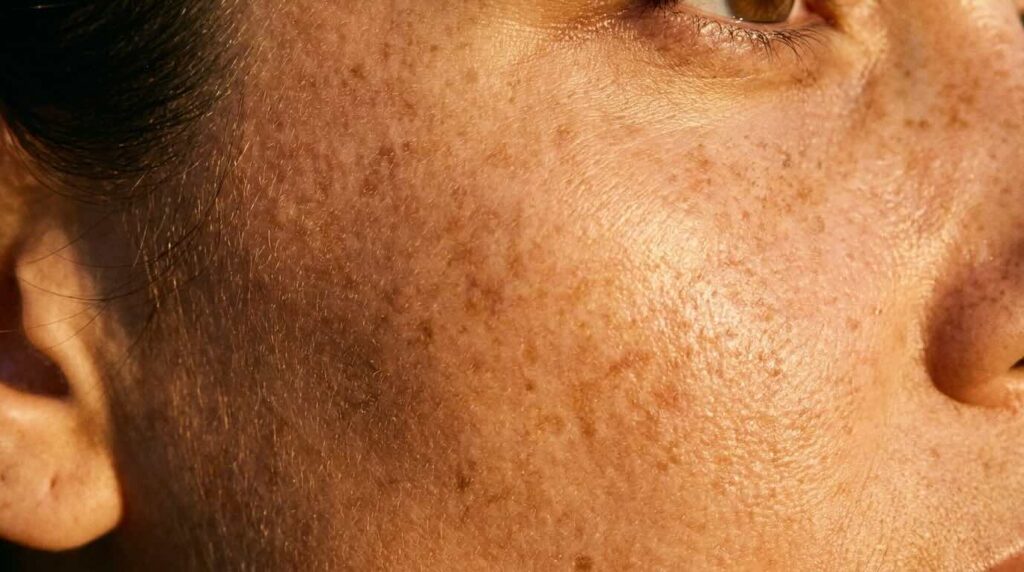
Freckles are genetic and usually appear in childhood. Unlike other hyperpigmentation, freckles actually fade with sun protection and tend to be less of a concern after 30 because most people stop actively getting new freckles (since sun exposure at 35 creates spots, not more freckles).
Why does this matter? Because the ingredients that fade solar lentigines work through different mechanisms than those targeting PIH. And melasma often requires professional treatments because the pigmentation is deeper in the skin. Before you start treating, identify what you’re actually dealing with. Your spots are probably solar lentigines or PIH, which is great news, because these respond beautifully to topical ingredients.
The Ingredients That Actually Fade Dark Spots
Brightening products differ in their ingredients, formulations and potential for irritation. The following section explains the evidence discussed in this guide; it is not a report of Glow Protocol testing dozens of products.
Alpha-arbutin is a tyrosinase inhibitor. Tyrosinase is the enzyme responsible for converting tyrosine into melanin. It’s the gatekeeper of pigment production. By inhibiting tyrosinase, alpha-arbutin essentially tells your melanocytes to slow down. Studies show it’s effective at fading solar lentigines and PIH, with results visible around 8 to 12 weeks. It’s gentler than other tyrosinase inhibitors (like hydroquinone), making it suitable for long-term use without thinning your skin.
Vitamin C works through multiple mechanisms. It’s an antioxidant that helps prevent future UV-induced pigmentation, but it also inhibits melanosome maturation, essentially interfering with the pigment granules before they deposit in your skin. The catch? Vitamin C is unstable and notoriously difficult to formulate. Most products oxidise before they reach your skin (that’s why they turn brown). If you’re going to use vitamin C, you need a well-formulated version that has been properly stabilised.
Niacinamide reduces sebum production and strengthens your skin barrier, which matters because inflammation makes pigmentation worse. Additionally, some research suggests niacinamide can inhibit melanosome transfer from melanocytes to keratinocytes (the cells in your outer skin layer). It’s not as directly melanin-targeting as alpha-arbutin, but it’s a solid supporting ingredient that helps your skin’s overall health.
Azelaic acid is particularly effective for post-inflammatory hyperpigmentation and melasma. It has antibacterial properties (which helps with PIH from acne), anti-inflammatory effects (which reduce the stimulus for excess melanin), and direct tyrosinase-inhibiting properties. Dermatologists often recommend it for PIH because it works at multiple levels. It’s slightly irritating for some people, so start low and go slow.
Chemical exfoliants (AHAs and BHAs) work on the principle that dark spots are only visible because they’re concentrated in the upper layers of your skin. By gently removing those layers through chemical exfoliation, you’re essentially speeding up cell turnover and bringing fresh, less pigmented skin to the surface. A 2% BHA is particularly effective because the exfoliation also helps prevent future pigmentation.
Sunscreen. I know it’s not a “brightening” ingredient, but it’s the most critical ingredient for treating dark spots because it prevents them from getting worse. If you’re trying to fade spots without using sunscreen, you’re essentially fighting with one hand tied behind your back. SPF 30 minimum, daily, every single day, even on cloudy days.
Best Products for Hyperpigmentation at Every Budget
You don’t need to spend $500 to fade dark spots. You need the right ingredients used consistently. Here’s what I recommend at different price points.
The Budget Routine ($25-30/month)
This is the routine I’d build for someone starting from scratch on a tight budget. Three products, all from The Ordinary, all genuinely effective, all under $25 combined. The formulations aren’t luxurious, but the active ingredients are properly concentrated and the brand has dermatologist credibility.
The Ordinary Alpha-Arbutin 2% + HA
Your primary tyrosinase inhibitor. Affordable, effective, and dermatologist-recommended. Apply after cleansing, before other serums. Visible fading around 8 weeks.
The Ordinary Vitamin C Suspension 23%
High-strength vitamin C in a stable suspension formula. Less elegant texture than serums, but the concentration is genuinely effective. Apply in the morning, let it dry, then layer your moisturiser.
The Ordinary Niacinamide 10% + Zinc 1%
Your supporting ingredient. Calms inflammation, strengthens the barrier, and has a subtle melanin-inhibiting effect. Affordable enough to use generously and gentle enough for daily use.
How to use: Cleanse → alpha-arbutin → vitamin C → niacinamide → moisturiser → sunscreen (AM) or moisturiser (PM). This routine addresses hyperpigmentation from multiple angles. Direct tyrosinase inhibition, antioxidant protection, and inflammation reduction.
The Moderate Routine (Add ~$35)
If the budget routine isn’t delivering results after 12 weeks, or if you have more aggressive hyperpigmentation, the next step is adding a chemical exfoliant. Keep the three Ordinary products and add one more.
Paula’s Choice 2% BHA Liquid Exfoliant
The best-formulated BHA exfoliant on the market. Removes the upper layers of pigmented skin while inhibiting future melanin production. Use 2 to 3 times weekly at night. Sunscreen during the day is non-negotiable.
Your routine becomes: cleanse → alpha-arbutin → BHA (2 to 3 times weekly) → vitamin C → niacinamide → moisturiser → sunscreen. The combination of direct melanin inhibition, exfoliation, and antioxidant protection is genuinely synergistic.
The Investment Routine ($120-160/month)
If you want premium formulations, have stubborn spots that haven’t responded to the budget routine after 16 weeks, or simply prefer products with more elegant textures, these are worth the investment.
Beauty of Joseon Glow Deep Serum
Korean beauty formulation with rice bran and arbutin targeting hyperpigmentation specifically. Genuinely elegant texture and effective. Layers beautifully under other serums.
Caudalie Vinoperfect Radiance Serum
Uses viniferine (derived from grape vine sap) as its brightening ingredient. Patent-protected and genuinely unique. For resistant melasma or very stubborn dark spots, this is often the product that finally breaks through.
Use either the Caudalie or continue with The Ordinary alpha-arbutin. Don’t use both, as it’s redundant. The real investment in this tier is in the premium formulation quality and the addition of Caudalie’s proprietary ingredient.
The Role of Sunscreen in Treating Dark Spots
Here’s the reality nobody wants to hear. Without sunscreen, you’re not treating hyperpigmentation. You’re fighting a losing battle where new spots form faster than old ones fade.
UV radiation triggers melanin production. Every minute you spend in the sun without protection (even on cloudy days) activates melanocytes to produce more pigment. If you’re using alpha-arbutin to slow melanin production on one side and then taking a lunchtime walk without sunscreen on the other, you’re essentially paying money to lose a slow-motion race.
Beyond prevention, sun protection is critical because treating dark spots involves bringing fresh, unpigmented skin to the surface through exfoliation and cell turnover. That new skin is more vulnerable to UV damage and more likely to become pigmented if exposed unprotected.
You need SPF 30 minimum (SPF 50 is better), every single day, including cloudy days and days you spend mostly indoors. Reapply every two hours if you’re outside. This isn’t optional. It’s the foundation of any hyperpigmentation treatment.
EltaMD UV Clear SPF 46
The sunscreen dermatologists recommend when treating hyperpigmentation. Lightweight, transparent on all skin tones, and contains calming niacinamide. Hospital-strength sun protection in a cosmetically elegant formula.
If cost is prohibitive, any mineral sunscreen with zinc oxide or titanium dioxide will work. The key is using enough (about a quarter teaspoon for your face), applying it consistently, and reapplying if you’re outside. Don’t let sunscreen be the weak link in your hyperpigmentation treatment. For more on sun protection and ageing skin, read our complete guide to → the best sunscreen after 30.
Another tinted sunscreen to compare
Eucerin Sun Age Defense Tinted Face Lotion SPF 50 adds another tinted option to your daily sun-protection shortlist. The US formula uses organic (chemical) UV filters, includes hyaluronic acid and offers broad-spectrum SPF 50. Choose it for its sunscreen role; a tint alone does not establish how well a particular formula protects against visible-light-related pigmentation.
Check whether the shade suits your skin, apply and reapply as directed, and use a water-resistant sunscreen when swimming or sweating. You do not need a separate new sunscreen if your current one already meets your needs and you use it consistently.
Check the manufacturer’s formula and directions.
Affiliate link: we may earn a commission if you buy through this link.
How Long Does It Actually Take to See Results?
This is the question everyone asks because waiting is the hardest part. Dark spots are incredibly frustrating because you can see them every time you look in the mirror, so the timeline feels impossibly long.
4 to 6 weeks: You might notice your skin texture improving or your overall complexion looking slightly brighter. Spots don’t fade noticeably yet, but you’re establishing consistency with your routine.
8 to 10 weeks: This is when you typically start seeing real fading, especially with alpha-arbutin or vitamin C. Spots don’t disappear completely, but they’re visibly lighter. This is why dermatologists recommend a 12-week commitment before deciding whether a treatment is working.
12 to 16 weeks: Significant fading if you’re using the right ingredients and actually being consistent. Many spots become barely noticeable. Some disappear entirely, especially if they’re post-inflammatory hyperpigmentation rather than deep solar lentigines.
16 to 24 weeks: Continued improvement. Deeper or more stubborn spots continue fading, though some never disappear completely. They just become so faint that they’re only noticeable under harsh lighting if you know to look for them.
The timeline depends on several factors. Spot depth (deeper spots take longer), your skin tone (darker skin takes slightly longer to see fading, partly because the contrast is different), consistency with your routine (missing days slows everything down), and whether you’re actually using sunscreen (skipping SPF basically resets your progress).

The most important thing is to commit to at least 12 weeks before deciding whether a routine is working. Spot fading is slow because melanin has to clear from your skin cell by cell as those cells turn over. There’s no shortcut to biology.
That said, if you’re 16 weeks in and seeing absolutely zero improvement, something isn’t working. Either your routine isn’t consistent enough, you’re not using enough product, your sunscreen strategy is failing, or your specific spots might require professional treatment (like laser). Talk to a dermatologist rather than changing products for the thousandth time.
The Honest Bottom Line
Dark spots after 30 are normal, common, and genuinely treatable with topical ingredients. You don’t need to accept them, but you also don’t need to panic about them. Most fade beautifully with a strategic routine built around tyrosinase inhibitors, exfoliation, and sun protection.
The products that actually work cost between $6 and $80, not $500. You don’t need seventeen serums. You need the right ingredients, applied consistently, for at least 12 weeks, with sunscreen as non-negotiable infrastructure.
Your skin at 35 is different from your skin at 25, and that’s okay. Those spots are a record of sun exposure and time, which is also kind of beautiful if you think about it. But that doesn’t mean you have to live with them. Use the evidence-based approach outlined here, be patient, and within a few months you’ll be back to wondering why people are suddenly asking if you’re feeling more rested. Because your face actually looks rested and glowing.

The right ingredients applied for 12 weeks will fade most dark spots. The wrong ingredients applied for two years will not. Patience is non-negotiable, but it has to be patience with the right protocol.
Related Reading
→ The best sunscreen after 30 at every budget
→ The complete guide to skin barrier repair after 30
→ Why your vitamin C serum is probably already expired
Sources
Research context: these sources cover ingredients, skin biology or specific tested formulations. Results depend on the concentration, delivery method and population studied. Product selections are editorial curation; these references are not head-to-head tests of all products listed.
- Hakozaki T, et al. (2002). The effect of niacinamide on reducing cutaneous pigmentation and suppression of melanosome transfer. Br J Dermatol. PubMed 12100180 Pigmentation research; not proof of every niacinamide product.
- Pillaiyar T, et al. (2017). Skin whitening agents: medicinal chemistry perspective of tyrosinase inhibitors. J Enzyme Inhib Med Chem. PubMed 28097901 Mechanism review; ingredient evidence varies and includes laboratory studies.
- Pinnell SR, et al. (2001). Topical L-ascorbic acid: percutaneous absorption studies. Dermatol Surg. PubMed 11207686 Pig-skin absorption study; not a universal layering timer.
All studies are published in peer-reviewed journals and freely accessible via PubMed, the US National Library of Medicine’s biomedical literature database.
Not sure where to start with your own dark spot routine?
Glow Protocol · glowprotocol.beauty · Science-backed skincare for women 30+
Affiliate Disclosure: This post contains affiliate links, which means we may earn a small commission if you make a purchase through these links at no extra cost to you. We only recommend products we have researched and believe offer real value. Our opinions remain our own and are not influenced by any brand or compensation.
Affiliate Disclosure: This post contains affiliate links, which means we may earn a small commission if you make a purchase through these links at no extra cost to you. We only recommend products we've researched and believe offer real value. Our opinions remain our own and are not influenced by any brand or compensation.