Created using AI; curated by Glow Protocol. AI tools support research, product comparisons and writing. Our recommendations are editorial selections. How we work.
Quick answer
If your skin becomes drier or more reactive around perimenopause, reassess cleanser, moisturiser and treatment frequency before adding more actives. Changes vary between people. A peptide serum or stronger retinoid is not a compulsory replacement for a routine that still works comfortably.
Background guidance: AAD: skin care in menopause.
Updated : Opening answer clarified and its supporting references checked; jump navigation added. Check current price, size and seller on the retailer listing.

Affiliate Disclosure: This post contains Amazon affiliate links. If you purchase through our links, we earn a small commission at no extra cost to you. We only recommend products we have researched and believe in. Not medical advice.
Perimenopause Skincare After 40: The Hormonal Shift That Changes Everything
Somewhere between 40 and 45, a lot of women notice their skin changes in a way that does not match anything the beauty industry prepared them for. The moisturiser that worked for a decade suddenly feels like it does nothing. Fine lines around the mouth appear overnight. Melasma that faded years ago reactivates. Skin dries out in ways that hyaluronic acid alone cannot fix. This is not you doing something wrong. This is perimenopause, the four-to-ten-year hormonal transition that ends at menopause. Estrogen levels start to decline, and estrogen is one of the primary drivers of skin health.
Almost nobody tells women this in advance. Your doctor talks about hot flashes and mood. Your dermatologist prescribes retinol regardless of what is actually happening to your barrier. Beauty media aimed at your age group is written by 27-year-olds. This post is the calm evidence-based walkthrough of what actually shifts at perimenopause and the four-pillar routine that addresses each shift specifically, with products across price tiers.
What Actually Shifts at Perimenopause (The Four Real Changes)
1. Collagen loss accelerates
Post-menopause research shows women lose approximately 30 percent of skin collagen in the first five years after menopause. The decline starts before menopause during perimenopause. This is why fine lines that were not there at 40 appear at 43. The solution is not more aggressive retinol. It is consistent peptide use plus barrier support so your skin can actually build the collagen its signals are asking for.
2. Barrier lipid production drops
Estrogen influences ceramide and cholesterol synthesis in the skin barrier. As estrogen declines, the barrier gets thinner and more permeable. This is why skin that never felt dry starts feeling dry, why moisturisers seem to stop working, and why reactive skin appears in women who were never sensitive before. Ceramide-heavy moisturisers become non-negotiable, not optional.
3. Hyaluronic acid content in the dermis decreases
The dermis loses roughly half of its natural hyaluronic acid during the menopause transition. Skin looks flatter, less plump, dehydrated even after applying moisturiser. Topical hyaluronic acid helps at the surface but the dermal loss is what changes the fundamental look of the face. Peptides and consistent occlusive layering compensate over time.
4. Melasma often reactivates
Melanocytes are highly hormone-sensitive. The estrogen and progesterone fluctuations of perimenopause commonly reactivate melasma that faded years ago, and often introduce it in women who never had it. This is the number one reason perimenopause skin looks “different” beyond the aging changes. A tinted mineral sunscreen becomes the most important product in the routine.
The Four-Pillar Perimenopause Routine
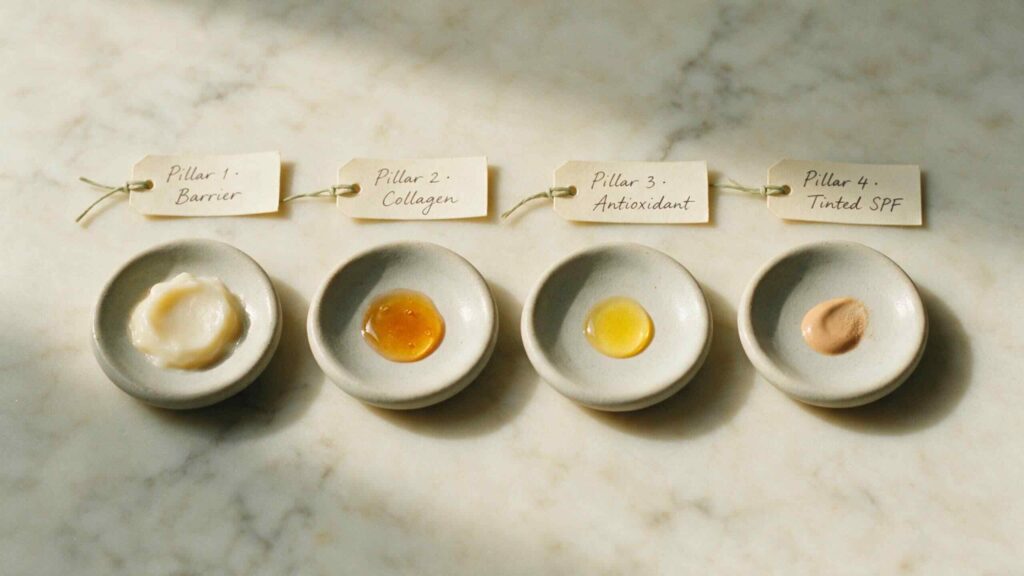
Pillar 1 is barrier support. Pillar 2 is collagen support. Pillar 3 is antioxidant defence. Pillar 4 is sun protection. Every pillar has a budget and a premium pick. Start with barrier support and SPF if the routine feels overwhelming. Those two alone address 70 percent of what perimenopause does to skin.
Pillar 1: Barrier Support (Ceramides and Occlusion)
Pillar 1 · The Budget Ceramide Cream
CeraVe Moisturising Cream
Three essential ceramides plus hyaluronic acid in a dermatologist-developed formula. The 16 oz tub lasts 3+ months at daily face-and-neck use. For perimenopause skin whose barrier is thinning, ceramide replacement is the highest-leverage product on the shelf. (If you have seen the viral CeraVe cancer claims, read our calm evidence-based take first.)
View on Amazon →
Pillar 1 · The Premium Barrier Cream
Dr Barbara Sturm Face Cream Rich
Rich barrier-supportive night cream with skullcap extract, hyaluronic acid, and a proprietary anti-inflammatory complex. Formulated for mature dry skin where barrier weakness is the primary concern. Expensive but a small amount goes very far and the jar lasts 4+ months. The pick for women 45+ whose barrier is significantly compromised and who want a single product doing serious lifting.
View on Amazon →
Pillar 2: Collagen Support (Peptides and Retinal)
Pillar 2 · The Budget Peptide Serum
The Ordinary Buffet + Copper Peptides 1%
Multi-peptide complex plus 1 percent copper peptides. Copper peptides directly stimulate collagen synthesis rather than only signalling for it, which matters more during perimenopause when the raw signal drop needs compensation. Apply nightly. See our copper vs signal peptides comparison for the mechanism.
View on Amazon →
Pillar 2 · The Retinal Upgrade
Medik8 Crystal Retinal 3
Retinal (retinaldehyde) is one conversion step closer to active retinoic acid than retinol, which means results in 6 to 8 weeks rather than 12. For perimenopause skin, retinal is often better tolerated than retinol because the formulations tend to include more barrier-supportive ingredients. Use 2 to 3 nights per week initially, always alternated with pure recovery nights.
View on Amazon →
Pillar 2 · The Perimenopause-Specific Serum
Emepelle Night Cream
This is the only skincare product on the shelf specifically formulated for estrogen-deficient skin. The proprietary MEP technology activates the same skin receptors that estrogen would activate, without introducing hormones. Results in the clinical studies were significant on wrinkle depth and skin firmness in perimenopause and post-menopause women. Expensive but genuinely novel. Consider if the routine below is not delivering the results you expected.
View on Amazon →
Pillar 3: Antioxidant Defence (Vitamin C, Morning)
Pillar 3 · The Stable Vitamin C
The Ordinary Ascorbyl Glucoside Solution 12%
12 percent ascorbyl glucoside, the stable derivative that does not oxidise for 6+ months once opened. Gentler than L-ascorbic acid, pH-neutral, and specifically well-suited to perimenopause skin that has become newly reactive. Apply mornings before SPF. See our vitamin C ranking for stable-derivative vs L-ascorbic acid comparison.
View on Amazon →
Pillar 4: Sun protection
Pillar 4 · Untinted chemical sunscreen option
Beauty of Joseon Relief Sun SPF50+
Beauty of Joseon’s original Relief Sun is an untinted SPF 50+ PA++++ sunscreen with organic UV filters, rice extract and niacinamide. The brand describes a creamy, dewy texture. Check the exact regional formula and authorised retailer before buying. Beauty of Joseon: formula details. This untinted formula should not be treated as a substitute for the visible-light protection discussed for tinted sunscreens below.
Find authorised retailers →
Pillar 4 · The Tinted Mineral for Melasma
Colorescience Sunforgettable Total Protection Face Shield SPF 50
The tinted mineral sunscreen dermatologists specifically recommend for melasma because the iron oxides block visible light in addition to UV. Visible light is a major melasma trigger that standard sunscreens do not address. Perimenopause is peak melasma reactivation window. This product is the single highest-leverage purchase in this entire post for anyone seeing hormonal pigmentation.
View on Amazon →
The Simplified Perimenopause Routine (Total Spend Under $70)
If the four pillars feel overwhelming, start here. Three products, under $70 total, addressing the three most impactful shifts.
Morning
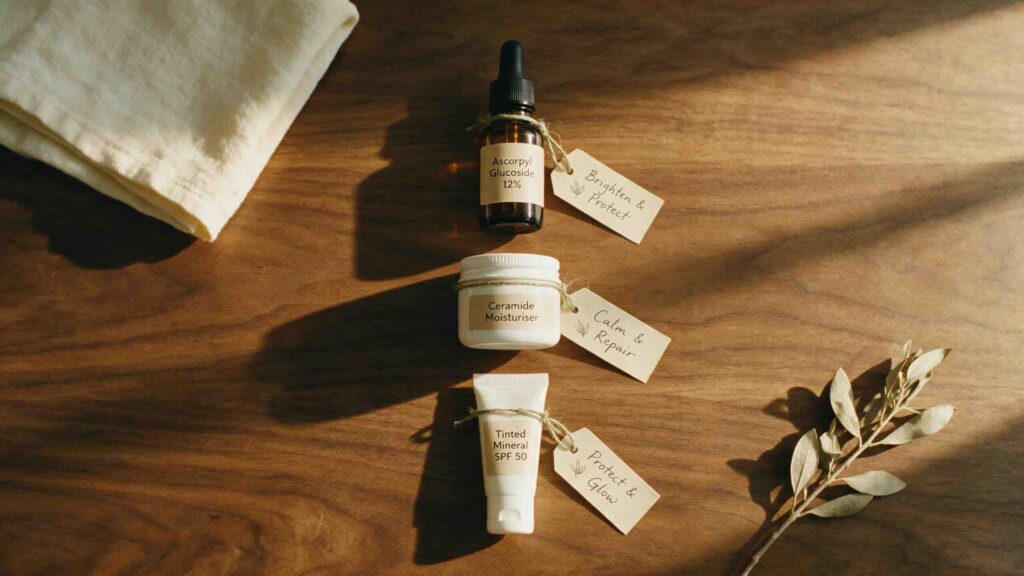
Cleanse. Apply The Ordinary Ascorbyl Glucoside 12% ($11). Moisturise with CeraVe Moisturising Cream ($16). Apply Beauty of Joseon Relief Sun SPF50+ ($18) as your final step. Total: $45.
Evening
Cleanse. Apply The Ordinary Buffet + Copper Peptides 1% ($27). Moisturise with CeraVe Moisturising Cream. Total added: $27.
Total three-product perimenopause routine: $72. Consistent daily use for 8 to 12 weeks delivers visible barrier improvement, softening of fine lines, and stabilisation of the melasma-reactivation risk. Add pillars 2 and 4 upgrades as budget and results dictate.
The Bottom Line
Perimenopause is not something your skincare failed to prevent. It is a hormonal transition that changes what your skin needs on a physiological level. The four-pillar routine addresses each of the four documented shifts. The three-product simplified version handles most of the impact for most women. The specialist products (Emepelle, retinal, Colorescience) are the upgrades when the basic routine is not enough.
One thing is more important than any specific product. Whatever you use, be consistent for 12 weeks before deciding whether it works. Perimenopause skin responds slower than 30s skin because collagen synthesis is running against a hormonal headwind. Give the routine time.
Sources
Research context: these sources cover ingredients, skin biology or specific tested formulations. Results depend on the concentration, delivery method and population studied. Product selections are editorial curation; these references are not head-to-head tests of all products listed.
- Thornton MJ (2013). Estrogens and aging skin. Dermatoendocrinol. PubMed 24194966
- Brincat MP, et al. (2005). Estrogens and the skin. Climacteric. PubMed 16096167
- Schagen SK (2017). Topical Peptide Treatments with Effective Anti-Aging Results. Cosmetics. Read source Review of selected peptides; not every marketed serum.
- Coderch L, et al. (2003). Ceramides and skin function. Am J Clin Dermatol. PubMed 12553851 Background on ceramide biology and skin function.
- Lyons AB, et al. (2021). Photoprotection beyond ultraviolet radiation: A review of tinted sunscreens. J Am Acad Dermatol. PubMed 32335182
Additional reading: best peptide serums ranked, copper vs signal peptides, tranexamic acid for hormonal melasma, best vitamin C serums ranked, skin cycling 4-night rotation, skin barrier repair, skincare layering order, and our evidence-based take on the viral CeraVe cancer claim.
Affiliate Disclosure: This post contains affiliate links, which means we may earn a small commission if you make a purchase through these links at no extra cost to you. We only recommend products we've researched and believe offer real value. Our opinions remain our own and are not influenced by any brand or compensation.