Created using AI; curated by Glow Protocol. AI tools support research, product comparisons and writing. Our recommendations are editorial selections. How we work.
Quick answer
There is no established universal winner between copper and other signal peptides for everyone over 30 or 40. Clinical evidence depends on the particular formulation. Choose by product instructions and routine compatibility; The Ordinary’s copper-peptide serum has restrictions that should not be generalised to all peptide products.
Background guidance: Review: topical peptide evidence · The Ordinary: copper-peptide directions.
Updated : Opening answer clarified and its supporting references checked; jump navigation added. Check current price, size and seller on the retailer listing.

Affiliate Disclosure: This post contains Amazon affiliate links. If you purchase through our links, we earn a small commission at no extra cost to you. We only recommend products we have researched and believe in.
Copper Peptides vs Signal Peptides: Which Anti-Aging Peptide Works Best After 30 and 40?
If you are navigating the peptide landscape in your 30s or 40s, you have probably noticed that not all peptides are created equal. Two major categories, copper peptides and signal peptides, are making waves in anti-aging skincare. But here is the thing. They work in completely different ways, and choosing between them depends on your specific skin needs and goals.
This post breaks down the science, compares the benefits, and helps you figure out which peptide type deserves a spot in your routine. If you have already read our best peptide products ranked guide, this is the deeper-cut companion piece that explains why the products in that ranking work the way they do, and which peptide type matches your specific concerns.
What Are Peptides (A Quick Refresher)
Before we dive into the copper-versus-signal debate, let us establish what peptides actually are. Peptides are short chains of amino acids, the building blocks of proteins. When you have fewer than 50 amino acids linked together, it is a peptide. More than that, and it is a protein. For skincare, peptides are tiny enough to potentially penetrate the skin barrier, which is why they have become such a foundational ingredient in anti-aging formulations.
As we age, collagen production naturally declines. About 1 percent per year after age 20. By the time you hit 30, that decline becomes noticeable. By 40+, it is visibly affecting skin texture, firmness, and elasticity. This is where peptides come in. Different peptide types signal your skin to do different things, which is why understanding the distinctions matters.
The skincare industry uses peptides in two main categories. Copper peptides and signal peptides. They look similar on ingredient lists, but their mechanisms of action are fundamentally different. Understanding these differences is the key to choosing the right peptide for your skin.
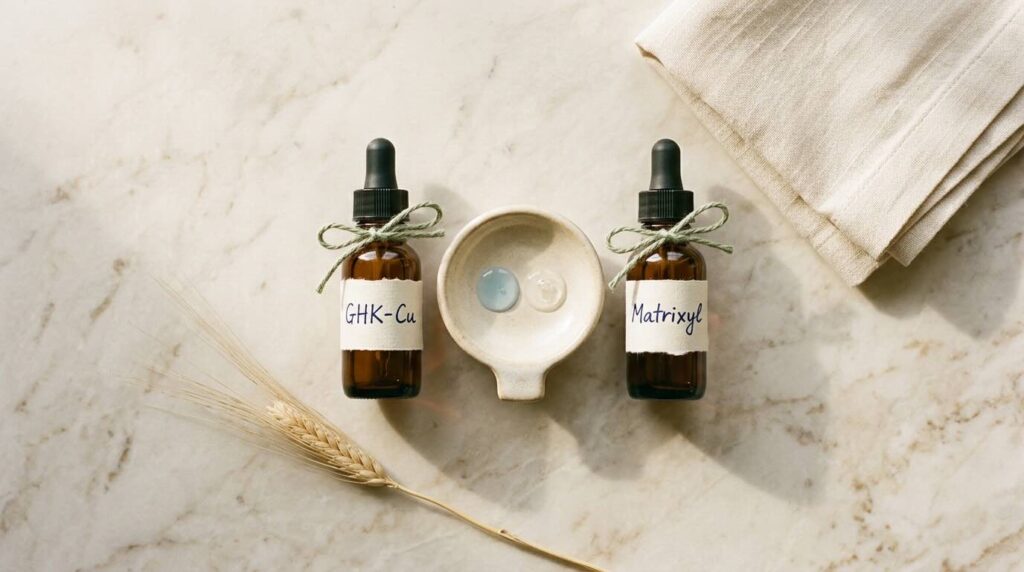
Copper Peptides (GHK-Cu): How They Work, What They Do
The science behind copper peptides
The most famous copper peptide is GHK-Cu (copper tripeptide-1). This peptide is unique because it is naturally found in human plasma, and it becomes less abundant as we age. GHK-Cu was discovered decades ago, making it one of the most researched peptides in skincare science.
Here is what makes copper peptides special. They are not just a signal to do something. They actively participate in skin repair. When GHK-Cu is present in your skin, it directly stimulates collagen and elastin synthesis, improves wound healing, and promotes skin remodeling. It is like giving your skin an active repair team rather than just telling it to start working.
Copper peptides also have antioxidant and anti-inflammatory properties. Copper is essential for the enzyme lysyl oxidase, which cross-links collagen and elastin to make them stronger and more resilient. Without adequate copper, your skin cannot properly stabilise the collagen it produces.
What copper peptides do for your skin
- Stimulate collagen and elastin production. Copper peptides directly upregulate fibroblasts, the cells that produce collagen. For 30+ skin starting to lose firmness, this is powerful.
- Improve skin firmness and texture. Over consistent use, you should notice smoother, more lifted skin. This effect is particularly noticeable by 40+ when firmness loss becomes more pronounced.
- Enhance wound healing and skin barrier repair. If your skin is reactive, sensitised, or compromised, copper peptides can help repair the skin barrier more efficiently than many other ingredients.
- Provide antioxidant protection. Copper peptides reduce free radical damage, protecting existing collagen from degradation.
- Support skin remodeling. They help your skin reorganise its structural components, which is why results improve over time.
Best for which skin concerns
Copper peptides excel when you are dealing with loss of firmness and elasticity (common 30+ concern), visible wrinkles and fine lines, dull tired-looking skin, compromised or sensitised skin barrier, post-procedure skin recovery, and general collagen maintenance and support.
Timeline for results
Copper peptides are not overnight miracles. Most people need 8 to 12 weeks of consistent use to notice visible improvements in skin texture and firmness. By 16+ weeks, results become more dramatic. This is important to know. If you switch products every two weeks, you will never see what copper peptides can do.
Signal Peptides (Matrixyl, Palmitoyl): How They Work, What They Do
The science behind signal peptides
Signal peptides work on a completely different principle than copper peptides. Instead of directly participating in collagen synthesis, they send chemical messages to your fibroblasts saying, “We need more collagen and elastin. Get to work.”
The most common signal peptides in skincare are:
- Palmitoyl Pentapeptide-4 (Matrixyl). The original and most studied signal peptide. It mimics the breakdown products of collagen, signalling your skin that collagen needs to be rebuilt.
- Palmitoyl Tripeptide-1 (Matrixyl 3000). A refined version that also boosts hyaluronic acid and glycosaminoglycan production for improved hydration.
- Acetyl Tetrapeptide-2. Targets elastin production specifically.
- Palmitoyl Hexapeptide. Another variant used in premium formulations.
The logic is elegant. Your skin naturally breaks down collagen with age. Signal peptides trick your skin into thinking collagen breakdown has occurred, triggering your body’s natural repair response. Biomimicry at its finest.
What signal peptides do for your skin
- Boost collagen production. Signal peptides upregulate collagen synthesis through cellular communication. The effect is cumulative. Continued use leads to visible improvements.
- Enhance elastin synthesis. Some signal peptides specifically target elastin, helping restore the bounce and resilience your skin loses with age.
- Improve skin hydration. Matrixyl 3000 and similar peptides also increase hyaluronic acid and GAG production, plumping fine lines from within.
- Support dermal-epidermal communication. Signal peptides help different skin layers talk to each other, which is essential for healthy skin aging.
- Provide a gentler, cumulative effect. Since they are signalling molecules rather than active participants, they tend to be well-tolerated even by reactive skin.
Timeline for results
Signal peptides typically require 6 to 10 weeks to show noticeable results. They work more subtly than copper peptides, so expectations should be calibrated accordingly. Consistent use over months leads to genuinely impressive improvements in skin texture and firmness.
Head-to-Head Comparison: Copper vs Signal Peptides
| Factor | Copper Peptides (GHK-Cu) | Signal Peptides (Matrixyl) |
|---|---|---|
| How it works | Directly stimulates collagen and elastin; active participant in skin repair | Sends chemical signals to boost collagen and elastin production |
| Speed of results | 8 to 12 weeks for noticeable changes; 16+ weeks for dramatic effects | 6 to 10 weeks; more gradual but cumulative |
| Skin barrier support | Excellent. Actively repairs and strengthens | Good. Supports but does not directly repair |
| Best for sensitive skin | Yes, but some people are sensitive to copper | Yes. More gentle, lower risk of irritation |
| Research depth | Decades of research; highly substantiated | Well-studied; solid clinical evidence |
| Best for 30+ skin | Preventive plus active support; excellent choice | Preventive, maintenance-focused; excellent choice |
| Best for 40+ skin | More intensive; addresses visible aging more dramatically | Supportive; good for ongoing maintenance and prevention |
| Cost range | Typically $27 to $105 per product | Typically $19 to $64 per product |
The bottom line comparison
Choose copper peptides if you want the most direct, proven-effective approach to stimulating collagen production. You have visible aging concerns (wrinkles, laxity, dullness) that need addressing. Your skin barrier is compromised and needs active support. You are willing to commit to 8 to 12+ weeks for results.
Choose signal peptides if you prefer a gentler, more nuanced approach. You are focused on prevention and maintenance. You want to layer peptides without overwhelming your skin. You are starting your anti-aging routine early (30+) and building a long-term strategy. You have very sensitive or reactive skin.
The honest truth. Both work. The difference between a 7/10 and 9/10 result depends more on your consistency, the rest of your routine, and your genetic predisposition than on choosing copper vs signal. But for maximum visible impact on 40+ skin with pronounced aging concerns, copper peptides generally deliver faster, more noticeable results.
Best Copper Peptide Products for Women 30+ and 40+
Copper · The Accessible Workhorse
The Ordinary Buffet + Copper Peptides 1%
The most accessible way to try copper peptides. The Ordinary combines their signature Buffet Complex (amino acids and peptides) with 1 percent copper peptides. For the price, genuinely impressive. The formula is lightweight, absorbs quickly, and plays well with other actives. Apply after cleansing and toning, before heavier serums or moisturisers. Use 2 to 3 pumps morning and/or evening. The pick for women 30+ dipping their toes into copper peptides, minimalist science-forward shoppers, and anyone on a budget who still wants serious peptide power. Results timeline: 8 to 10 weeks for noticeable texture improvement, 16+ weeks for visible firmness gains.
View on Amazon →
Copper · The Sensory Pick
Drunk Elephant Protini Polypeptide Cream
Protini is a cream-based peptide powerhouse loaded with amino acids and polypeptides. Particularly good if your skin is on the drier side or if you want peptides in a moisturiser format. The texture is luxe without being heavy, and it is formulated to support skin firmness and barrier health. Apply as the final step in your evening routine. Can be used morning and evening, though the rich texture makes it ideal for nighttime. The pick for women 30+ and 40+ with dry or combination skin, those who prefer peptides in a moisturising formula, and anyone looking for a premium efficacious night cream. Results timeline: 6 to 8 weeks for hydration improvements, 12+ weeks for visible firmness gains.
View on Amazon →
Copper · The Investment Tier
SkinMedica TNS Advanced Serum
If you are serious about copper peptides, this is the investment-level option. TNS Advanced contains human fibroblast conditioned media (the growth-factor supernatant from cultured skin cells) plus copper peptides. A powerhouse formula that delivers visible firmness, texture, and glow improvements. Apply to clean skin morning and/or evening. A little goes a long way. Two to three drops covers the entire face. The pick for women 40+ with visible aging concerns, those willing to invest in a premium treatment serum, and anyone who has tried other peptides and wants to level up. Results timeline: visible improvements in 6 to 8 weeks, dramatic results by 12 to 16 weeks.
View on Amazon →
Best Signal Peptide Products for Women 30+ and 40+
Signal · The K-Beauty Breakthrough
Medicube PDRN Pink Peptide Serum
Incredible value. Combines PDRN (polydeoxyribonucleotide, a growth-factor-rich ingredient) with peptides and hyaluronic acid. The formula is lightweight, hydrating, and genuinely supportive of collagen production. Medicube is a Korean beauty brand known for innovative peptide formulations, and this serum proves why. Apply to clean skin morning and/or evening. Two to three pumps covers the face and neck. Layers well with all other skincare actives. The pick for budget-conscious women 30+ who do not want to sacrifice efficacy, K-beauty fans, and anyone with normal to combination skin who wants hydration plus peptide support. Results timeline: 6 to 10 weeks for noticeable texture and hydration improvements, 12 to 16 weeks for visible firmness gains.
View on Amazon →
Signal · The Drugstore Multi-Tasker
Olay Regenerist Micro-Sculpting Cream
An underrated workhorse. This cream contains Matrixyl 3000 (the enhanced signal peptide) plus hyaluronic acid, retinol, and niacinamide. For the price point, an exceptional multi-tasking moisturiser. Particularly good if you are new to peptides and want to see results without investing heavily. Apply as your final moisturising step morning and evening. A nickel-sized amount covers the entire face. This is your moisturiser, and it delivers multiple benefits in one product. The pick for women 30+ who want an all-in-one moisturiser, budget-conscious shoppers, and anyone who prefers established dermatologist-recommended brands. Results timeline: 4 to 6 weeks for hydration and smoothness, 10 to 12 weeks for visible firmness and line-softening.
View on Amazon →
Signal · The Research-Backed Booster
Paula’s Choice Peptide Booster
A weightless, highly concentrated peptide serum that layers seamlessly into any routine. Contains multiple signal peptides plus niacinamide for extra skin-strengthening benefits. Paula’s Choice is known for no-nonsense formulations backed by solid research, and this product delivers. Apply after cleansing and toning, before other serums. Two to three pumps covers the face and neck. Works beautifully with vitamin C serums, niacinamide boosters, and retinoids. The pick for women 30+ starting or maintaining a peptide routine, those who like to layer actives without any thickness, and anyone with combination or oily skin who wants peptide benefits in a lightweight formula. Results timeline: 6 to 8 weeks for texture improvements, 12+ weeks for visible firmness gains.
View on Amazon →
Signal · The All-in-One Moisturiser
Paula’s Choice Pro-Collagen Peptide Plumping Moisturizer
If you want signal peptides in a moisturising vehicle, this is a smart choice. Combines peptides with glycerin and ceramides for a hydration-focused formula that supports collagen production without being heavy. The plumping effect comes from increased hydration and improved barrier function, not from any inflaming ingredients. Apply as the final step in morning and evening routines. Can be used alone or over other serums depending on skin needs. This is your moisturiser, not an additional step. The pick for women 30+ and 40+ with dry, dehydrated, or sensitive skin, those who prefer peptides in a multi-functional moisturiser, and anyone who wants to simplify their routine with one product doing heavy lifting. Results timeline: 4 to 6 weeks for hydration improvements, 10 to 12 weeks for visible firmness and texture gains.
View on Amazon →
Can You Use Both Copper and Signal Peptides Together?
The question we get asked constantly. The answer. Yes, but with strategy.
There is no interaction between copper peptides and signal peptides. They work through different mechanisms and will not interfere with each other. However, using both simultaneously is not necessarily better than using one. Here is the strategic approach.
The layering strategy
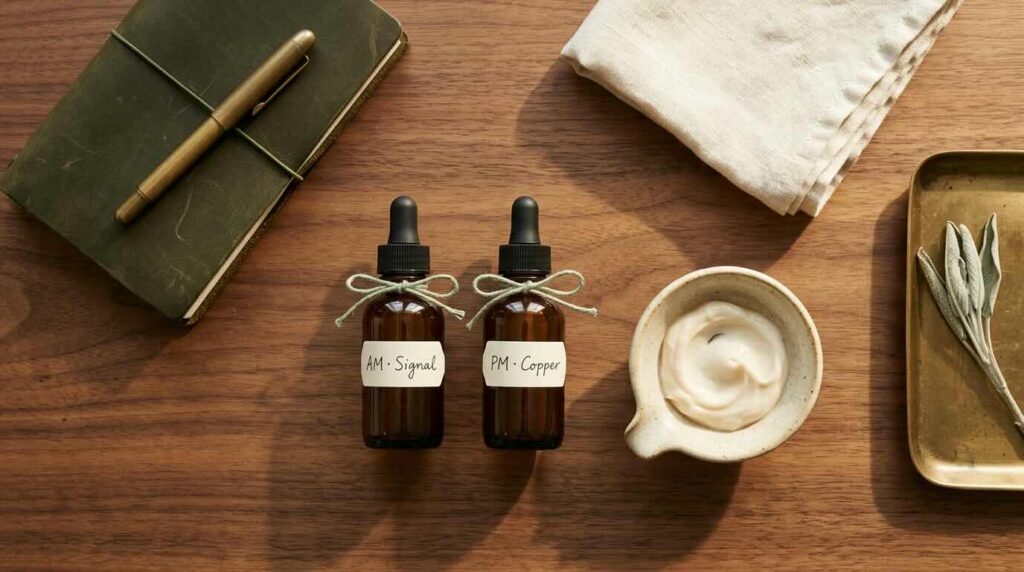
For women 30+. Start with one. Pick either copper peptides or signal peptides and use for 12 weeks. This allows you to isolate what you are seeing and create a baseline. Once you have found what works, you can add a second peptide type if you want to maximise results. A typical routine might be: signal peptide serum AM, copper peptide serum PM.
For women 40+. If you have the budget and commitment, you can use both. But again, introduce them sequentially. Try one for 8 to 12 weeks, then add the second. This prevents overwhelming your skin and allows you to troubleshoot if irritation occurs.
Sample combination routines
Budget-conscious peptide combo (~$46 total)
AM: Paula’s Choice Peptide Booster + sunscreen. PM: The Ordinary Buffet + Copper Peptides 1% + moisturiser.
Mid-range balanced combo (~$170 total)
AM: Paula’s Choice Peptide Booster + Paula’s Choice Pro-Collagen Moisturiser. PM: The Ordinary Buffet + Copper Peptides 1% + lightweight moisturiser.
Premium peptide combo (~$200 total)
AM: SkinMedica TNS Advanced Serum + sunscreen. PM: Drunk Elephant Protini Polypeptide Cream as your night moisturiser.
Avoiding overwhelm
Peptides are additive and synergistic, but they also require consistency to work. If you are using both copper and signal peptides but only 3 times a week, you will see weaker results than someone using one peptide type consistently every day. Consistency beats complexity.
Pick a peptide strategy that you will actually stick to. That might be one peptide used religiously, or it might be two peptides used every single day. But it will not be three peptides used sporadically. See our skincare layering order guide for the optimal sequence when combining peptides with other actives.
The Honest Bottom Line: Which Peptide Is Right for You?
For women in their 30s
Your skin is still producing collagen at a decent rate, but you are starting to see the first subtle signs. Fine lines becoming visible when you are tired, a slight loss of bounce, maybe some dullness. This is the ideal time to start a peptide routine because prevention is genuinely easier than correction.
For you, signal peptides are probably the best starting point. They are gentler, they support natural collagen production over time, and they fit beautifully into a prevention-focused routine. Products like Paula’s Choice Peptide Booster or PDRN Pink Peptide Serum introduce your skin to peptides without intensity. You are establishing a habit and getting consistent results without overwhelming your skin.
If you are dealing with visible loss of firmness or pronounced texture changes already in your 30s, copper peptides could be your move. They deliver faster, more noticeable results. Just commit to using them consistently for at least 12 weeks to see what they can do.
For women in their 40s and beyond
Your skin has made it clear that collagen production is declining. Firmness loss is visible, texture is becoming an issue, and preventive measures alone might not be enough. You likely want to see visible improvements relatively soon.
For you, copper peptides are often the more impactful choice. They work more aggressively than signal peptides, stimulating collagen synthesis more directly and comprehensively. If you have already tried signal peptides and want to amplify results, copper peptides are the logical upgrade. Products like SkinMedica TNS Advanced Serum or the budget-friendly The Ordinary Buffet + Copper Peptides can make a noticeable difference within 12 weeks.
That does not mean signal peptides are not worth using. They absolutely are, especially as a maintenance ingredient once you have built collagen with copper peptides. But for addressing established aging concerns, copper peptides have the edge.
The universal truth about peptides
Peptides work best when you are consistent. Once daily is good. Twice daily is better. Every single day for 12+ weeks is how you actually see transformative results. If you are the type to use a product three times a week when you remember, peptides will not be your magic solution. But if you are willing to build a habit, peptides deliver.
Peptides are long-term investments. You are not going to wake up after one application with dramatically firmer skin. But three months of consistent use? Four months? That is when people stop you and ask what you have been doing differently.
Peptide compatibility depends on the formula. Check both product labels before combining separate serums. Copper peptide products can have different restrictions from other peptide formulas; sunscreen and a tolerated moisturiser remain the basic routine. See azelaic acid ranking, best under-eye treatments.
Compatibility note: Compatibility depends on the actual formulas. Follow both product labels; there is no universal rule that peptides must go before or after vitamin C. The Ordinary Multi-Peptide + Copper Peptides 1% (formerly Buffet + Copper Peptides 1%) should be kept separate from vitamin C, direct acids and retinoids according to its manufacturer. Use vitamin C in the morning and that peptide serum in a separate evening routine; use retinoids on different evenings. A waiting period or weeks of tolerance do not override product instructions. Official product instructions (checked 5 September 2026).
Sources
Research context: these sources cover ingredients, skin biology or specific tested formulations. Results depend on the concentration, delivery method and population studied. Product selections are editorial curation; these references are not head-to-head tests of all products listed.
- Schagen SK (2017). Topical Peptide Treatments with Effective Anti-Aging Results. Cosmetics. Read source Review of selected peptides; not every marketed serum.
- Pickart L, Margolina A (2018). Regenerative and Protective Actions of the GHK-Cu Peptide in the Light of the New Gene Data. Int J Mol Sci. PubMed 29986520 Mechanistic review; not proof of every finished copper peptide serum.
- Lupo MP, Cole AL (2007). Cosmeceutical peptides. Dermatol Ther. PubMed 18045359 Review of peptide categories and developing evidence.
- Mukherjee S, et al. (2006). Retinoids in the treatment of skin aging: an overview of clinical efficacy and safety. Clin Interv Aging. PubMed 18046911 Review distinguishing retinoids, formulations and tolerability.
- Bissett DL, et al. (2005). Niacinamide: A B vitamin that improves aging facial skin appearance. Dermatol Surg. PubMed 16029679 Specific 5% niacinamide formula; 50 women, 12 weeks.
Additional reading: Build out the routine with our guides on best peptide serums ranked, peptides vs retinol after 30, best under-eye treatments with peptides, best azelaic acid products, skin barrier repair, great skin after 30, and our evidence-based take on the viral CeraVe cancer claim.
Affiliate Disclosure: This post contains affiliate links, which means we may earn a small commission if you make a purchase through these links at no extra cost to you. We only recommend products we've researched and believe offer real value. Our opinions remain our own and are not influenced by any brand or compensation.