Created using AI; curated by Glow Protocol. AI tools support research, product comparisons and writing. Our recommendations are editorial selections. How we work.
Quick answer
Before using a new skincare product widely, test a small area according to its directions. The AAD’s general home method uses repeat applications over seven to ten days. This can help flag a reaction, but it is different from medical patch testing and cannot guarantee that your face will tolerate the product. AAD: testing skincare products at home; DermNet: open application testing and its limits.
A new moisturiser arrives and the tempting next step is a full-face application that evening. A more useful start is to read the directions, make a small-area check and keep a record. Here is how to understand patch-testing advice without mistaking a home product check for an allergy diagnosis.
How we curated this: AI-assisted research using the sources linked below, curated for everyday skincare decisions. We have not conducted product testing or medical review.
Some related buying guides contain affiliate links. If you buy through those links, Glow Protocol may earn a commission at no extra cost to you.

An at-home product check is not a medical allergy test
In everyday beauty language, “patch test” often means trying a little product on a small area. Medical patch testing is a different process: a dermatologist applies selected substances and assesses delayed skin responses to help identify contact allergens. Your moisturiser on your forearm cannot tell you which ingredient caused a reaction. AAD: medical patch testing.
| What you are doing | What it can help with | What it cannot establish |
|---|---|---|
| Small-area home product check | Noticing a reaction to that product under those conditions | A diagnosis, a complete allergen list or guaranteed facial tolerance |
| Medical patch testing | Investigating suspected allergic contact dermatitis with a clinician | A universal ranking of all skincare that will work for you |
| Trying a routine after the check | Observing comfort and practical fit during normal use | Proof that an ingredient caused every change you notice |
The distinction matters when a product has already caused problems. Our recommendation is to keep the packaging and your notes for a clinician, rather than turn several bottles into a do-it-yourself allergy panel. The useful goal is a better next decision, not proving that you can tolerate a product at any cost.
How to make a small-area skincare check at home
For an ordinary skincare product, the AAD suggests a roughly coin-sized area such as the inner arm or elbow crease, using your normal amount twice daily for seven to ten days. Leave it for its usual wear time; rinse-off products should follow their stated contact time rather than being left on overnight. If a reaction develops, wash it off gently and stop using it. AAD: testing skincare products at home.
Read the product-specific instructions first. Brands may specify a different testing method or restricted use. Do not increase a product’s permitted frequency or contact time to fit a general checklist. Prescription medicines, peels and products with special warnings need their own instructions or advice from the prescriber or manufacturer.
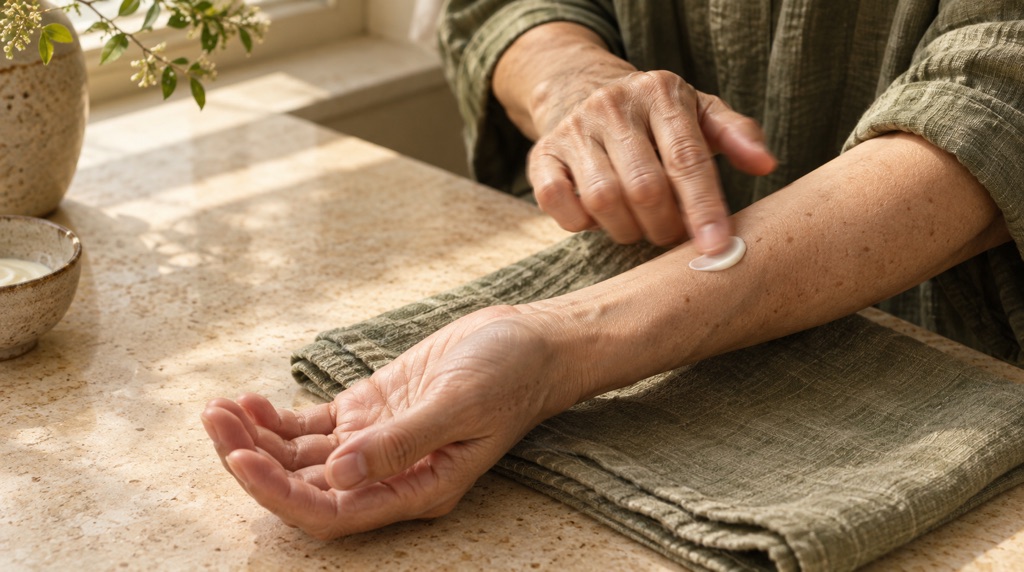
For a concrete example of differing guidance, The Ordinary’s Azelaic Acid Suspension 10% safety section describes an upper-forearm check, keeping the area dry, and rinsing at the specified time or after 24 hours if none is given. This is an example of a brand method, not permission to apply every skincare product for 24 hours. The Ordinary: Azelaic Acid Suspension 10% directions.
Choose an area of intact skin. Avoid improvising an adhesive dressing to make the test look more clinical. DermNet’s open application method leaves the area uncovered and notes that testing on a different skin site or at a different frequency can produce misleading results. DermNet: open application testing and its limits.
Keep a short record you can actually use
The following is our suggested note format. It is not a diagnostic score. A few precise observations are easier to review than trying to remember which of three new products you used on a busy morning.
| Write down | Example of a useful entry |
|---|---|
| Exact product and version | Full name, strength if shown, and a photo of the ingredient list |
| Directions used | Leave-on or rinse-off; the testing instructions you followed |
| Date, time and area | First application date and the small area you used |
| What you noticed | Whether there was itching, burning, swelling, a colour change or no change noticed |
| What you did next | Stopped and rinsed, sought advice, or completed the directed check without a reaction |
Avoid turning a blank observation into a claim such as “allergy-free”. Write “no reaction noticed in this check” instead. It is a more accurate record of what happened and remains useful if a different response appears during normal use later.
Keep the product’s original packaging rather than decanting it into an unlabelled jar during this process. A clear photograph of the exact label gives you something concrete to share if you contact the manufacturer or a healthcare professional. The unbranded objects in our photographs simply illustrate the routine decisions.

What to do after the check
If no reaction appears, follow the product’s directions for normal use. Our routine-building suggestion is to introduce that one new step while keeping the rest of a comfortable routine stable. If you change the cleanser, moisturiser and active at the same time, it becomes harder to understand a later problem.
A passed arm check does not guarantee an uneventful facial application. DermNet notes that thicker test-site skin can yield a false negative for a product intended for thinner facial or eyelid skin. A home check also does not evaluate every future combination with your other products. DermNet: open application testing and its limits.
If a reaction occurs, do not keep applying to “finish” the test. The NHS describes contact dermatitis symptoms including itching, blisters, dryness and cracking; colour changes can appear red on lighter skin or brown, purple or grey on darker skin. Persistent, recurrent or severe symptoms warrant medical assessment. NHS: contact dermatitis.
Seek urgent medical help for difficulty breathing or significant swelling associated with an allergic reaction. Medical guidance, not another skincare purchase, is the next step in that situation. AAD: medical patch testing.
For everyday routine choices, our dry vs dehydrated guide helps you frame the moisturising decision, while CeraVe cream vs lotion compares two familiar textures. There is no need to introduce both products simply because they appear in a comparison.

Common questions
Is one uneventful night enough?
One night does not cover the AAD’s general seven-to-ten-day repeat-use approach, and delayed responses are possible. Follow the particular product’s instructions rather than treating a single uneventful application as a guarantee. AAD: testing skincare products at home.
Can I test several new products together?
Our recommendation is one product at a time. Keep the purpose of the check easy to understand. Mixing products on the same spot means a reaction would not tell you which finished product was involved.
Does “sensitive skin” on the label remove the need?
Treat the claim as product information, not a personal guarantee. Read its warnings and testing directions, especially if you have reacted before. An individual response is something a product label or an online quiz cannot rule out.
Your takeaway: check the directions, make one carefully observed change and keep the record. Testing is a useful precaution with limits; it should make your next decision clearer, not pressure you into using something that feels wrong.
Sources and how we used them
Sources checked on 11 September 2026. Dermatology organisations provide general guidance; brand pages describe their own ingredients and directions. None reviewed or endorsed this article. Decision tables and examples are Glow Protocol editorial suggestions, not clinical protocols.
- AAD: testing skincare products at home
- AAD: medical patch testing
- DermNet: open application testing and its limits
- The Ordinary: Azelaic Acid Suspension 10% directions
- NHS: contact dermatitis
Affiliate Disclosure: This post contains affiliate links, which means we may earn a small commission if you make a purchase through these links at no extra cost to you. We only recommend products we've researched and believe offer real value. Our opinions remain our own and are not influenced by any brand or compensation.