Created using AI; curated by Glow Protocol. AI tools support research, product comparisons and writing. Our recommendations are editorial selections. How we work.
Quick answer
Crème de la Mer is a luxury moisturiser to consider for its particular formula and experience, if it suits your skin and budget. This review does not establish that its proprietary ingredients outperform every alternative. Compare a smaller purchase size and a basic moisturiser before committing to a premium routine.
Background guidance: AAD: skincare on a budget.
Updated : Opening answer clarified and its supporting references checked; jump navigation added. Check current price, size and seller on the retailer listing.
Affiliate Disclosure: This post contains Amazon affiliate links. If you purchase through our links, we earn a small commission at no extra cost to you. We only recommend products we have researched and believe in.
The Question Every Woman Eventually Asks
This review focuses on Crème de la Mer itself. For help interpreting other shoppers’ experiences, see how to read La Mer customer reviews.
La Mer has held a particular place in luxury skincare for decades. The Crème de la Mer, that heavy, rich, beautifully packaged moisturiser in the jade-green jar, has been sold as transformative for women who want extraordinary skin. It costs around $395 for 60ml. It is aspirational, it is beautiful, and for a very specific type of skin, under specific conditions, it genuinely delivers results.
But that is a different statement from “La Mer is worth $400.” And those two things are not the same.
This la mer review is not a teardown. La Mer is a well-formulated product and we are not here to pretend otherwise. What we are here to do is give you an honest, evidence-based answer about whether it is worth it for you, specifically, and what you might get instead for less money if the answer turns out to be no.
A product can be genuinely good and still not be worth the price. These are different questions.
What Is Actually in La Mer Crème de la Mer
Most la mer review content online skips the ingredient list entirely. So let us start there. The brand’s signature ingredient is “Miracle Broth,” a fermented kelp extract developed by Max Huber, an aerospace physicist who suffered severe burns and reportedly spent over a decade developing the formula. The Miracle Broth is a fermented blend of sea kelp, lime tea, sea lettuce, and various other marine extracts. It is exclusive to La Mer and undeniably part of what you are paying for.
Beyond the Miracle Broth, the formula contains mineral oil (a highly effective occlusive moisturiser), petrolatum, glycerin, seaweed extract, wax components, vitamins C and E, lime extract, and a mineral pigment that gives the cream its characteristic colour. It is a rich, occlusive, emollient formula. Excellent at sealing in moisture and creating a smooth, plump surface.
What it does not contain, in any meaningful concentration, is retinoids, significant levels of proven peptides, AHAs, or other extensively clinically validated actives. It is primarily a moisturiser. An extremely well-made one, but a moisturiser nonetheless.
What La Mer Does Well
No la mer review is complete without acknowledging what the product genuinely does better than most. And there are three areas where it earns real praise.
For Very Dry or Compromised Skin
La Mer Crème de la Mer excels at what rich, occlusive moisturisers do: it locks in moisture, creates a protective film over the skin, and prevents transepidermal water loss. For women with very dry, dehydrated, or sensitised skin, particularly those going through hormonal shifts, living in cold climates, or recovering from over-exfoliation or barrier damage, this type of formula is deeply effective. Many women with dry skin in their 40s and 50s find it genuinely transformative.
Texture and Sensorial Experience
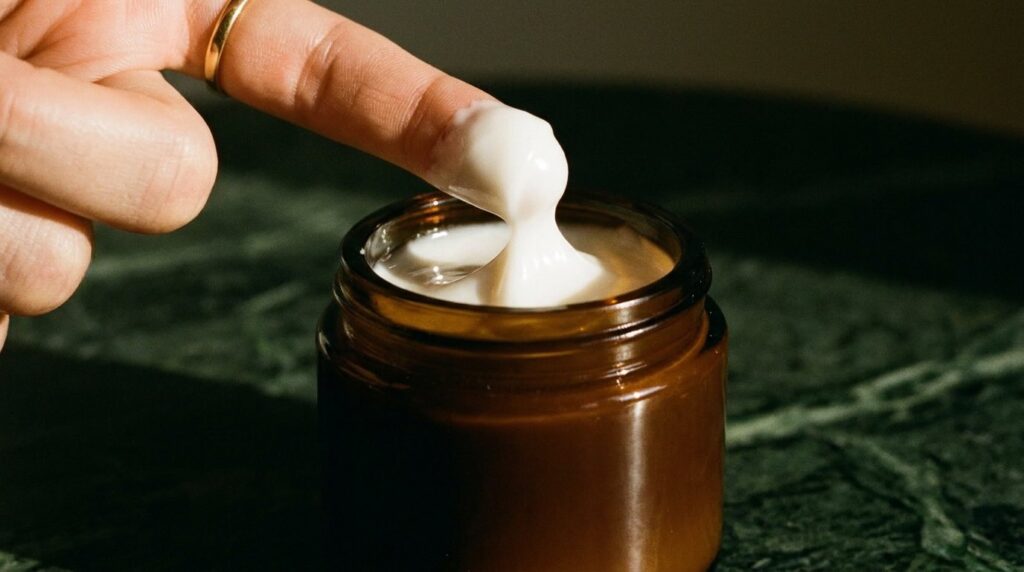
La Mer has invested significantly in the texture and experience of the product. It absorbs slowly, has a distinctive weight, and delivers that “skin felt cushioned” sensation that a lighter moisturiser simply cannot replicate. This is not trivial. The ritual of skincare matters for some women, and a product that makes you want to use it is a product you will actually use.
Immediate Radiance
The mineral pigment in the formula, along with the occlusive film it leaves, creates an immediate luminosity that many women find comparable to nothing else. This is cosmetic rather than functional, but it is real and it photographs beautifully.
Where La Mer Falls Short
This is the part of the la mer review that most beauty sites skip. Because it is easier to praise a $400 product than to be honest about where the price stops making sense.
It Is Not an Anti-Ageing Treatment
This is the most important finding of any honest la mer review: La Mer does not contain the ingredients with the strongest clinical evidence for reversing signs of ageing. No retinoids, no significant Vitamin C concentration, no clinically dosed peptides, no AHAs. If your primary concern is collagen loss, fine lines, hyperpigmentation, or slow cell turnover (the actual biological changes that happen after 30) La Mer addresses none of these directly. You would need to add an active serum regardless, which further questions the value of spending $400 on a moisturiser.
For Normal or Oily Skin After 30
La Mer Crème de la Mer is heavy. For women with normal or combination skin, it is often too rich. It can cause breakouts, look greasy, and feel uncomfortable. La Mer does make lighter formulations (the Soft Cream, Moisturising Gel Cream) that suit a wider range of skin types, but these are significantly less distinctive formulations and harder to justify at the price.
The Price Premium Is Substantial
The functional moisturising ingredients in La Mer (glycerin, mineral oil, petrolatum, emollients) are widely available. Very good moisturisers using similar occlusive-rich formulations exist at a fraction of the price. The premium you are paying is partly for the proprietary Miracle Broth, partly for the brand’s heritage and positioning, and partly for the packaging and sensory experience. Any thorough la mer review has to acknowledge that these are legitimate reasons to buy it, but they are not skincare reasons.
You are paying for one of the best moisturisers in the world. Whether you need the best is a different question.
Our Verdict: When La Mer Is Worth It
So where does this la mer review land? It depends entirely on your skin type and what you are trying to achieve.
La Mer makes sense if:
✓ Your skin is very dry, sensitised, or your barrier is compromised
✓ You are in your 40s or 50s and conventional moisturisers feel insufficient
✓ You live in a cold or harsh climate and need maximum occlusiveness
✓ You already use active serums (retinoid, Vitamin C) and just need a barrier moisturiser
✓ The ritual and experience of luxury skincare is genuinely meaningful to you
La Mer does not make sense if:
✗ You have normal, combination, or oily skin. It will feel too heavy.
✗ You want anti-ageing results. You will need additional actives regardless.
✗ You expect it to transform your skin. It will hydrate it, not transform it.
✗ Budget is a concern. The results can be closely replicated for far less.
What to Use Instead: La Mer Alternatives That Deliver
No la mer review would be fair without showing what else is out there. If you want the rich, occlusive, barrier-repairing benefits of La Mer without the price, these alternatives have strong formulations and clinical support.
Budget Alternative
La Roche-Posay Toleriane Ultra Rich
Ceramide-rich, fragrance-free, intensely occlusive. Clinically tested for very dry and reactive skin. The closest functional match to La Mer’s moisturising performance at a tenth of the price.
View on Amazon →
Mid-Range Alternatives
CeraVe PM Facial Moisturising Lotion
Ceramides, hyaluronic acid, niacinamide. Barrier-repairing without heaviness. Lighter than La Mer, which is an advantage for normal and combination skin.
View on Amazon →
Weleda Skin Food
Rich, occlusive, and visibly plumping. Beloved by makeup artists for the same finish La Mer gives. Not a clinical skincare product, but delivers a similar sensory experience at 5% of the cost.
View on Amazon →
Luxury Alternative
Augustinus Bader The Rich Cream
TFC8 complex with ceramides, amino acids, and growth factors. Clinical studies show measurable improvements in barrier function, texture, and skin renewal. If you want luxury-tier with proven regenerative technology, this is where to put the money.
View on Amazon →
SkinCeuticals Triple Lipid Restore 2:4:2
Ceramides, cholesterol, and fatty acids at clinical ratios (2% pure ceramides, 4% natural cholesterol, 2% fatty acids). The science-first alternative for barrier repair at a luxury level.
Shop →
The Final Word
La Mer Crème de la Mer is a genuinely excellent moisturiser. It does exactly what an occlusive-rich, emollient formula is supposed to do, and it does it beautifully. For women with very dry or compromised skin, particularly those in their 40s and 50s, it can genuinely feel unlike anything else. That is the honest conclusion of this la mer review: the product is good, but good and worth it are not the same thing.
But “unlike anything else” is not the same as “better than everything else.” If you are spending $400 on a moisturiser and also spending $50 on a retinoid and $30 on a Vitamin C serum, you are choosing to put your budget where the experience is rather than where the evidence is. That is a valid choice. Just know that it is a choice, and that your skin will not necessarily know the difference.
Our recommendation, and the bottom line of this la mer review: if you love La Mer, have the budget, and your skin loves it back, enjoy it. If you are considering it for the first time, try Augustinus Bader The Rich Cream first at $265, or La Roche-Posay Toleriane Ultra Rich at $32. Then decide whether the jump to $400 makes sense for you.
For a head-to-head comparison of the top three luxury moisturisers, read our La Mer vs. Augustinus Bader vs. Dr. Barbara Sturm review.
→ Start with our complete barrier repair guide
→ Read our breakdown of what you actually pay for in luxury skincare
If you want to know how I figured all of this out through years of trial and error, read my story here.
Sources
Research context: these sources cover ingredients, skin biology or specific tested formulations. Results depend on the concentration, delivery method and population studied. Product selections are editorial curation; these references are not head-to-head tests of all products listed.
- Mukherjee S, et al. (2006). Retinoids in the treatment of skin aging: an overview of clinical efficacy and safety. Clin Interv Aging. PubMed 18046911 Review distinguishing retinoids, formulations and tolerability.
- Pullar JM, et al. (2017). The Roles of Vitamin C in Skin Health. Nutrients. PubMed 28805671 Review covering biological roles and limits of topical evidence.
- Coderch L, et al. (2003). Ceramides and skin function. Am J Clin Dermatol. PubMed 12553851 Background on ceramide biology and skin function.
- Quan T, Fisher GJ (2015). Role of Age-Associated Alterations of the Dermal Extracellular Matrix Microenvironment in Human Skin Aging: A Mini-Review. Gerontology. PubMed 25660807
Glow Protocol · glowprotocol.beauty · Science-backed skincare for women 30+
Affiliate Disclosure: This post contains affiliate links, which means we may earn a small commission if you make a purchase through these links at no extra cost to you. We only recommend products we've researched and believe offer real value. Our opinions remain our own and are not influenced by any brand or compensation.