Created using AI; curated by Glow Protocol. AI tools support research, product comparisons and writing. Our recommendations are editorial selections. How we work.
Quick answer
If a product is causing burning or irritation, stop using it and simplify to care your skin tolerates. A gentle cleanser, moisturiser and sun protection are a starting point, not a guaranteed 72-hour cure. Persistent or severe symptoms need professional assessment because several skin conditions can look similar.
Background guidance: AAD: product reactions and testing · AAD: dry-skin care.
Related guide: barrier repair guide.
Updated : Opening answer clarified and its supporting references checked; jump navigation added. Check current price, size and seller on the retailer listing.

Affiliate Disclosure: This post contains Amazon affiliate links. If you purchase through our links, we earn a small commission at no extra cost to you. We only recommend products we have researched and believe in.
Skin Barrier Care: A 72-Hour Plan to Simplify and Reassess
Stinging, tightness and redness can follow an irritating routine, but they do not identify a single diagnosis. This is a guide to simplifying skincare over the next few days, not a diagnostic test or a promise of recovery within 72 hours.
The longer barrier-care guide offers further reading on a simple routine. Whether symptoms settle quickly or persist varies with their cause; do not move to more actives simply because day four has arrived. See skin barrier repair guide.
There is no universal 72-hour treatment window supported by the sources checked here. Removing an irritating cosmetic and using tolerated basic care may help, but recovery cannot be guaranteed by a particular combination or schedule.
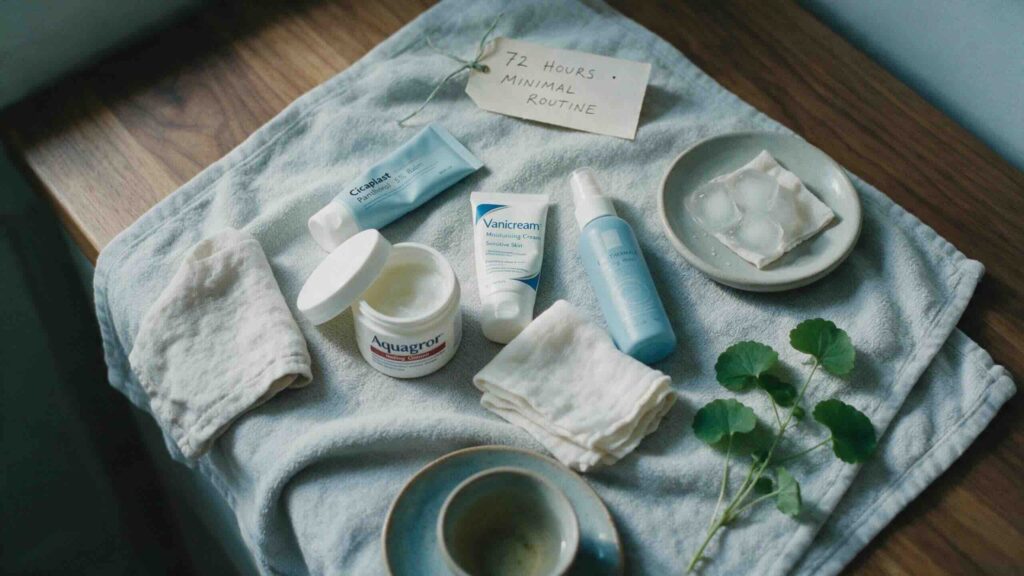
Understanding Stinging and Redness
Burning, redness and tightness can overlap with irritation, eczema, allergy and other conditions. The number of symptoms does not reliably distinguish a barrier emergency from general sensitivity. See long-term barrier repair guide.
Immediate burning within 30 seconds of applying moisturiser or water. Not mild tingling. A sharp sting, or a hot flush, the moment product touches skin. Healthy skin does not feel this. This is your barrier signalling that it cannot regulate what passes through it.
Visible redness or flushing across large areas. Cheeks, jaw, forehead, or the whole face appearing pink to red, warm to touch, sometimes with reactive blotches that appear and disappear within an hour.
Extreme tightness after cleansing. Your skin feels drum-tight when you smile. This is lipid depletion in the stratum corneum. The barrier is literally cracking under normal facial movement.
Dehydration despite heavy moisturising. You are applying rich creams and your skin still looks parched, flaky, or textured within an hour. Water cannot be held in because the seal is broken.
Every product causes reaction. Not just actives. Gentle cleansers, thermal mists, and even facial oils feel irritating. When the barrier is compromised, everything penetrates too deeply and triggers inflammation.
A recent trigger you can trace. A new retinoid, an increased exfoliation frequency, an acid used two days in a row, or a professional treatment followed by home actives. Emergencies do not happen randomly. Something specific broke the barrier.
There is no validated three-symptom threshold for choosing this routine. Persistent, severe or worsening symptoms need assessment rather than a product-selection rule. See long-term barrier rebuild.
What to Stop Immediately (The Non-Negotiable List)
Emergency care starts with subtraction. Before you add anything, remove every product that is disrupting recovery. For the next 72 hours, you use nothing from the list below. This feels counterintuitive because your instinct is to do more when your skin is in crisis. Do less. The barrier repairs itself when you stop disrupting it.
- All retinoids: retinol, retinal, retinaldehyde, prescription tretinoin, and every “gentle” retinol alternative.
- All chemical exfoliants: glycolic, lactic, mandelic, salicylic, and PHA. See our AHA vs BHA guide for what to reintroduce and when, but during the emergency window everything is paused.
- Vitamin C serums, especially L-ascorbic acid formulations.
- Benzoyl peroxide and any acne actives.
- Azelaic acid, even at low percentages.
- Enzyme masks and physical scrubs of every kind.
- Cleansing brushes, silicone pads, konjac sponges, and washcloths.
- Fragranced products, including essential-oil-based serums.
- Hot water on the face. Lukewarm only, and briefly.
Pause cosmetic actives that are irritating your skin. Reintroduce them only when symptoms have settled and their instructions or your clinician’s advice support it, not automatically on day four or five. See skin cycling with peptides guide, retinol mistakes guide.
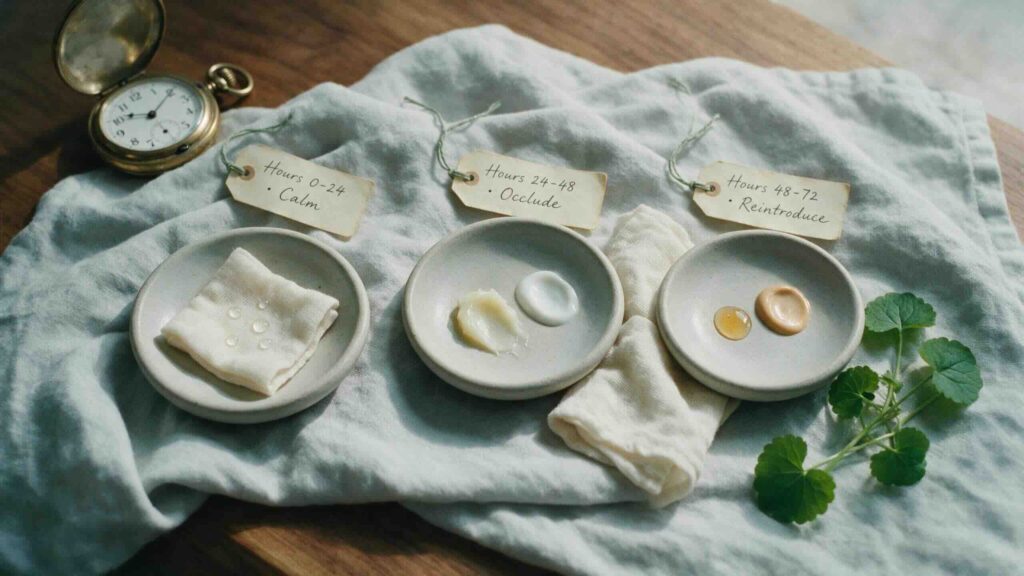
Hours 0 to 24: Stop the Damage, Layer the Repair Base
For the first day, simplify to products you already tolerate. Avoid adding several new products at once. Continue suitable sun protection; a repair balm is not a sunscreen.
Cleanser: the only cleanser you use for 72 hours
A single, non-foaming, pH-neutral cleanser once daily in the evening. Morning gets a plain lukewarm water rinse. Nothing else touches your skin. If you are already using CeraVe or Vanicream, keep using it. If not, one of the two below is the fastest way to stabilise.
CLEANSER · THE ONLY ONE YOU NEED
CeraVe Hydrating Gentle Cleanser
Ceramides plus hyaluronic acid plus niacinamide in a non-foaming, pH-neutral, fragrance-free formula. This is the baseline for a barrier crisis. Cleanses without stripping the lipids you are trying to rebuild. Use lukewarm water only. Once daily, evening. Morning is a plain water rinse. If you own a stronger cleanser and it stings on contact, replace it immediately with this.
View on Amazon →
CLEANSER · BUDGET OPTION
Vanicream Gentle Facial Cleanser
Extremely gentle, fragrance-free, formulated for compromised and reactive skin. Cleanses effectively without ceramides in the formula, but does not strip either. Same protocol as above: lukewarm water, once daily in the evening, water rinse in the morning. The pick if the CeraVe formula is unavailable or you want the lowest-cost stabiliser.
View on Amazon →
Pat gently after washing. Slightly damp skin may make moisturiser comfortable to spread, but panthenol and glycerin do not become ineffective on dry skin.
Panthenol layer: the first hour of repair
Within one minute of towel-blotting, apply a generous layer of a panthenol-and-centella cream to slightly damp skin. This is the workhorse of the 72-hour protocol. Panthenol (provitamin B5) is one of the most well-documented ingredients for calming reactive skin and supporting lipid recovery. Centella (cica) adds an anti-inflammatory boost.
PANTHENOL LAYER · THE 72-HOUR WORKHORSE
La Roche-Posay Cicaplast Baume B5
Panthenol (5 percent) plus centella plus niacinamide plus prebiotic thermal water. Specifically formulated for barrier damage: anti-inflammatory, occlusive without feeling heavy, and stable across the pH range of compromised skin. Apply generously to slightly damp skin morning and evening. Use only the amount and frequency described by the product directions. During the emergency window, this is the single most important layer in your routine.
View on Amazon →
Overnight occlusive seal: the slugging step
On night one, add a thin layer of a petrolatum-based ointment over your Cicaplast right before bed. Petrolatum is the most effective occlusive available in over-the-counter skincare, blocking up to 99 percent of transepidermal water loss. This is the step that lets your barrier rebuild overnight instead of drying out again by morning.
OCCLUSIVE SEAL · THE OVERNIGHT LAYER
Aquaphor Healing Ointment
Petrolatum (41 percent) plus glycerin plus panthenol plus bisabolol. Apply a thin layer over your Cicaplast at night to lock everything in. Blocks transepidermal water loss overnight, giving the panthenol and any residual barrier lipids time to work while you sleep. Use nightly for the full 72-hour window. Clinical-feeling and thick. That is the point.
View on Amazon →
OCCLUSIVE SEAL · CERAMIDE-BOOSTED ALTERNATIVE
CeraVe Healing Ointment
Petrolatum plus ceramides plus hyaluronic acid. Slightly less occlusive than Aquaphor, but the ceramide addition supports lipid recovery while the petrolatum seals. Use identically: thin layer over Cicaplast at night. Choose based on availability and preference. Either works.
View on Amazon →
Persistent or Severe Symptoms: Seek Advice
Severe symptoms, weeping skin or a reaction following a procedure are reasons to contact a clinician. Do not escalate to another cosmetic cream as a substitute for assessment.
SEVERE DAMAGE · THE CLINIC-GRADE ESCALATION
Avène Cicalfate+ Restorative Protective Cream
Avène thermal water plus zinc plus copper plus sucralfate (a polymer that forms a protective seal over damaged skin). Clinically designed for post-procedure recovery and severe barrier compromise. Use it in place of Cicaplast if stinging does not ease within 36 hours, or from hour one if your damage is post-laser, post-peel, or reactive to a professional treatment. More expensive than Cicaplast, faster relief when the damage is deep.
View on Amazon →
Hours 24 to 48: Add Gentle Hydration if Tolerated
Use symptoms rather than a countdown to decide what happens next. If your skin remains sore or reactive, do not add more layers merely because 24 hours have passed.
DAY TWO HYDRATION · THERMAL WATER MIST
Avène Thermal Spring Water Mist
Pure thermal water and nothing else. If everything stings, mist this on skin before your Cicaplast to provide a hydrating substrate for the panthenol to bind. Zero active ingredients, safe on the most reactive skin. Tap water performs a similar role for free, so only add this if you want a portable soothing ritual for daytime resets.
View on Amazon →
DAY TWO HYDRATION · SNAIL MUCIN ESSENCE
COSRX Advanced Snail 96 Mucin Essence
96 percent snail secretion filtrate plus trace glycoproteins. A hydrating essence, not a serum, and one of the gentlest hydration layers available for reactive skin. Apply to slightly damp skin before Cicaplast, only on day two or later, only if your skin no longer stings on contact. If it burns on application, remove immediately, wait until day three, and reintroduce then.
View on Amazon →

Hours 48 to 72: Review Tolerance and Symptoms
A tolerated ceramide moisturiser can be used from the start. There is no universal requirement to delay ceramides until day three or evidence that skin needs 48–72 hours before accepting them.
Choose a moisturiser by tolerance and formulation. The following options are editorial choices, not a proven fastest-recovery ranking. See best ceramide moisturiser guide.
DAY THREE CERAMIDES · THE GOLD STANDARD
CeraVe Moisturizing Cream (Tub)
Ceramides 1, 3, and 6-II plus hyaluronic acid plus glycerin, in a ratio designed to match the lipid profile of healthy skin. Layer on top of Cicaplast morning and evening from hour 48 onward. The ceramide ratio matters more than the total concentration, and this formulation is the clinical benchmark most dermatologists recommend for post-emergency barrier recovery.
View on Amazon →
DAY THREE CERAMIDES · BUDGET ALTERNATIVE
Vanicream Moisturizing Cream
Ceramides plus glycerin, fragrance-free, dye-free. A simpler formulation than CeraVe but equally effective at the day-three layer. Use identically: morning and evening over Cicaplast. The pick for the most reactive skin or the lowest budget. The absence of any potential irritants in the formula makes it the safest option if you are still sensitive on day three.
View on Amazon →
The full 72-hour routine, mapped by day
Morning care: gentle washing if needed, a tolerated moisturiser, and sun protection appropriate to your exposure. If sunscreen stings, avoid that formula and prioritise shade and clothing while seeking advice on a tolerated option.
Day 1 evening: CeraVe Hydrating Gentle Cleanser with lukewarm water. Pat damp. Cicaplast generously. Aquaphor thin layer over the top. Sleep.
Day 2 morning: Water rinse. Optional Avène thermal mist or COSRX snail essence if tolerated. Cicaplast generously. Nothing else.
Day 2 evening: Gentle cleanser. Optional snail essence. Cicaplast. Aquaphor over the top. Sleep.
Day 3 morning: Water rinse. Optional snail essence. Cicaplast. CeraVe or Vanicream Moisturizing Cream on top.
Day 3 evening: Gentle cleanser. Optional snail essence. Cicaplast. CeraVe Moisturizing Cream. Aquaphor over the top for one more night. Sleep.
Reassess comfort and symptoms after a few days. Improvement is not proof that the barrier has fully recovered, and lack of improvement is not a reason to add progressively stronger cosmetics. See long-term barrier repair guide.
Sunscreen During the Emergency Window: What to Do
Sun protection remains relevant while skin is irritated. Different sunscreen formulas may feel different; neither mineral nor chemical filters guarantee a comfortable product.
A repair balm such as Cicaplast is not a substitute for sunscreen. Use shade, clothing and a tolerated broad-spectrum sunscreen; do not keep applying a product that burns.
There is no universal day-three restart rule for sunscreen. Choose a tolerated formula and seek advice if irritation makes sun protection difficult.
DAY THREE ONWARD · MINERAL SPF
La Roche-Posay Anthelios SPF 50 · SPF 50
Mineral formulation designed for sensitive and post-procedure skin. Reintroduce from day 3 morning if you are going outdoors. Apply as the last step, after Cicaplast and CeraVe cream. Available at most pharmacies. If you have a mineral SPF you already tolerate, use that instead. The point is protection, not brand loyalty.
View on Amazon →
Red Flags: When to Stop and See a Dermatologist
This guide cannot diagnose or treat every cause of burning or redness. Seek professional advice for severe, persistent or worsening symptoms, including the situations below.
Stinging worsens after day 2. Recovery should trend downward, not upward. If burning intensifies despite the protocol, you may have contact dermatitis, an allergic reaction, or an infection layered on top of the barrier damage. Get evaluated.
Weeping, oozing, blisters, or crusting. This is beyond self-care. It suggests dermatitis, herpetic reactivation, or bacterial infection. Stop all products (including Cicaplast) and see a dermatologist as soon as possible.
Severe or uncontrollable itching. Mild itching is normal in barrier recovery. Intense, persistent itching that disrupts sleep suggests eczema, allergic contact dermatitis, or another underlying condition that needs prescription support.
Redness spreading past day 3. Fading is normal. Spreading is not. Spreading redness can indicate a reaction to a product still in your routine (fragrance in a hand cream you touch to your face, a laundry detergent on pillowcases) or something more serious.
If symptoms are not improving, ask a clinician to assess the cause. Do not assume that a steroid or a particular prescription cream is the next step.
After 72 Hours: Reassess Before Adding Actives
Comfort may improve before the skin is fully settled. The checked sources do not establish a universal day-four recovery or a fixed protein-rebuilding timetable.
This is where the full long-term barrier repair guide takes over. That guide walks you through weeks 1 to 8 of the phased rebuild: how to gradually add back sunscreen, hydrating serums, and eventually a single active at a time. It also covers how to identify which specific pattern broke your barrier (aggressive retinoid escalation, acid stacking, cleanser mismatch, environmental) so you do not repeat the crisis.
A short transition kit from day 4 onward:
DAY 4 ONWARD · GENTLE NIACINAMIDE LAYER
CeraVe PM Facial Moisturizing Lotion
Contains 4 percent niacinamide plus ceramides plus hyaluronic acid. Introduce from day 4 evening if you want a gentle anti-inflammatory active in the mix. Niacinamide is calming and supportive at this concentration, and unlike retinol or acids it will not disrupt the barrier recovery you just achieved. Use in place of the day-three ceramide cream in the evening, keeping Cicaplast underneath.
View on Amazon →
WEEK 2 ONWARD · DAILY BARRIER MOISTURISER
Avène Tolerance Control Soothing Skin Recovery Cream
Thermal water plus ceramides plus glycerin in a light, elegant, daily-wear formulation. This is your “new normal” moisturiser once the emergency is fully behind you. Use it in place of your pre-emergency moisturiser, which was probably too active or too fragranced. Also useful as a maintenance cream during future active-heavy periods, before another emergency can start.
View on Amazon →
Reintroduce one optional active at a time only after irritation settles, following its label and any professional advice. There is no universal maximum of one acid application every ten days. See retinol mistakes guide, skin cycling with peptides guide, AHA vs BHA guide.
The Bottom Line
A simpler routine can reduce unnecessary irritation. It is not a guaranteed three-products, three-days cure, and persistent symptoms deserve assessment.
The products listed here are optional moisturising choices. You do not need the whole kit, and severe or post-procedure reactions should be discussed with a clinician rather than treated by upgrading a cream. See La Roche-Posay Cicaplast Baume B5, Aquaphor Healing Ointment, CeraVe Hydrating Gentle Cleanser, CeraVe Moisturizing Cream, Avène Cicalfate+, 8-week barrier rebuild.
Sources
Research context: These sources cover ingredients, skin biology or specific tested treatments. Results depend on the formulation, delivery method and population studied. Product selections are editorial curation; these references are not head-to-head tests of the products listed.
- Proksch E, et al. (2008). The skin: an indispensable barrier. Exp Dermatol. PubMed 19043850
- Ebner F, et al. (2002). Topical use of dexpanthenol in skin disorders. Am J Clin Dermatol. PubMed 12113650 Evidence concerns particular dexpanthenol preparations and skin conditions.
- Bissett DL, et al. (2005). Niacinamide: A B vitamin that improves aging facial skin appearance. Dermatol Surg. PubMed 16029679 Specific 5% niacinamide formula; 50 women, 12 weeks.
- Bylka W, et al. (2013). Centella asiatica in cosmetology. Postepy Dermatol Alergol. PubMed 24278045 Review includes wound healing and experimental evidence; finished formulations differ.
- Rawlings AV, Harding CR (2004). Moisturization and skin barrier function. Dermatol Ther. PubMed 14728698 Background on hydration biology, not a fixed recovery timetable.
- Lodén M (2003). Role of topical emollients and moisturizers in the treatment of dry skin barrier disorders. Am J Clin Dermatol. PubMed 14572299
- Draelos ZD (2018). The science behind skin care: Moisturizers. J Cosmet Dermatol. PubMed 29319217 Moisturiser review; not evidence that all creams perform equally.
Additional reading: the long-term 8-week barrier repair guide, best ceramide moisturiser ranked, AHA vs BHA exfoliant guide, skin cycling with peptides after 30, and retinol mistakes that break barriers.
Affiliate Disclosure: This post contains affiliate links, which means we may earn a small commission if you make a purchase through these links at no extra cost to you. We only recommend products we've researched and believe offer real value. Our opinions remain our own and are not influenced by any brand or compensation.