Created using AI; curated by Glow Protocol. AI tools support research, product comparisons and writing. Our recommendations are editorial selections. How we work.
Quick answer
If retinol is suitable for you, begin with a lower-intensity option and a gradual schedule that follows the label. Use moisturiser and daytime sun protection. More is not automatically better; avoid retinoids during pregnancy, and seek advice if you have persistent irritation or a skin condition.
Background guidance: AAD: retinoids and retinol.
Updated : Opening answer clarified and its supporting references checked; jump navigation added. Check current price, size and seller on the retailer listing.
Affiliate Disclosure: This post contains Amazon affiliate links. If you purchase through our links, we earn a small commission at no extra cost to you. We only recommend products we have researched and believe in.
Retinol for Beginners: The Honest Guide From Someone Who Got It Wrong First
Retinol for beginners is one of the most-googled phrases in skincare for a reason. At 30, suddenly everyone is telling you that you need it. Then you hear the horror stories. Your friend tried it once, her skin peeled off, and she has never touched it since. So you have waited. You are still waiting.
This is a practical guide to getting real results from retinol without the unnecessary irritation. It is what I wish I had known at the beginning.
You do not need to tolerate peeling and burning to get results. The women who quit retinol almost always started too strong, too fast. Patience is the active ingredient.
How Retinol Actually Works (And Why Most People Quit Too Early)
Retinol is a vitamin A derivative. Your skin converts it to retinoic acid, which increases cell turnover, stimulates collagen production, and reduces fine lines. The research is solid. Decades of it, backed by dermatologists globally. This is one of the few things in skincare where the science genuinely is there.
A landmark study in the Journal of the American Academy of Dermatology followed women using retinol for 24 weeks. By the end, they had measurably reduced fine lines, improved skin texture, and increased dermal collagen. But here is what matters: the women who tolerated the retinol, meaning they did not drop out due to irritation, saw the benefits. The ones who used it sporadically or quit after two weeks saw nothing. That is the pattern.
Retinol requires consistency, and your skin needs 12 to 16 weeks to show real improvement. If you start too strong or use it incorrectly, you will get an irritation reaction, decide it is not for you, and abandon it. That is the trap.
Understanding Retinoid Strength for Beginners
Not all retinol is equal. There is a hierarchy of strength and stability, and where you enter that hierarchy matters enormously. From weakest to strongest the order is: retinyl palmitate, then retinol, then retinaldehyde, then adapalene, then prescription tretinoin. Retinol itself sits in the middle of this range. It is effective, it is stable in formulas, and it is available without a prescription. For retinol for beginners, retinol or retinaldehyde is ideal. Tretinoin is genuinely stronger and causes more irritation, and you do not need it to start.
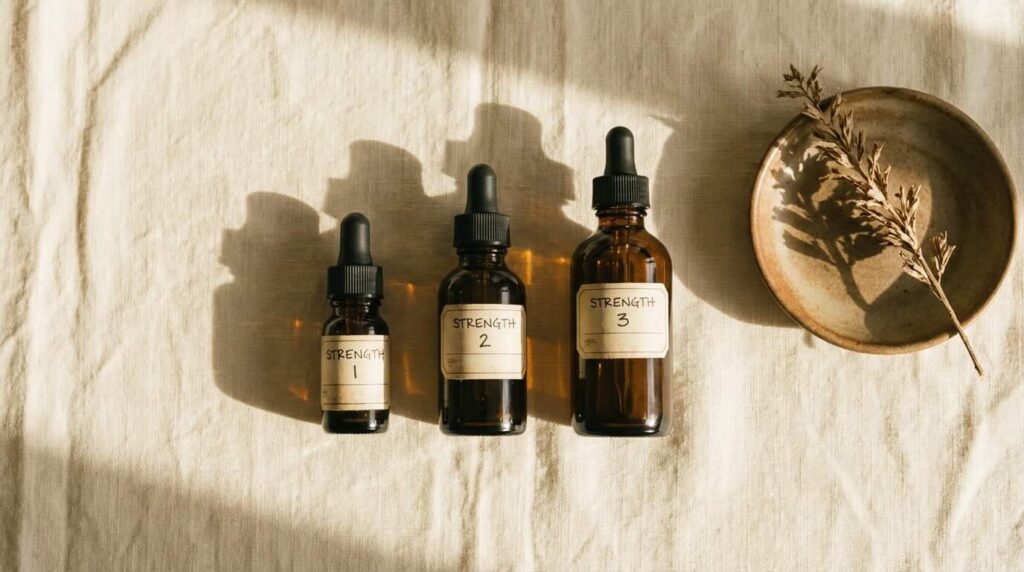
Within retinol products, strength is measured by percentage. A 0.25% formulation is considerably milder than 1%. Most beginners should never start above 0.5%. If you have never used retinol before, start at 0.25% to 0.3% once or twice a week for four weeks, then build to two or three times a week. If you tried retinol once and quit because of irritation, restart at 0.3% to 0.5% one night a week, adding a night every two weeks if your skin is handling it. If you are already using retinol two or three times a week, 0.5% to 1% is the range where real collagen-building happens. Most people never need to go above 1%. The research shows the effectiveness curve flattens after that point. You are not getting significantly better results, you are just adding irritation risk.
The Buffering Method (And Why It Changes Everything)
Moisturiser can help some people tolerate retinol. Applying retinol to bare skin is not automatically a mistake: follow the directions for your particular formula and adjust if irritation occurs.
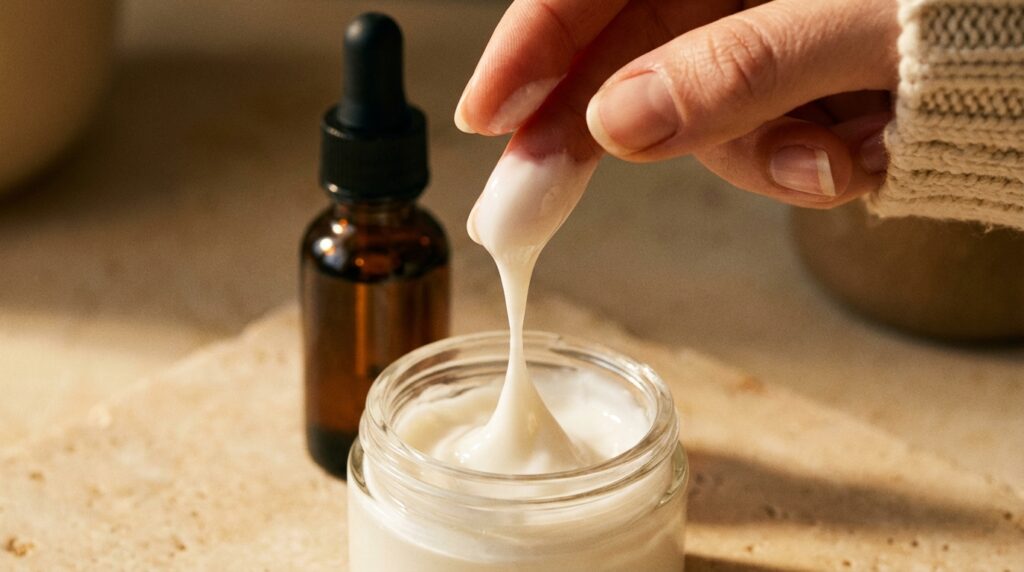
Buffering means using moisturiser before or around a retinol application when the product instructions allow it. It may improve comfort, but the sources checked here do not establish a universal 40–60% reduction in irritation or identical results for every formula. A brief pause can help layers settle; it is not a clinically established timer.
This is sometimes called the sandwich method, and it is standard practice in dermatology offices. You are not weakening the retinol. You are reducing the irritation that makes people quit before they see results.
The Buffering Base
CeraVe Moisturising Cream (16oz)
The ideal buffering moisturiser. Ceramides and hyaluronic acid provide barrier support, and the texture is thick enough to properly dilute retinol without being so occlusive that it blocks absorption entirely. The 16oz size lasts months. This is the same product dermatologists hand to patients starting tretinoin.
View on Amazon →
The Best Retinol for Beginners at Every Budget
For a first retinol product, consider the stated strength, formulation, directions and price. Individual tolerance varies. These three products are curated examples to compare, not products that Glow Protocol has tested in a controlled trial.
Budget Pick
The Ordinary Retinol 0.5% in Squalane
The true entry point for retinol for beginners. The squalane base is lightweight and non-irritating. At 0.5% it is strong enough to actually work, but forgiving if you over-use it. Start once or twice a week, building to three times over 4 to 6 weeks. Expect mild dryness in the first two weeks, then it settles. Best for sensitive skin and budget-conscious users.
View on Amazon →
Mid-Range Pick
RoC Retinol Correxion Deep Wrinkle Night Cream
A retinol night cream rather than a pure serum. The formula is already built around moisturising ingredients, so you do not need to buffer as strictly. Use 2 to 3 times per week. Texture is richer than The Ordinary, which makes it better for skin prone to dryness. A solid one-step option for women who want simplicity.
View on Amazon →
La Roche-Posay Pure Retinol Face Serum
For women who have used a gentle retinol before and want to move up to 0.5% to 0.7%. Mid-range price, higher strength than The Ordinary, and designed by dermatologists. Use with the buffering method 2 to 3 times per week. Visible results typically appear at week 8 to 12.
View on Amazon →
The Sensitive Skin Pick
Medik8 Crystal Retinal 3
This is retinaldehyde, not retinol, which means it converts to retinoic acid 11 times faster than standard retinol but stays gentle enough for sensitive or reactive skin. Microencapsulated for stability and gradual release. The best option for women who tried retinol and reacted badly. Use 2 to 3 times per week with buffering.
View on Amazon →
The choice between these depends on your budget and current skin sensitivity. If you have never used retinol, start with The Ordinary. If you have tried it before and tolerated it, jump to RoC or La Roche-Posay. If your skin is reactive or your skin barrier has been compromised in the past, start with Medik8 Crystal Retinal 3 instead. Do not overthink the choice.
The Realistic 12-Week Timeline
Retinol can cause dryness, redness or flaking. These are side effects, not proof that it is working. Reduce frequency or pause if irritation develops, and seek advice for a persistent or substantial reaction.
Weeks 3 to 4 are when the initial irritation settles and your barrier adapts. If you started at once a week, move to twice a week. Many people report their skin feeling smoother at this point, even without any visible changes to wrinkles yet. Weeks 5 to 8 may bring slight peeling or flaking, usually too subtle for others to notice. Fine lines around your eyes and mouth begin to soften. Skin texture improves noticeably. Hyperpigmentation spots may begin to fade. If your skin is tolerating it well, increase to three times per week. Weeks 9 to 12 are when real changes become visible. Fine lines are softer, skin looks smoother and more luminous, pores may appear smaller. This is when most women realise why dermatologists recommend retinol.
After week 13, you are in maintenance mode. You can use it three to five times per week indefinitely, or consider moving up in strength if you want faster results.
What Not to Mix With Retinol
Compatibility depends on the formula. Vitamin C and niacinamide are not universally incompatible with retinol. Separating vitamin C into a morning routine may be simpler; separate exfoliating acids can add irritation. Check product instructions before combining retinoids with benzoyl peroxide or other actives.
Safe to use with retinol: moisturisers (in fact, essential for buffering), gentle hydrating serums like hyaluronic acid or snail mucin, ceramides, squalane or other hydrating oils, and sunscreen the next morning. The confusion usually comes from people trying to use too many actives at once. If you are just starting retinol, your routine should be cleanser, then moisturiser for buffering, then retinol, then moisturiser. That is it. Simple routines work because your skin can actually tolerate consistent use.
Moving Beyond 0.5% (When You Are Ready)
If you have used 0.5% retinol consistently for 12 or more weeks and your skin is clear and happy, you can increase strength. The most common upgrade options are RoC Retinol Correxion Max Wrinkle Cream (around $28) for a thicker formula at 0.75 to 1% strength, Paula’s Choice CLINICAL 1% Retinol Treatment (around $58) for a 1% retinol with elegant serum texture, and L’Oréal Revitalift 1.5% Pure Retinol Serum (around $47) as a budget-friendly higher-strength option.
There is no automatic strength-escalation timetable. AAD advises starting with a lower-intensity retinoid and building gradually. Increasing strength is optional, not an age-based requirement. AAD retinoid guidance. skin changes after 30
SPF Is Non-Negotiable When You Use Retinol
Retinol increases cell turnover, which temporarily makes your skin more sensitive to UV damage. If you use retinol at night but skip sunscreen during the day, you are undoing the work and potentially burning your skin more easily. Daily SPF 30 or higher is essential while using retinol. This is not a suggestion, it is a safety requirement. If you need help building a complete morning routine to support your retinol use, our skincare routine after 40 guide walks through the exact AM and PM stack.
The Daily SPF
EltaMD UV Clear SPF 46
The dermatologist-favourite SPF for women using retinol. Mineral-chemical hybrid with niacinamide, no fragrance, no white cast. Lightweight enough to wear under makeup. Use a generous amount every morning, no exceptions, especially during the first 12 weeks of starting retinol.
View on Amazon →
The Honest Truth About Retinol Results
Some retinol formulations improve fine lines, texture and uneven tone over weeks to months. Results vary by product, use and skin; the cited studies do not guarantee a particular result by week four, eight or twelve. Persistent irritation warrants a simpler routine or professional advice.
The women who get the best results from retinol are not the ones using the strongest formula. They are the ones who never stopped.
Your Action Plan
If this is your first retinol, start with The Ordinary 0.5% in Squalane or RoC Correxion Deep Wrinkle Night Cream. Get a good buffering moisturiser like CeraVe 16oz. Start conservatively, once or twice a week for the first four weeks. Be patient, twelve weeks minimum before deciding if it is working. Increase gradually: move to two or three times per week after four weeks, three or four times after eight. Use SPF every single day, non-negotiable. Do not mix retinol with other actives in the same routine.
Use the directions for the exact product. Consistency matters, but a fixed twelve-week schedule cannot guarantee a result. Persistent irritation is a reason to reassess the product. habits women with great skin after 30 share
Related Reading
→ The complete skin barrier repair guide
→ The luminous skin routine after 40
→ 7 habits every woman with great skin after 30 has in common
If you want to know how I figured all of this out the hard way over a decade of trial and error across multiple climates and skin states, read my story here.
Sources
Research context: these sources cover ingredients, skin biology or specific tested formulations. Results depend on the concentration, delivery method and population studied. Product selections are editorial curation; these references are not head-to-head tests of all products listed.
- Mukherjee S, et al. (2006). Retinoids in the treatment of skin aging: an overview of clinical efficacy and safety. Clin Interv Aging. PubMed 18046911 Review distinguishing retinoids, formulations and tolerability.
- Kligman AM, et al. (1986). Topical tretinoin for photoaged skin. J Am Acad Dermatol. PubMed 3771853
- Kafi R, et al. (2007). Improvement of naturally aged skin with vitamin A (retinol). Arch Dermatol. PubMed 17515510 Specific topical retinol study; not a brand comparison.
- Sorg O, Saurat JH (2014). Topical retinoids in skin ageing: a focused update with reference to sun-induced epidermal vitamin A deficiency. Dermatology. PubMed 24821234
- Bagatin E, et al. (2020). Consensus on the use of oral isotretinoin in dermatology – Brazilian Society of Dermatology. An Bras Dermatol. PubMed 33036809 Oral isotretinoin guidance; not cosmetic retinol or pregnancy-safety evidence.
Glow Protocol · glowprotocol.beauty · Science-backed skincare for women 30+
Affiliate Disclosure: This post contains affiliate links, which means we may earn a small commission if you make a purchase through these links at no extra cost to you. We only recommend products we've researched and believe offer real value. Our opinions remain our own and are not influenced by any brand or compensation.