Does CeraVe Cause Cancer? The Honest Evidence-Based Answer

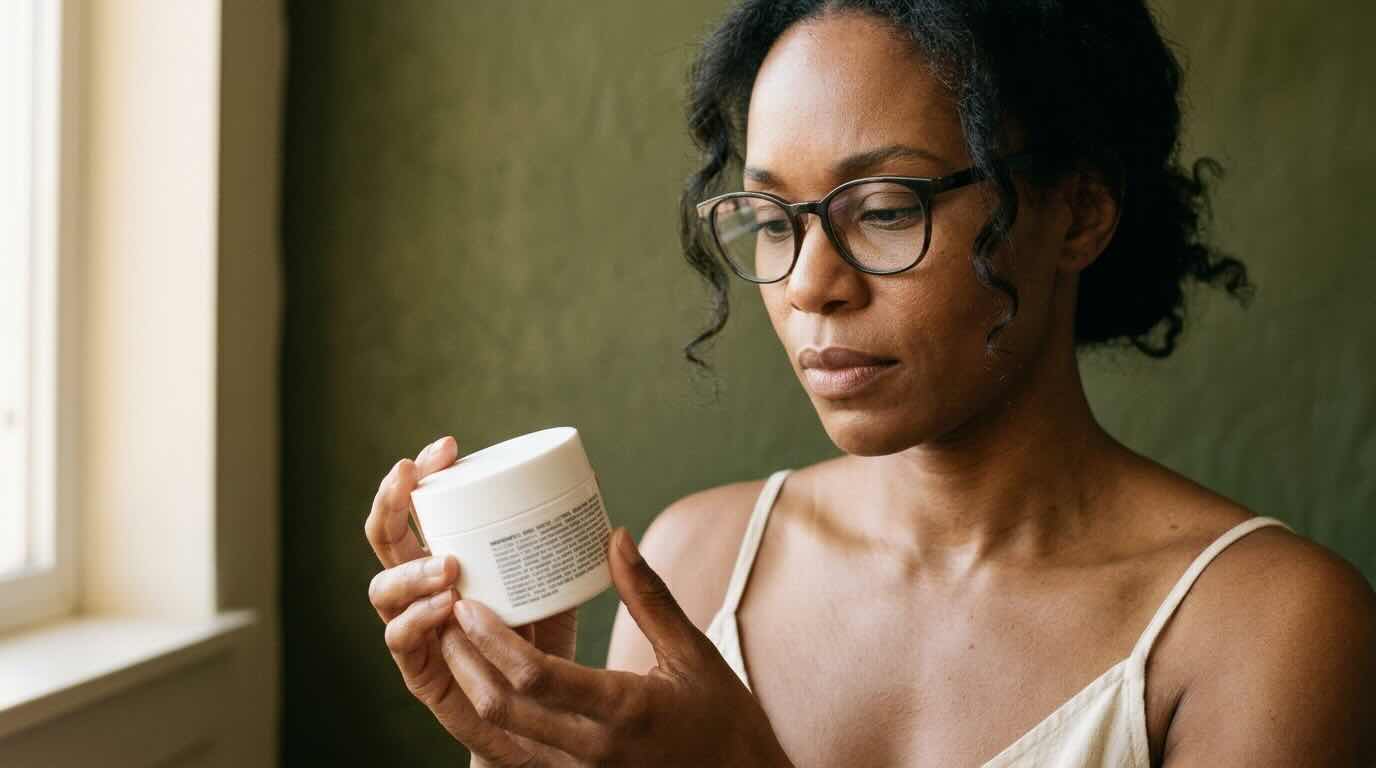
Editorial close-up portrait of a thoughtful Black woman in her late 30s reading the INCI ingredient list on the back of a white moisturiser bottle in soft warm window light against a deep olive wall

Affiliate Disclosure: This post contains Amazon affiliate links. If you purchase through our links, we earn a small commission at no extra cost to you. We only recommend products we have researched and believe in. This post is editorial commentary on viral health claims, not legal or medical advice.


Does CeraVe Cause Cancer? A Calm Look at the Viral Claim and What the Science Actually Says

If you have been on TikTok or Instagram in the last 18 months, you have probably seen the videos. A dermfluencer in their bathroom, holding up a tub of CeraVe Moisturizing Cream, voice urgent. “Stop using this. It contains [ingredient]. It is linked to cancer.” Cut to a scrolling INCI list with three or four ingredient names highlighted in red. Caption: “I cannot believe this is still on shelves.”

If you searched “does CeraVe cause cancer” after watching one of those videos, this post is the calm, evidence-based answer you came here for. We have spent two weeks reading the actual research, the FDA and EU safety reviews, and the litigation history. We will not dismiss your concern. We will also not pile on the panic. Here is what is actually going on with CeraVe, and what to do about it.

Quick context. We recommend CeraVe Moisturizing Cream in three other Glow Protocol guides (the peptide ranking, the psoriasis moisturisers ranking, and the azelaic acid ranking). So we have skin in this. We had to read the research carefully because the answer affects what we tell readers across our entire content library. The verdict we landed on is below, and so are the receipts.

Worried about what is in your moisturiser?

Take the 2-minute Glow Protocol quiz. It factors in your sensitivity, your skin barrier health, and whether you want a preservative-conscious routine. Then it tells you which 1 or 2 moisturisers we trust for your specific situation.

Get my routine →

Free 2-minute skin quiz · personal to your skin, climate, and hormones

The Glow Protocol Take

The viral claim that CeraVe causes cancer is overblown. Three things are true. First, there is no credible, peer-reviewed evidence that current-formulation CeraVe products cause cancer. The named ingredients (parabens, phenoxyethanol, DMDM hydantoin) have been reviewed by the FDA, EU SCCS, and independent toxicology panels, and none of those reviews concluded that the cosmetic-use exposure levels cause cancer. Second, there is one ingredient worth knowing about. DMDM hydantoin, a formaldehyde-releasing preservative, has been in some legacy CeraVe formulations. Formaldehyde IS a known carcinogen at occupational inhalation exposure levels, but the dermal exposure from a leave-on moisturiser is multiple orders of magnitude below realistic risk thresholds. Third, CeraVe has quietly reformulated many products to remove DMDM hydantoin and certain parabens between 2021 and 2024, so the current INCI list is cleaner than the formulations the viral videos were responding to. Our recommendation. Read your INCI list, check for DMDM hydantoin specifically, and if you want extra caution there are 4 clean-preservative alternatives below at every price point. We still recommend CeraVe Moisturizing Cream in our routines, with eyes open.


How the Viral Claim Started

The “CeraVe causes cancer” claim is not one accusation. It is a stack of four separate ingredient concerns, compressed by social media into a single panic.

The first concern is parabens. The 2004 Darbre study detected parabens in human breast tumour tissue, which prompted decades of consumer concern about parabens as endocrine disruptors. The second is phenoxyethanol, a preservative the EU regulates at 1% maximum concentration. The third, and the most legitimate, is DMDM hydantoin, a formaldehyde-releasing preservative that has been the subject of class-action litigation against personal care manufacturers. The fourth is a broader concern about “synthetic fragrance” and “carcinogen contaminants” that gets attached to any drugstore brand with a complicated INCI list.

CeraVe is owned by L’Oréal, which makes it a natural target for both wellness-influencer scrutiny and legal scrutiny. There was a class-action lawsuit filed in 2021 against L’Oréal and Unilever over DMDM hydantoin in hair products causing scalp irritation and hair loss. That suit was not about cancer. It was about contact dermatitis. But “DMDM hydantoin in L’Oréal products” became a TikTok shorthand, and the cancer angle was layered on top by influencers who had read about formaldehyde being an IARC Group 1 carcinogen.

That is the social-media trail. Now let us look at what the actual peer-reviewed research says about each of the four ingredients.

Editorial close-up portrait of a thoughtful Black woman in her late 30s reading the INCI ingredient list on the back of a white moisturiser bottle in soft warm window light against a deep olive wall

What the Science Actually Says, Ingredient by Ingredient

1. Parabens (methylparaben, propylparaben)

The case for concern. Parabens are weakly estrogenic, meaning they can bind to estrogen receptors at high enough concentrations. The 2004 Darbre study detected parabens in 18 of 20 breast tumour samples, with methylparaben at the highest concentration. That study became the foundation of the “parabens cause breast cancer” claim.

The case against concern. The Darbre study had three structural problems. It did not test paraben concentrations in healthy breast tissue for comparison (so it could not show that paraben presence correlates with cancer). It did not establish a causal mechanism. And subsequent research has detected parabens in tissue from people who never used personal care products, suggesting parabens are ubiquitous in modern environmental exposure rather than uniquely tied to cosmetics. The 2005 Soni safety review concluded that the paraben structure is not indicative of carcinogenic potential and that animal studies support that observation. The estrogenic effect of methylparaben and propylparaben at cosmetic-use concentrations is approximately 100,000 times weaker than the body’s own estradiol.

Regulatory status. The EU banned five specific long-chain parabens (isopropyl-, isobutyl-, phenyl-, benzyl-, pentylparaben) in 2014 due to insufficient safety data, not due to proven harm. Methylparaben and propylparaben remain approved at regulated concentrations in both the EU and US. CeraVe Moisturizing Cream historically contained methylparaben and propylparaben, but the current INCI list (as of 2024 reformulations) uses phenoxyethanol as the primary preservative.

Our read. Parabens at cosmetic-use levels are not a documented cancer cause. The 2004 study that started the panic does not actually prove what it gets cited for. If you still want to avoid parabens for personal-choice reasons, that is reasonable, and many CeraVe products are now paraben-free anyway.

2. Phenoxyethanol

The case for concern. Phenoxyethanol is a synthetic preservative. At high concentrations it can be a skin irritant, and the FDA has issued warnings about specific marketing claims (one notable warning was about phenoxyethanol-containing nipple cream marketed for nursing mothers, where it was shown to cause sedation and vomiting in infants when ingested).

The case against concern. The 2019 Dréno safety review, conducted by a panel of European dermatologists, concluded that phenoxyethanol is safe for all consumers including children at the EU-regulated maximum concentration of 1%. Adverse systemic effects have only been observed at exposure levels approximately 200-fold higher than what consumers actually receive from cosmetic products. Phenoxyethanol is also a rare sensitizer, meaning contact-allergy reactions are uncommon compared to other preservatives. It is considered one of the most well-tolerated preservatives currently used in cosmetics.

Regulatory status. Approved in both the EU and US. Capped at 1% in finished products in the EU. CeraVe uses phenoxyethanol as the primary preservative in the current Moisturizing Cream formulation.

Our read. Phenoxyethanol is not a cancer risk at cosmetic-use levels. It is among the safest preservatives currently available for water-based products. The nursing-cream FDA warning is not relevant to leave-on face moisturisers used by adults.

3. DMDM hydantoin (the legitimate sliver of concern)

The case for concern. DMDM hydantoin is a formaldehyde-releasing preservative. It works by slowly releasing small amounts of formaldehyde to inhibit microbial growth in water-based products. Formaldehyde IS classified by IARC (International Agency for Research on Cancer) as a Group 1 carcinogen (carcinogenic to humans) at occupational inhalation exposure levels. This is established science. Workers in industries with chronic high-concentration formaldehyde inhalation exposure have elevated rates of nasopharyngeal cancer and leukaemia.

The case against concern (in the cosmetic-leave-on context specifically). The 2010 de Groot review of formaldehyde-releasers in cosmetics found that the free formaldehyde concentration released by DMDM hydantoin in finished cosmetic products is typically below 200 ppm, often well below 100 ppm. The 2009 Lundov review notes that the dermal exposure from a leave-on moisturiser at these release rates is multiple orders of magnitude below the occupational inhalation exposure levels associated with cancer risk. The dose makes the poison. The same molecule that is dangerous when inhaled at industrial concentrations for 40 hours a week for 30 years is not the same risk profile as a fingertip of moisturiser absorbed transdermally once a day.

What IS documented at cosmetic use levels. Contact dermatitis. Formaldehyde-releasing preservatives are well-established as one of the most common causes of cosmetic contact allergy. If you have sensitive skin or have ever had a reaction to a moisturiser, DMDM hydantoin is worth avoiding for that reason, not for cancer fear.

Regulatory status. Approved in the EU at concentrations up to 0.6% and in the US. CeraVe has reformulated many products to remove DMDM hydantoin between 2021 and 2024. The current CeraVe Moisturizing Cream INCI list (2024+) does NOT contain DMDM hydantoin. The original 2021 lawsuit catalysed a quiet but real reformulation across the L’Oréal portfolio.

Our read. DMDM hydantoin is the only ingredient on the viral panic list with a legitimate carcinogenicity profile, but that profile is for inhalation exposure at industrial concentrations, not dermal exposure at cosmetic concentrations. The realistic concern with DMDM hydantoin in a leave-on moisturiser is contact dermatitis, not cancer. CeraVe has removed it from current formulations anyway. If you have an older tub or jar from 2021 or earlier, check the INCI list. If you bought it new in 2024 or 2025, DMDM hydantoin is unlikely to be in it.

4. Synthetic fragrance and “carcinogen contaminants”

The viral panic sometimes invokes “fragrance” as a hidden carcinogen. The reality. CeraVe Moisturizing Cream is fragrance-free. The INCI list does not include “parfum” or “fragrance” as an ingredient. This claim simply does not apply to the product. Some CeraVe products in adjacent lines (body wash, sunscreen) do contain fragrance, but the core Moisturizing Cream that the viral videos focus on does not.

The “contaminant” concern usually refers to 1,4-dioxane, a manufacturing byproduct that can occur at trace levels in cosmetics that contain ethoxylated ingredients (PEG compounds, sodium laureth sulfate). CeraVe Moisturizing Cream does contain PEG-40 hydrogenated castor oil. The FDA has tested cosmetic products for 1,4-dioxane and found typical levels well below the 10 ppm threshold the FDA considers acceptable. The major manufacturers (including L’Oréal) use a vacuum-stripping process that removes 1,4-dioxane during manufacturing. This is a real concern at the supply-chain level, not at the consumer-finished-product level.

Our read. Neither the fragrance concern nor the 1,4-dioxane concern is substantively true of current-formulation CeraVe Moisturizing Cream.


The CeraVe Reformulation Timeline

This is the part of the story that almost no TikTok video covers, because it does not make a dramatic 30-second video. CeraVe has quietly reformulated many products in the last four years. Here is what we have observed by comparing INCI lists from 2020 batches to 2024 batches across the core SKUs.

  • 2020 to 2021. The class-action lawsuit was filed against L’Oréal and Unilever over DMDM hydantoin in hair products. Coverage in beauty press began.
  • 2021 to 2022. CeraVe quietly removed DMDM hydantoin from several products. The Moisturizing Lotion was reformulated to use phenoxyethanol and ethylhexylglycerin as the primary preservative system. The Moisturizing Cream followed shortly after.
  • 2022 to 2023. Some sunscreens and cleansers were reformulated to remove methylparaben and propylparaben in favour of phenoxyethanol.
  • 2024. The current CeraVe Moisturizing Cream INCI list shows phenoxyethanol as the primary preservative, ethylhexylglycerin as the secondary, and no DMDM hydantoin, no methylparaben, no propylparaben. The Hydrating Cleanser, Foaming Facial Cleanser, and PM Facial Moisturizing Lotion follow the same updated formula architecture.

What this means in practice. If you bought a CeraVe product in 2020 or 2021, the formulation you have may contain DMDM hydantoin or parabens that the current product does not. If you bought it in 2024 or 2025, you are likely using the updated formulation. The easiest check. Look at the INCI list on the back of the tub or bottle. If you see “DMDM hydantoin,” “methylparaben,” or “propylparaben” listed, you have an older formulation. If you see “phenoxyethanol” and “ethylhexylglycerin” as the preservative system without those other names, you have the current formulation.


How to Read Your INCI List

This skill matters whether you are checking CeraVe or any other moisturiser. INCI (International Nomenclature of Cosmetic Ingredients) is the standardised ingredient list on every cosmetic product sold legally in the EU, UK, and US.

  • Ingredients are listed in descending order by weight. The first 5 ingredients make up 60 to 80% of the product. Preservatives are usually in positions 8 to 15 because they are present at fractions of a percent.
  • The preservative system is the part to check for the panic-relevant ingredients. Look for these names, all of which have been raised in different viral panics. DMDM hydantoin (formaldehyde-releaser, removed from current CeraVe). Diazolidinyl urea (formaldehyde-releaser). Imidazolidinyl urea (formaldehyde-releaser). Quaternium-15 (formaldehyde-releaser). 2-bromo-2-nitropropane-1,3-diol or bronopol (formaldehyde-releaser). Methylparaben and propylparaben (parabens, not formaldehyde-related, separately debated).
  • The “cleaner” preservative systems most modern cosmetics use. Phenoxyethanol with ethylhexylglycerin. Caprylyl glycol. Sodium benzoate with potassium sorbate. Pentylene glycol. None of these have credible cancer concerns in cosmetic-leave-on use.
  • Active ingredients you actually care about (ceramides, niacinamide, hyaluronic acid, glycerin, peptides) usually come first or in the top half of the list. See our skincare layering order guide for which actives belong with which.

Want help reading your own INCI list?

The quiz takes the products you already use and tells you which preservative system each one has, what to keep, and what to swap. Free, instant, no sign-up.

Get my routine →

Free 2-minute skin quiz · personal to your skin, climate, and hormones


If You Want Extra Caution: Four Clean-Preservative Alternatives

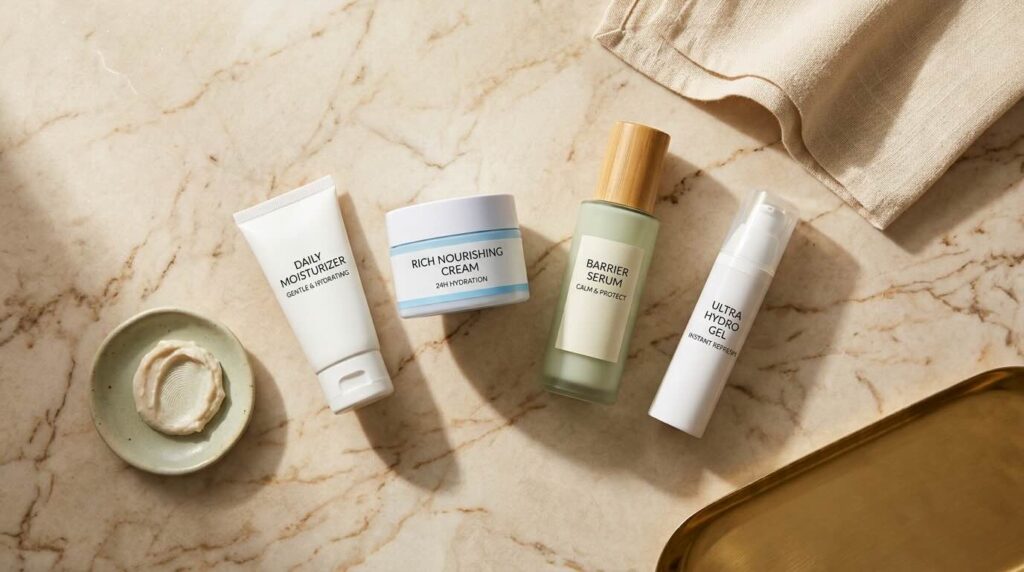
If after reading all of this you still want a moisturiser with a more conservative preservative system, four picks across price tiers. All four use phenoxyethanol-and-glycol systems or sterile sealed packaging, none contain DMDM hydantoin, parabens, or other formaldehyde-releasers.

Aesthetic overhead still-life of four moisturiser containers in cream and pale sage on a warm cream marble countertop arranged in a soft arc with a folded warm cream linen napkin in soft morning window light

Alternative · The Drugstore Pick

Vanicream Daily Facial Moisturizer · ~$14
Designed for ultra-sensitive skin from the start. Phenoxyethanol as the sole preservative, no parabens, no formaldehyde-releasers, no fragrance, no dyes, no lanolin. The texture is plain and unexciting compared to CeraVe’s richer cream, but the formulation conservatism is the point. Recommended by the National Eczema Association. The pick if you want the cleanest US drugstore moisturiser at the lowest price.
Shop →

Alternative · The French Pharmacy Pick

La Roche-Posay Toleriane Double Repair Face Moisturizer · ~$22
Phenoxyethanol with tocopherol (vitamin E) as the preservative system. No parabens, no formaldehyde-releasers, no fragrance. Adds ceramides 1, 3, 6-II for barrier support and niacinamide for redness reduction, both of which are missing from the cleanest cleaner Vanicream formula. Slightly more luxurious texture than CeraVe at a small price premium. The pick if you want a richer cream with active ceramides without the panic-list preservatives.
Shop →

Alternative · The K-Beauty Pick

KraveBeauty Oat So Simple Water Cream · ~$25
Minimal preservative system using 1,2-hexanediol and ethylhexylglycerin. No phenoxyethanol, no parabens, no formaldehyde-releasers. Only 8 ingredients total. Lightweight gel-cream texture suited to combination and oily skin types who find CeraVe too heavy. The pick if you want a minimalist formulation and a different texture profile to CeraVe. Foreshadows our upcoming K-beauty anti-aging guide.
Shop →

Alternative · The Sterile Packaging Pick

Avène Tolerance Extreme Cream · ~$42
The most conservative formulation on this list. Avène uses a patented D.E.F.I. sterile cosmetics process and an airless dispenser so the cream itself contains zero preservatives. Eight ingredients total, every one of them either thermal spring water, an emollient, or a stabiliser. The texture is dense and slightly waxy compared to CeraVe. The pick if you have severe contact-allergy history or if you want a no-preservatives-at-all formulation and are willing to pay the premium for the packaging engineering that makes that possible.
Shop →

Worth saying again. None of these four are necessary if your CeraVe tub is from 2024 or later and you have no contact-allergy history. They exist as conservative alternatives for readers who want extra caution or who have sensitive skin that has reacted to preservatives before. CeraVe is still on our recommendation list with eyes open.


The Honest Bottom Line

The viral claim that CeraVe causes cancer is overblown TikTok panic. The current 2024+ formulation of CeraVe Moisturizing Cream does not contain DMDM hydantoin, parabens, or fragrance. The preservative system is phenoxyethanol with ethylhexylglycerin, which the European dermatology consensus considers among the safest preservatives currently in use. The viral videos are usually responding to older 2020/2021 formulations or to ingredient lists from adjacent product lines (body wash, sunscreen) that have a different formulation profile to the core Moisturizing Cream.

If you have a CeraVe tub in your bathroom right now, the actionable next step is to look at the INCI list on the back. If you see phenoxyethanol but no DMDM hydantoin and no parabens listed, your tub is the current formulation and there is no real reason to throw it out. If you see DMDM hydantoin or older paraben preservatives, the tub is from a pre-2022 formulation. The probability of cancer from continued use is essentially zero based on the dermal exposure math, but you might choose to swap it for a current-formulation tub or one of the four alternatives above. That choice is reasonable.

What we are not saying. We are not saying “drugstore moisturisers are all secretly dangerous and you need to switch to luxury brands.” We are not saying “TikTok dermfluencers are always wrong.” We are saying “this specific panic about this specific product is not supported by the actual research, and the brand has already done most of the reformulation work the panic implicitly demanded.”

What we ARE saying. Read your INCI lists. Understand what is in your products. Do not let viral panic make decisions for you, and do not let brand loyalty stop you from making changes when the evidence warrants. Use the four alternatives above if you want extra caution. Keep using CeraVe with eyes open if the current formulation suits your skin. Both are reasonable positions.

A note from Carolina

Researching this post was uncomfortable. I have recommended CeraVe Moisturizing Cream in multiple Glow Protocol guides, so when the panic peaked I had to ask myself if I had been wrong. I spent two weeks reading the actual peer-reviewed research, the EU SCCS reviews, the FDA position papers, and the litigation history. I read the 2004 Darbre study that started the parabens-and-breast-cancer panic, and I read the seven follow-up reviews that contextualised it.

The conclusion I landed on. The CeraVe-causes-cancer claim is not supported by the evidence. The legitimate sliver of concern is DMDM hydantoin in pre-2022 formulations, and CeraVe has already removed it. The current formulation is one of the safer preservative systems on the drugstore shelf.

If you want a quieter routine because the TikTok stress was real even if the science was not, the four alternatives above are good. If you want to keep using CeraVe, your tub is probably fine. Read the INCI list either way.

The bigger lesson is the one that applies beyond this one ingredient panic. Viral skincare content is almost always overstated in one direction or the other. The honest answer is usually messier, more conditional, and less screenshot-friendly than the 30-second video. Take the Glow Protocol quiz to get a personalised read on your routine that does not depend on whatever this week’s panic is.

Editorial close-up portrait of a calm Korean-American woman in her early 40s pressing moisturiser onto her cheek with her ring and middle fingers in soft warm morning light against a deep olive wall, the bottle out of focus on a marble ledge beside her

Get a personalised routine read in 2 minutes

The quiz factors in your sensitivity, your concerns, and the products you already use, then tells you which to keep and which to swap. No viral-panic bias, no luxury-brand bias.

Get my routine →

Free 2-minute skin quiz · personal to your skin, climate, and hormones


Sources

  • Soni MG, Carabin IG, Burdock GA. Safety assessment of esters of p-hydroxybenzoic acid (parabens). Food and Chemical Toxicology, 2005. PubMed 15833376
  • Darbre PD, Aljarrah A, Miller WR, et al. Concentrations of parabens in human breast tumours. Journal of Applied Toxicology, 2004. PubMed 14745841
  • Lundov MD, Moesby L, Zachariae C, Johansen JD. Contamination versus preservation of cosmetics: a review on legislation, usage, infections, and contact allergy. Contact Dermatitis, 2009. PubMed 19207376
  • de Groot AC, White IR, Flyvholm MA, et al. Formaldehyde-releasers in cosmetics: relationship to formaldehyde contact allergy. Contact Dermatitis, 2010. PubMed 20136875
  • Dréno B, Zuberbier T, Gelmetti C, et al. Safety review of phenoxyethanol when used as a preservative in cosmetics. Journal of the European Academy of Dermatology and Venereology, 2019. PubMed 31588615

Additional reading: Build out the routine with our guides on best peptide serums ranked, best azelaic acid products, best moisturisers for psoriasis and sensitive skin, skin barrier repair, skincare layering order, and great skin after 30.


Affiliate Disclosure: This post contains affiliate links, which means we may earn a small commission if you make a purchase through these links at no extra cost to you. We only recommend products we've researched and believe offer real value. Our opinions remain our own and are not influenced by any brand or compensation.

Scroll to Top