Created using AI; curated by Glow Protocol. AI tools support research, product comparisons and writing. Our recommendations are editorial selections. How we work.
Quick answer
Azelaic acid and niacinamide can be used in the same routine, when the particular formulas and your skin tolerate them. The INKEY List describes using its products together or splitting them between morning and evening. That is manufacturer guidance, not proof that every pairing is suitable or that everyone needs two treatments. The INKEY List: azelaic acid and niacinamide.
You have found an azelaic acid product, but your serum or moisturiser already contains niacinamide. Should you use them together, alternate nights or leave one out? Start with the exact bottles and a clear reason for each step. A compatible ingredient pair does not automatically make a useful routine.
How we curated this: AI-assisted research using the sources linked below, curated for everyday skincare decisions. We have not conducted product testing or medical review.
Some related buying guides contain affiliate links. If you buy through those links, Glow Protocol may earn a commission at no extra cost to you.

Start with the concern you want to address
Azelaic acid has uses in acne and papulopustular rosacea treatment. DermNet describes different preparations, including 15% and 20% products. This clinical background should not be read as evidence that a cosmetic 10% serum is interchangeable with a prescribed medicine. DermNet: azelaic acid.
Niacinamide is a form of vitamin B3 used in skincare; The INKEY List describes its role in supporting the barrier and the appearance of tone and texture. That ingredient description does not mean a separate high-percentage serum is necessary when your moisturiser already contains it. The INKEY List: azelaic acid and niacinamide.
Our first question is simple: “What would the second product add?” If you cannot answer it beyond wanting more actives, pause the purchase. If one step already works well, keep that useful baseline while deciding whether another is worth the extra cost and effort.
For example, a niacinamide-containing moisturiser and an optional azelaic product are a different shopping decision from two new concentrated serums plus a new moisturiser. Count products and changes, not just ingredient names. You do not have to remove every repeated ingredient, but you should know where it already appears.
Check the exact formulas before making a timetable
Read the full product name, strength, directions and warnings. For example, The Ordinary’s Azelaic Acid Suspension 10% page directs use on unbroken skin, avoidance of the eye contour, and sun protection during the day. It advises rinsing off and stopping if irritation occurs. Those instructions belong to that formula, not every product with “azelaic” in its name. The Ordinary: Azelaic Acid Suspension 10% directions.

A tube, a watery serum and a moisturiser can place the same headline ingredient in different textures. This is why a generic chart saying “niacinamide always first” can be less useful than the actual directions. The INKEY List places its thinner niacinamide serum before its azelaic serum when the two share a session. It also suggests separating them across morning and evening. The INKEY List: azelaic acid and niacinamide.
Our checklist before adding anything: write down what you own, the time you use it, the area it is intended for and any instructions about other treatments. If something is prescribed, ask the prescriber or pharmacist about changes. A general blog routine should not replace that plan.
Same routine or morning and evening: choose what is manageable
These are editorial ways to organise your options, conditional on the labels allowing them. They are not three competing treatment protocols, and we are not claiming that one delivers faster results.
| Option | When it may be practical | What to check |
|---|---|---|
| Use both in one session | You already tolerate each and prefer fewer separate routines | Product order, permitted pairings and whether the layers sit comfortably |
| Split between morning and evening | You prefer fewer layers at a time | That each product permits the chosen timing; keep daytime sun protection |
| Keep only the step you need | A second product adds cost or complexity without a clear job | Whether niacinamide is already in a moisturiser you like |
In a same-session example using a thinner niacinamide serum and a compatible thicker azelaic product, you would follow their directions for the serum, treatment and moisturiser. The numbered photograph illustrates organisation only; it is not a tested product combination. There is no universal five-minute wait established here.
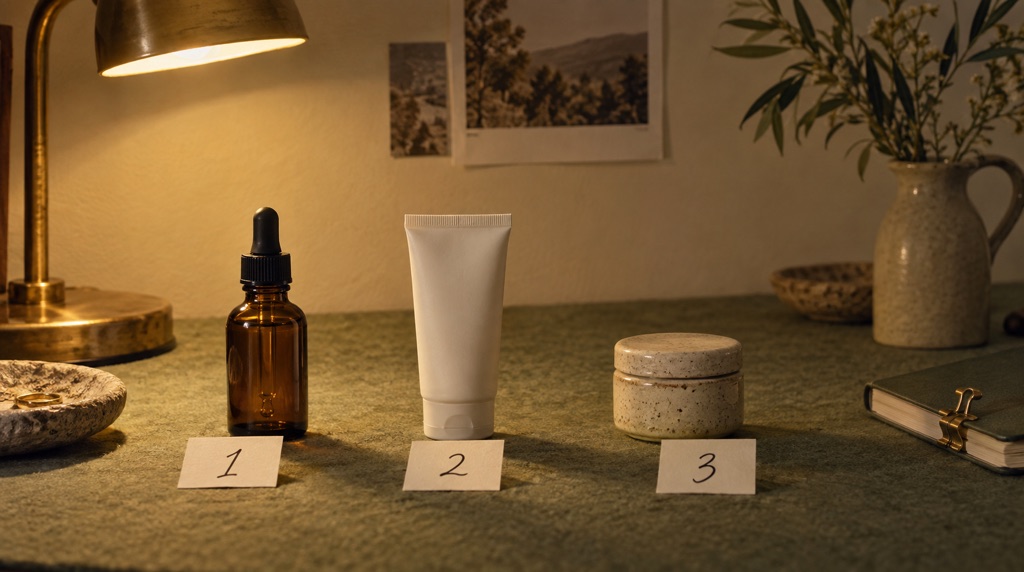
For a split example, a morning routine might keep your existing niacinamide-containing step, moisturiser as needed and sunscreen; the evening might include the azelaic product as directed. You do not need to copy this arrangement if your current routine is comfortable or your prescriber has advised something different.
Keep sunscreen instructions intact: the AAD recommends broad-spectrum, water-resistant SPF 30 or higher, with reapplication every two hours outdoors and after swimming or sweating. Product layering should accommodate that step. AAD: applying sunscreen.
For a broader ordering question, read our skincare layering guide. If you are using The Ordinary, its routine and compatibility guide is a better next stop than adding a third active because it appears on someone else’s shelf.
What if the combination stings, flakes or pills?
Treat discomfort and product rolling as different observations. DermNet notes that azelaic acid can cause stinging, burning or itching, particularly on sensitive skin, and advises stopping and seeking medical advice for severe irritation. Irritation is not a result you need to chase. DermNet: azelaic acid.
If your products form little rolls while you apply them, use our pilling troubleshooting guide. Keep a note of the step at which it starts. Our preference is to investigate one optional layer or pairing at a time rather than buying a replacement for every product.
Introduce one new product at a time and use its testing guidance before wider application. A home check cannot guarantee facial tolerance. If symptoms persist, recur or are severe, the NHS advises seeking medical assessment. Do not repeatedly retry a product that appears to trigger a rash just to complete a routine. DermNet: open application testing and its limits; NHS: contact dermatitis.

Common questions
Does combining them work better than using one?
Not necessarily for you. Compatibility does not prove extra benefit, and this guide does not establish that any two finished products outperform one. Start with a specific concern and a product you tolerate; let usefulness decide whether a second step earns its place.
Does niacinamide have to come first?
Check the textures and directions. A niacinamide serum before a thicker product is one example, but niacinamide may already be inside your moisturiser. Its ingredient name alone cannot determine where that moisturiser belongs.
Can I add retinol or exfoliating acids too?
Do not treat this pairing guide as approval for the rest of your shelf. Review every formula’s restrictions and any treatment plan before adding more. Our suggestion is to establish a manageable routine first, rather than introducing several optional actives together.
Your takeaway: using both is an option, not an obligation. Check the exact formulas, make one deliberate change and give comfort and consistency more weight than an elaborate schedule.
Sources and how we used them
Sources checked on 11 September 2026. Dermatology organisations provide general guidance; brand pages describe their own ingredients and directions. None reviewed or endorsed this article. Decision tables and examples are Glow Protocol editorial suggestions, not clinical protocols.
- The INKEY List: azelaic acid and niacinamide
- DermNet: azelaic acid
- The Ordinary: Azelaic Acid Suspension 10% directions
- DermNet: open application testing and its limits
- NHS: contact dermatitis
- AAD: applying sunscreen
Affiliate Disclosure: This post contains affiliate links, which means we may earn a small commission if you make a purchase through these links at no extra cost to you. We only recommend products we've researched and believe offer real value. Our opinions remain our own and are not influenced by any brand or compensation.