Created using AI; curated by Glow Protocol. AI tools support research, product comparisons and writing. Our recommendations are editorial selections. How we work.
Quick answer
Fragrance-free moisturising can help dryness alongside psoriasis treatment, but cosmetic skincare does not replace treatment of the condition itself. Choose tolerable care and avoid irritation. A budget routine is a purchasing example, not proof that every level of psoriasis responds to the same products.
Background guidance: AAD: non-prescription psoriasis care.
Updated : Opening answer clarified and its supporting references checked; jump navigation added. Check current price, size and seller on the retailer listing.
Affiliate Disclosure: This post contains Amazon affiliate links. If you purchase through our links, we earn a small commission at no extra cost to you. We only recommend products we have researched and believe in. This post is for informational purposes and should not replace professional medical advice. Always consult your dermatologist before starting new skincare or if your psoriasis worsens.
Psoriasis Skincare After 30: A Gentle, Evidence-Backed Guide That Will Not Wreck Your Routine
Most skincare advice for psoriasis assumes you are 19 and have nothing else going on. After 30, that advice falls apart. Your barrier is thinner. Your hormones are shifting. Your stress is higher. The same cream that worked through your twenties starts feeling abrasive, and the routines dermatologists give you have nothing to say about perimenopause or about the fact that you also want to address fine lines on the parts of your face that are not currently flaring.
This is the guide I wish someone had given the friends of mine who deal with this. It is built around three things. The specific ways psoriatic skin changes after 30 (so you know what you are actually working with). The cleansers, moisturisers, and occlusives that calm flares without breaking your barrier (with budget picks across the board, because nothing here needs to cost more than 25 dollars). And the honest line on what newer treatments like PEPITEM peptides can and cannot do yet, so you stop wasting money on cosmetic peptide serums hoping they will treat your plaques.
Nothing here is a substitute for medical care. If your psoriasis is severe or worsening, a dermatologist’s prescription routine (topical steroids, vitamin D analogs, sometimes biologics) does work that no over-the-counter product can. But about 70 percent of women managing mild to moderate psoriasis after 30 see meaningful improvement from a tight gentle routine alone. This guide is for that work.
What Actually Changes About Psoriasis After 30
Psoriasis is an autoimmune condition where your skin cells multiply too quickly, creating thick inflamed plaques. The condition itself does not change after 30, but the skin it is happening on does. Three things converge.
Hormonal shifts amplify flares. Between perimenopause (which can begin in the late thirties) and the hormonal fluctuations of stress and lifestyle, women over 30 often see real changes in psoriasis severity. Estrogen plays a regulatory role in immune function, so declining or fluctuating estrogen levels can intensify flares. Cortisol, your body’s stress hormone, directly activates the inflammatory pathways that drive psoriasis. Career stress, relationship changes, and family demands accumulate. So the same patches that used to flare twice a year now flare every two months.
Your barrier resilience declines. The outermost layer of your skin (lipids, ceramides, proteins) gradually loses structural integrity with age. Collagen and elastin production slow. The ability to retain moisture diminishes. For psoriasis-prone skin, this means an already compromised barrier becomes more vulnerable to irritation, water loss, and infection. Studies show psoriatic skin has roughly 10 times higher transepidermal water loss than healthy skin. After 30, that gap widens. This is why ceramides and humectants stop being optional.
Cumulative damage stacks up. Years of sun exposure, environmental stress, and previous psoriasis episodes leave your skin more sensitised and slower to heal. Products that worked at 25 can suddenly trigger irritation at 32. This is why a “less is more” philosophy (simple formulations, proven ingredients, fewer steps) works better after 30 than the kind of layered routine that may have worked in your twenties.

The Cleansers That Will Not Make Your Skin Worse
Cleansing is the foundation. Harsh cleansers strip your skin’s natural oils, exacerbate dryness, and trigger the inflammatory cascade that drives flares. The goal is to remove daily grime without disrupting barrier function. Look for cleansers that are sulfate-free, fragrance-free, low-pH, and formulated with skin-calming ingredients like ceramides or colloidal oatmeal. Use lukewarm water (never hot) and pat your skin dry rather than rubbing.
Cleanser · The Cheapest Serious Pick
Vanicream Gentle Facial Cleanser
Specifically designed for compromised skin barriers. Cleanses without stripping. Free of dyes, fragrance, and irritating cleansing agents. The absence of sulfates is the part that matters most for psoriasis-prone skin. At under 10 dollars, this is the most affordable cleanser dermatologists consistently recommend. Use it daily, including during flares.
View on Amazon →
Cleanser · The Ceramide Workhorse
CeraVe Hydrating Facial Cleanser
Formulated with the exact ceramide ratio found in healthy skin (1:1:1) plus hyaluronic acid and niacinamide. This cleanser hydrates while it cleanses, which is genuinely useful for psoriatic skin that needs both removal of dead skin buildup and moisture replenishment. The niacinamide adds quiet anti-inflammatory benefit. A perennial dermatologist recommendation for a reason.
View on Amazon →
Cleanser · The Thermal-Water Option
La Roche-Posay Toleriane Hydrating Gentle Cleanser
La Roche-Posay’s thermal water has been studied for its anti-inflammatory properties, which makes this cleanser particularly soothing during acute flares. The formula adds ceramide-3 and niacinamide. A step up in price, but worth it if Vanicream or CeraVe causes any residual irritation. Fragrance-free and clinically tested on reactive skin.
View on Amazon →
Moisturisers Psoriasis Skin Loves: Barrier Repair Is the Whole Game
If cleansing is the foundation, moisturising is the fortress. Psoriatic skin loses moisture rapidly, and your barrier needs three categories of ingredients working together. Ceramides seal moisture in. Humectants (hyaluronic acid, glycerin, urea) draw water into the skin. Occlusives (petrolatum, shea butter) create a protective layer that prevents water from escaping. The moisturisers below range from lightweight to occlusive. Pick lighter during stable periods and heavier during flares.
Daily Moisturiser · The Stable-Skin Pick
Vanicream Daily Facial Moisturizer
Lightweight without being thin. Layers beautifully under sunscreen and does not feel heavy on combination skin. Free of fragrance, dyes, and irritating additives. The right pick during stable periods when your psoriasis is calm and you want moisture without occlusion. Pairs with any SPF.
View on Amazon →
Active Flare · The Psoriasis-Specific Cream
CeraVe Moisturizing Cream for Psoriasis
The actual psoriasis-specific formula. 2 percent salicylic acid plus lactic acid provides gentle chemical exfoliation to soften and reduce scale buildup. Ceramides and urea restore barrier function and lock in moisture. Thick creamy texture provides a strong moisture seal without feeling greasy. Best used at night or during flares. See our ceramide moisturiser guide for more on the science.
View on Amazon →
Sensitive Skin · The Eczema-Overlap Pick
La Roche-Posay Lipikar Balm AP+
Formulated specifically for eczema and psoriasis-prone skin. Ceramides and niacinamide reduce inflammation while providing a strong moisture seal. Rich but absorbs relatively quickly, which makes it usable both morning and night. The thermal water adds calming benefit. The pick if you have eczema-psoriasis overlap or if your skin gets reactive on top of being flared.
View on Amazon →
Itch Relief · The Colloidal-Oatmeal Option
Cetaphil RESTORADERM Soothing Moisturizer
Allantoin is underrated in psoriasis skincare. It soothes irritation and promotes healing. Combined with colloidal oatmeal and ceramides, RESTORADERM is the right pick when your psoriasis flares with intense itching and redness. Dermatologist-tested and free of fragrance and dyes. The product to reach for on the worst itch days.
View on Amazon →
Severe Barrier Damage · The Heavy Pick
Bioderma Atoderm Intensive Balm
Premium feel without premium pricing. Combines occlusive shea butter with barrier-repair ceramides and soothing niacinamide. The right pick if your psoriasis is resistant to the standard ceramide creams above, or if you have additional aging concerns layered on top. The texture is genuinely lovely (rare in this category) which helps with the consistency you actually need.
View on Amazon →
The key ingredients to look for in any psoriasis moisturiser are ceramides, urea, colloidal oatmeal, and humectants like hyaluronic acid and glycerin. Each has clinical evidence specific to psoriatic skin. For a deeper dive on rebuilding a compromised barrier, see our complete barrier repair guide.
When Flares Strike: Occlusive Protection
During acute flares, your routine needs to pivot toward heavy occlusive protection. Ointments create an air-tight seal over psoriatic plaques, trapping moisture and creating an environment for healing. These are best used at night or directly on the worst patches. They can be layered over your usual moisturiser for compounded benefit.
Occlusive · The Ceramide-Petrolatum Hybrid
CeraVe Healing Ointment
An occlusive powerhouse that is significantly more elegant than pure petroleum jelly. Seals moisture into psoriatic plaques while the ceramide content continues supporting barrier repair. Apply over your moisturiser on affected areas before bed. The right pick if you want the seal of petrolatum without the texture penalty.
View on Amazon →
Occlusive · The Classic for a Reason
Aquaphor Healing Ointment
Simple, affordable, deeply occlusive. Panthenol (provitamin B5) adds mild soothing properties on top of the petrolatum. The go-to when you need maximum moisture seal without spending much. Dermatologists have recommended this for decades because nothing else this cheap works this well.
View on Amazon →
Transition Phase · The Mid-Weight Cream
Eucerin Advanced Repair Cream
Heavier than a typical moisturiser but lighter than a pure ointment, which makes it versatile. Lactic acid provides gentle exfoliating action to prevent scale buildup without harsh scrubbing. Ceramides and natural moisturising factors do the barrier work. Use this during transition phases. Moving out of a severe flare but not yet at stable baseline.
View on Amazon →
The Routine: AM and PM in Under 10 Minutes
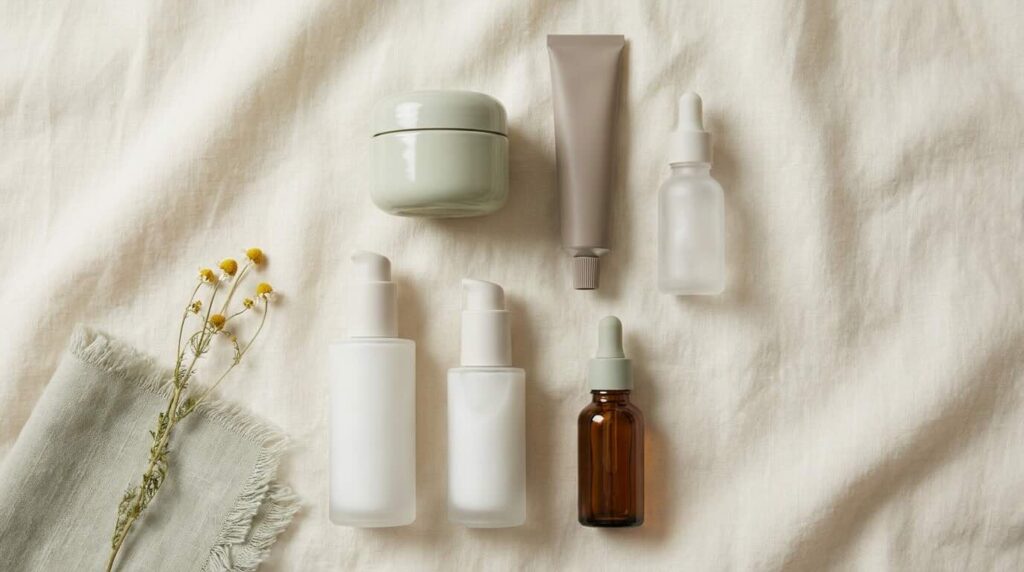
The secret to managing psoriasis after 30 is consistency, not complexity. Overloading your skin triggers flares. Here is the routine that actually works for most women.
Morning (5 minutes).
- Cleanse. Vanicream Gentle Facial Cleanser or CeraVe Hydrating Cleanser with lukewarm water. Removes overnight oil buildup and preps skin for the day.
- Moisturise. Apply Vanicream Daily Moisturizer (or your stable-skin moisturiser) while skin is still slightly damp. The damp application traps water into the skin.
- Protect exposed skin with suitable sunscreen and other sun-protective measures. Ask your clinician how this fits any prescribed light treatment. Do not interpret this routine as a psoriasis treatment. sunscreen guide
Evening (7 minutes).
- Cleanse. Same gentle, fragrance-free formula as morning.
- Pat dry, leave slightly damp. About 30 seconds of air-drying after patting.
- Richer moisturiser. Apply CeraVe Moisturizing Cream for Psoriasis, La Roche-Posay Lipikar, or Bioderma Atoderm. This is when you use the heavier formulations.
- Spot treatment (if flaring). Apply Aquaphor or CeraVe Healing Ointment directly to active patches. Let it sit for 5 to 10 minutes before bed.
Flare mode. During acute episodes, simplify further. Cleanse, apply heavy moisturiser, layer with ointment on patches. Skip anything that is not essential. Even niacinamide serums and “gentle” actives are usually too much during a flare.
Stable mode. When psoriasis is calm, you can introduce other skincare goals (gentle brightening, a peptide serum on non-plaque areas, etc.). Just maintain your core gentle routine underneath. See great skin after 30 for what to layer in carefully.
What to Avoid: Triggers That Make It Worse
Knowing what to eliminate is as important as knowing what to include. These ingredients and practices commonly trigger or worsen psoriasis.
Ingredients to skip.
- Sulfates. Sodium lauryl sulfate (SLS) and sodium laureth sulfate strip skin and disrupt the barrier. They are in most drugstore cleansers. Avoid entirely.
- Essential oils and fragrance. Lavender, tea tree, citrus oils, and even “natural” fragrances irritate psoriatic skin. Fragrance-free formulations only, including the ones marketed as “unscented” with masking fragrance.
- Alcohol denat. Drying alcohols evaporate moisture and trigger flares. Humectant-based formulations (glycerin, hyaluronic acid) are better.
- Strong actives during flares. Retinol, high-dose vitamin C, and high-dose niacinamide can irritate during active flares. Introduce slowly during stable periods only. See our 7 retinol mistakes guide if you want to add retinol carefully.
- Dyes and colourants. They serve no skincare function and commonly trigger reactions. Opt for fragrance-free, dye-free formulations.
Lifestyle triggers beyond skincare.
- Hot water. Hot showers and baths intensify psoriasis. Use lukewarm water and keep showers under 10 minutes.
- Chronic stress. Non-negotiable. Stress elevates cortisol, which amplifies psoriasis through direct immune pathway activation. Prioritise sleep, exercise, and the stress reduction tools that work for you.
- Sun exposure extremes. Moderate sun can help psoriasis. Excessive sun burns skin and triggers flares. Balance is real here.
- Smoking and alcohol. Both worsen psoriasis and accelerate skin aging. Cutting back or quitting genuinely improves outcomes.
- Dehydration. Drink water consistently. Dehydrated skin flares more easily.
What the Science Says About Peptides and Psoriasis
You may have heard that peptides are a cornerstone of anti-aging skincare. They are. But the relationship between peptides and psoriasis is more complex, and it is worth understanding if you are navigating both aging concerns and psoriatic skin.
Antimicrobial peptides (AMPs) and LL-37. Your skin naturally produces antimicrobial peptides as part of its immune defence system. One of the most studied is LL-37 (also called cathelicidin). In healthy skin, LL-37 defends against bacteria and supports wound healing. But in psoriatic skin, something goes wrong. LL-37 becomes dramatically overexpressed and overactive. Instead of just fighting bacteria, these overproduced peptides bind to the body’s own genetic material, essentially tricking the immune system into triggering severe inflammation. This is one of the core mechanisms behind psoriatic flares.
This is why applying general “peptide serums” to psoriatic plaques is not the same as using them on aging skin. The peptides in anti-aging products (signal peptides, copper peptides) work through completely different pathways than the antimicrobial peptides involved in psoriasis. They will not worsen your psoriasis, but they will not treat it either. See our peptides guide for what they actually do for the non-psoriatic parts of your skin.
PEPITEM: emerging research that is genuinely exciting. Recent clinical research from the University of Birmingham identified a small three-amino-acid peptide sequence derived from a molecule called PEPITEM. When applied topically via an emollient cream, this peptide was shown to regulate the movement of pro-inflammatory T-cells into the skin (essentially calming the immune overreaction that drives psoriasis). Early studies suggest this approach reduces psoriasis severity in a way that is comparable to standard steroid creams, potentially with fewer side effects.
This matters because long-term steroid use thins the skin and creates dependency. A real concern for women over 30 whose barrier is already becoming more fragile. PEPITEM-based treatments are not yet available in consumer skincare products. This is still in clinical research. But it represents a meaningful shift in how scientists think about treating psoriasis. Moving away from broad immunosuppression and toward targeted peptide therapy. Research worth watching.
The practical takeaway. Do not avoid peptide-containing moisturisers if you have psoriasis. They are fine for the non-psoriatic areas of your skin and for general anti-aging support. But do not expect anti-aging peptide serums to treat your plaques. The science is heading somewhere promising, but we are not there yet with over-the-counter products. Stick with ceramides, urea, colloidal oatmeal, and gentle exfoliants for psoriasis-specific care.
The Honest Bottom Line
Psoriasis after 30 requires patience and consistency, but it is entirely manageable with the right approach. The products in this guide are not miracle cures. Psoriasis is a systemic condition that sometimes requires medical intervention (topical corticosteroids, vitamin D analogs, biologics, or phototherapy). But a solid skincare routine prevents flares, accelerates healing, and supports whatever medical treatments you are using.
The core principles are simple. Cleanse gently. Moisturise heavily and often. Repair your barrier with ceramides and proven humectants. Protect against triggers. All the products featured here align with these principles and fit realistic budgets. You do not need a 10-step routine. You need consistency with products that work for your skin.
If your psoriasis worsens despite diligent skincare, or you develop new symptoms, consult your dermatologist. Skincare is foundational. Sometimes additional medical support is necessary, and that is genuinely okay.
Sources
Research context: these sources cover ingredients, skin biology or specific tested formulations. Results depend on the concentration, delivery method and population studied. Product selections are editorial curation; these references are not head-to-head tests of all products listed.
- Lande R, et al. (2007). Plasmacytoid dendritic cells sense self-DNA coupled with antimicrobial peptide. Nature. PubMed 17873860
- Nestle FO, et al. (2009). Psoriasis. N Engl J Med. PubMed 19641206
- Boehncke WH, Schön MP (2015). Psoriasis. Lancet. PubMed 26025581
- Greb JE, et al. (2016). Psoriasis. Nat Rev Dis Primers. PubMed 27883001
- Coderch L, et al. (2003). Ceramides and skin function. Am J Clin Dermatol. PubMed 12553851 Background on ceramide biology and skin function.
Additional reading: For more on related concerns and routine building, see our guides on skin barrier repair, the best ceramide moisturisers, the best sunscreens after 30, melasma management, and the 7 retinol mistakes to avoid.
Affiliate Disclosure: This post contains affiliate links, which means we may earn a small commission if you make a purchase through these links at no extra cost to you. We only recommend products we've researched and believe offer real value. Our opinions remain our own and are not influenced by any brand or compensation.