Created using AI; curated by Glow Protocol. AI tools support research, product comparisons and writing. Our recommendations are editorial selections. How we work.
Quick answer
Sun protection and a tolerated moisturiser are the starting point; collagen marketing does not mean you need five serums. Retinoids and cosmetic peptides have different evidence bases, and an ingredient study is not proof that every finished product rebuilds collagen. Choose an optional treatment for a specific concern.
Background guidance: AAD: choosing anti-ageing skincare · Review: topical peptide evidence.
Updated : Opening answer clarified and its supporting references checked; jump navigation added. Check current price, size and seller on the retailer listing.

Affiliate Disclosure: This post contains Amazon affiliate links. If you purchase through our links, we earn a small commission at no extra cost to you. We only recommend products we have researched and believe in.
Collagen Loss After 40: Ingredients, Evidence and Routine Options
Changes in firmness, texture and appearance can prompt questions about collagen after 40. This guide discusses the published evidence and its limits; it does not diagnose a particular change from a community anecdote.
The biology is well established. After age 30, women lose roughly 1 percent of dermal collagen per year. By 40, cumulative loss reaches 10 to 15 percent, which is the tipping point at which the change becomes visually obvious. The compounding is what makes 40 feel different from 35: you are no longer noticing the beginning of loss, you are seeing what a decade of it looks like on your face.
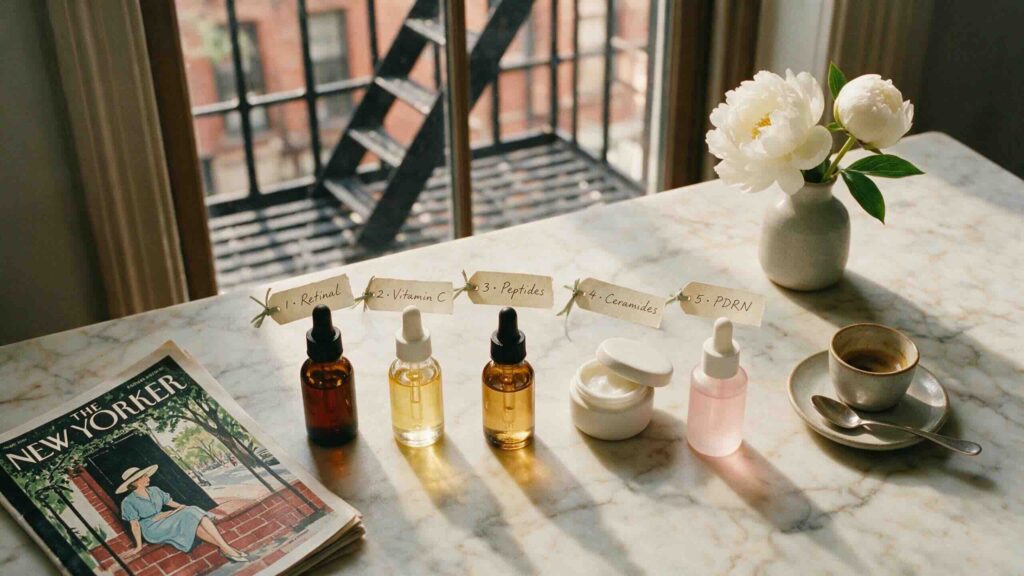
This guide compares five ingredient categories often discussed in collagen-focused skincare. Their roles and strength of evidence differ: moisturising support, cosmetic peptide research and PDRN wound-healing research are not equivalent proof of rebuilding facial collagen.
Why Collagen Loss Accelerates After 40
Fibroblasts, the specialised cells in the dermis that synthesise collagen, do not fail suddenly at 40. They slow gradually from 30 onward. What changes at 40 is that several parallel processes reach a critical mass at the same time.
Fibroblast activity declines. The cells are still there. They simply produce less collagen per cell, and the collagen they do produce is structurally slightly weaker than what a 25-year-old fibroblast produces.
Matrix metalloproteinases activate more aggressively. MMPs are enzymes that break down existing collagen. UV exposure, chronic low-grade inflammation, and oxidative stress all upregulate MMP activity. By 40, cumulative sun exposure has trained the skin toward higher baseline MMP output.
Glycation compounds the damage. Sugar molecules bind to collagen proteins in a process called glycation, creating advanced glycation end-products (AGEs) that stiffen collagen and reduce elasticity. This process is measurable from 30 onward and becomes visually apparent in the 40s.
Oestrogen decline drops the ceiling. For women approaching perimenopause, declining oestrogen removes one of the strongest natural collagen-supportive signals. Studies indicate women lose 30 percent of dermal collagen in the first five years after menopause. If you are 40+ and noticing an inflection, the hormonal contribution is often larger than the chronological contribution.
The ingredient categories below have different roles and evidence. Combining all five has not been established as a necessary or superior routine.
For the broader context on how these mechanisms interact with the hormonal shift, our perimenopause skincare after 40 guide walks through the oestrogen piece in more detail.
Ingredient #1: Retinoids (Retinal, Retinol, Tretinoin)
Retinoids are the single most studied topical anti-aging ingredient. They bind directly to retinoic acid receptors in fibroblasts and upregulate the genes responsible for collagen synthesis. They also inhibit MMP enzymes, giving you the dual benefit of increased production plus reduced breakdown. If you use one collagen ingredient after 40, this is the one.
The retinoid hierarchy for collagen loss
Potency scales from retinol esters (weakest) to retinol (moderate) to retinaldehyde (strong) to tretinoin (prescription, strongest). Each step up delivers faster collagen results but also more irritation. The strategic approach for 40+ skin is to start at retinol 0.3 to 0.5 percent, adapt over 8 to 12 weeks, then step up to retinaldehyde only if the skin has tolerated retinol well.
Retinaldehyde is one metabolic conversion step from retinoic acid, while retinol requires two. That does not by itself prove a fixed speed advantage or half the irritation for every finished formula.
Retinoid product picks
Retinoid · The Entry Point
The Ordinary Retinol 0.5% in Squalane
The standard first retinol for a reason. 0.5 percent is enough to stimulate collagen synthesis meaningfully without pushing most skin into irritation. Suspended in squalane, which supports the barrier while the retinol works. Start 1 to 2 nights per week, build to 2 to 3, then to alternate nights. Apply to completely dry skin, follow with moisturiser. Slight peeling in weeks 2 to 4 is normal. Collagen-dependent firmness changes appear from week 8. The pick for anyone beginning retinoid therapy after 40 or restarting after a break.
View on Amazon →
Premium Retinoid · The Retinaldehyde Upgrade
Medik8 Crystal Retinal 3
Retinaldehyde, one conversion step from tretinoin, encapsulated for stability and reduced irritation. Significantly stronger than retinol but gentler than prescription retinoids. Texture improvements appear in 2 to 3 weeks. Collagen-dependent firmness by week 6 to 8. The pick for women who have used retinol successfully for 3 months and want to step up without going prescription. Medik8 offers a graduated Crystal Retinal ladder (1, 3, 6, 10, 20) so you can climb it slowly over years.
View on Amazon →
Premium Retinoid · The Stabilised 1% Formula
Paula’s Choice Clinical 1% Retinol Treatment
1 percent retinol in a stabilised, airless-packaged formula. Retinol is notoriously unstable when exposed to air and light. Paula’s Choice uses airless packaging and chelating agents to keep it active for the full jar life. Because the concentration is double The Ordinary’s, results appear faster (texture at 3 weeks, firmness at 8). Start 1 night per week if new to retinoids, or 2 to 3 nights if already adapted. The pick for anyone who wants high-strength retinol without moving to retinaldehyde or prescription tretinoin.
View on Amazon →
Non-negotiable retinoid protocol: retinoids are photosensitising. Night use only. Daytime SPF 30 or higher (50+ is better after 40). UV damage upregulates the exact MMPs the retinoid is trying to suppress, which is why the sunscreen half of the equation matters as much as the retinoid half.

Ingredient #2: Peptides (Signal, Copper, and Enzyme-Inhibitor)
Peptides are short chains of amino acids that signal skin cells. The signal peptides used in collagen-focused formulas mimic the fragments produced when collagen is damaged. When a fibroblast recognises those fragments, it interprets the signal as “collagen needs repair” and increases synthesis. In effect, peptides trick older fibroblasts into behaving like younger cells.
Not all peptides do the same job
- Signal peptides, including palmitoyl pentapeptide-4, have been studied in particular cosmetic formulations.
- Copper peptides are commonly described as carrier peptides. Their research includes laboratory and wound-healing work.
- A multi-peptide label does not establish that the formula covers every repair mechanism or is superior to a simpler product.
Peptide categories describe different proposed functions. They do not establish that layering multiple peptide types is better than using one well-formulated product. See copper peptides vs signal peptides guide, best peptide serums ranked.
Peptide product picks
Peptides · The Best-Value Multi-Peptide
The Ordinary Buffet + Copper Peptides 1%
A multi-peptide and copper-peptide option. Check its current compatibility instructions and keep it separate from retinoids, direct vitamin C and acids as directed. This guide does not establish an eight-to-twelve-week community outcome.
View on Amazon →
Premium Peptides · The Research-Backed Booster
Paula’s Choice Peptide Booster
A higher-concentration signal peptide complex with soothing botanicals and antioxidants. Every peptide in the formula has published research supporting its role in collagen synthesis. Results typically appear at week 6 to 8 rather than 10 to 12. The soothing base makes it a suitable choice for reactive or combination skin that struggles with plainer peptide serums. The pick for anyone wanting the peptide category done properly.
View on Amazon →
Premium Peptides · The Cream Format
Drunk Elephant Protini Polypeptide Cream
A peptide-rich moisturiser rather than a serum, which means it replaces your standard cream instead of adding a step. Combines a proprietary peptide blend with ceramides and squalane for simultaneous collagen signalling and barrier support. Skin feels deeply hydrated within days. Peptide-driven firmness follows over 8 to 12 weeks. The pick for mature skin that is dry or dehydrated and wants one product doing two jobs.
View on Amazon →
The peptide reality check: consistency is what makes peptides work. Fibroblasts need repeated signalling over 8 weeks before synthesis meaningfully increases. Two weeks on then dropping the serum will not produce results. Peptides are a daily practice, not a treatment course.
Ingredient #3: Vitamin C (L-Ascorbic Acid, 10 to 20 Percent)
Vitamin C plays a different role in the collagen story. It does not stimulate new collagen the way retinoids do, and it does not signal fibroblasts the way peptides do. What it does is stabilise the collagen you make.
L-ascorbic acid is a required cofactor for prolyl hydroxylase and lysyl hydroxylase, two enzymes essential for the cross-linking process that gives collagen its structural stability. Without adequate vitamin C, synthesised collagen remains structurally weak. Vitamin C is also a potent antioxidant, neutralising the free radicals that otherwise trigger MMP activity and accelerate collagen breakdown. Retinoids and peptides can stimulate all the synthesis they want, but if oxidative stress is high, the environment is working against them.
What makes a vitamin C serum work
- Concentration. 10 to 20 percent L-ascorbic acid is the effective range. Below 10 percent, antioxidant benefit is minimal. Above 20 percent, penetration plateaus without added benefit.
- pH. L-ascorbic acid requires acidic pH (3.5 or lower) to penetrate the stratum corneum. Neutral-pH vitamin C sits on the surface.
- Stabilisation. Vitamin C oxidises rapidly. Opaque or amber packaging is required. Refrigeration after opening extends shelf life. A serum that has turned dark orange or brown has already degraded.
Vitamin C product picks
Vitamin C · The Best-Value Formula
Timeless 20% Vitamin C + E + Ferulic Serum
The most budget-friendly serum that mirrors the SkinCeuticals formula: 20 percent L-ascorbic acid, vitamin E, ferulic acid, correct pH. No filler ingredients that dilute efficacy. Brightening becomes visible within days. Over 4 to 6 weeks, texture smooths and dark spots fade. Slight tingling on application is normal for acidic vitamin C. Apply in the morning to clean dry skin before sunscreen. The pick for anyone starting vitamin C, or for stacking with retinoids and peptides without a premium price tag.
View on Amazon →
Premium Vitamin C · The Clinical Gold Standard
SkinCeuticals C E Ferulic Serum
The patented combination of 15 percent L-ascorbic acid, vitamin E, and ferulic acid that established the entire category. Decades of clinical research demonstrating collagen support and photoprotective effect. Stabilisation is exceptional. pH is precisely calibrated. Brightening appears within 3 to 5 days, and cumulative firmness and even tone follow over 8 to 12 weeks. The pick for anyone who has used vitamin C successfully and wants the reference formulation, particularly when combined with retinoids for the full anti-aging stack.
View on Amazon →
Ingredient #4: PDRN (Polydeoxyribonucleotide)
PDRN research includes nucleotide salvage and adenosine A2A signalling in wound healing and other studied settings. That evidence should not be presented as proof that an over-the-counter serum supplies cellular repair materials effectively through intact skin.
What PDRN Research Can and Cannot Show
- Experimental findings. Fibroblast effects in a laboratory do not establish increased facial collagen from a cosmetic serum.
- Research setting. Growth-factor findings must be matched to the preparation, route and tissue studied.
- Therapeutic versus cosmetic use. Anti-inflammatory findings from wound-healing research do not establish treatment of a skin condition with a beauty serum.
- Age and product choice. The evidence does not establish that age alone makes a PDRN cosmetic necessary or predicts its benefit.
A PDRN cosmetic is not universally compatible or irritation-free. Check the complete formula and instructions before adding it to a routine with retinoids or vitamin C. See best peptide serums ranked.
PDRN product picks
PDRN · The Accessible Entry Point
Medicube PDRN Pink Peptide Serum
An optional PDRN cosmetic serum. Check the current formula and directions; the research discussed here does not establish a fixed firmness timetable or clinical equivalence to a therapeutic preparation.
View on Amazon →
Companion Moisturiser · The Cream Format
Medicube Collagen Jelly Cream
A companion moisturiser, not verified here as containing PDRN. The Collagen Jelly Cream and Medicube products explicitly named PDRN are distinct products. Check the current ingredient list and choose by texture and tolerance.
View on Amazon →
The PDRN evidence cited in our linked guide includes experimental, wound-healing and injectable applications. It does not establish that cosmetic serums rebuild facial collagen or that combining PDRN with peptides is superior.
Ingredient #5: Ceramides (The Barrier Foundation)
Ceramides are the ingredient most often skipped in a collagen conversation, and it is the omission that most frequently sabotages the results of the other four. Here is the mechanism: a compromised barrier drives chronic low-grade inflammation. Chronic inflammation upregulates MMP activity. MMP activity breaks down collagen. Layering four active ingredients on top of an inflamed, barrier-compromised face means you are stimulating collagen synthesis with one hand while accelerating breakdown with the other.
What barrier support looks like
- Ceramides. The lipid molecules that hold the barrier together. CeraVe, La Roche-Posay Toleriane, and SkinCeuticals Triple Lipid Restore all deliver ceramides in effective ratios.
- Niacinamide. Supports the skin’s own ceramide production and reduces inflammation. Many peptide serums already include it. If yours does not, a standalone 5 percent niacinamide serum adds it cheaply.
- Hyaluronic acid. Foundational for hydration, which is prerequisite for barrier function.
- Squalane or plant oils. Mimic the skin’s natural sebum and support the lipid layer of the barrier.
The good news: several of the products already in this guide double as barrier support. Drunk Elephant’s Protini Cream contains ceramides. Paula’s Choice Peptide Booster contains soothing antioxidants. The Ordinary’s retinol in squalane uses squalane as the delivery base for barrier reasons. If you cannot add a fifth product to your routine, ensure at least one of the four already in your stack is doing barrier work.
For the full framework on how barrier health drives the results of every collagen ingredient above it, our skincare routine after 40 guide walks through the layering sequence in detail.
The Collagen Layering Framework
The routine discussion below is an editorial framework. Check compatibility and directions for the exact products; combining five categories is not a requirement or a guarantee against irritation.
Morning
- Gentle cleanser.
- Optional vitamin C serum, following its label. A universal five-to-ten-minute waiting period is not required.
- Hydrating essence or toner if desired.
- Optional peptide product only if compatible with the morning routine; keep The Ordinary copper peptide serum separate from vitamin C.
- Ceramide-rich moisturiser if the peptide product is a serum.
- Broad-spectrum SPF 50+. Non-negotiable.
Evening (retinoid nights: 2 to 3 per week)
- Gentle cleanser or double cleanse if wearing makeup or SPF.
- Wait until skin is fully dry.
- Retinoid (Retinol 0.5%, Crystal Retinal 3, or Clinical 1% Retinol).
- Ceramide-rich moisturiser to buffer.
Evening (non-retinoid nights: 4 to 5 per week)
- Gentle cleanser.
- Hydrating essence or toner.
- PDRN serum (Medicube Pink Peptide) on damp skin.
- Optional copper peptide serum on a separate evening without retinoids, direct vitamin C or acids; extra PDRN or peptide layers are not required.
- Ceramide-rich moisturiser.
A simple schedule is vitamin C in the morning, if tolerated, and a suitable retinoid on selected evenings. Keep The Ordinary copper peptide serum for separate evenings without retinoids, direct vitamin C or acids. A basic moisturiser can be used throughout.
Realistic Timeline for Collagen Results
- Weeks 1 to 2: Hydration improves. Skin feels smoother. Mild brightening from vitamin C.
- Weeks 3 to 4: Texture continues to improve. Fine lines look subtly softer from hydration and initial retinoid turnover. Slight peeling is normal.
- Weeks 6 to 8: Collagen-dependent changes begin to appear. Firmness increases incrementally. Fine lines are noticeably softer. Tone evens (vitamin C effect).
- Week 12+: Cumulative effects compound. Firmness improvements become obvious to you and often to others. Wrinkles that felt fixed are visibly softer.
- Month 6+: Continued improvement, with results plateauing somewhat after 16 weeks. What you have rebuilt at that point is what topical treatment can rebuild.
These timelines assume consistent use. Sporadic application will not produce the results above. Collagen rebuilding is compounding. Miss a week and you do not lose the compound. Miss a month and you reset the timeline.
The Bottom Line
A useful routine can contain fewer than five ingredient categories. Prioritise tolerance and sun protection; added complexity is not proof of better collagen results.
Add one optional product at a time. If using the listed copper peptide serum, separate it from vitamin C and retinoids according to its label. PDRN is optional, and a moisturiser belongs in the basic routine from the start. See The Ordinary Retinol 0.5% in Squalane, Buffet + Copper Peptides, Timeless 20% Vitamin C E Ferulic, Medicube PDRN Pink Peptide Serum.
Compatibility note: Compatibility depends on the actual formulas. Follow both product labels; there is no universal rule that peptides must go before or after vitamin C. The Ordinary Multi-Peptide + Copper Peptides 1% (formerly Buffet + Copper Peptides 1%) should be kept separate from vitamin C, direct acids and retinoids according to its manufacturer. Use vitamin C in the morning and that peptide serum in a separate evening routine; use retinoids on different evenings. A waiting period or weeks of tolerance do not override product instructions. Official product instructions (checked 5 September 2026).
Sources
Research context: These sources cover ingredients, skin biology or specific tested treatments. Results depend on the formulation, delivery method and population studied. Product selections are editorial curation; these references are not head-to-head tests of the products listed.
- Varani J, et al. (2006). Decreased collagen production in chronologically aged skin: roles of age-dependent alteration in fibroblast function and defective mechanical stimulation. Am J Pathol. PubMed 16723701
- Fisher GJ, et al. (1997). Pathophysiology of premature skin aging induced by ultraviolet light. N Engl J Med. PubMed 9358139
- Quan T, Fisher GJ (2015). Role of Age-Associated Alterations of the Dermal Extracellular Matrix Microenvironment in Human Skin Aging: A Mini-Review. Gerontology. PubMed 25660807
- Brincat MP, et al. (2005). Estrogens and the skin. Climacteric. PubMed 16096167
- Mukherjee S, et al. (2006). Retinoids in the treatment of skin aging: an overview of clinical efficacy and safety. Clin Interv Aging. PubMed 18046911 Review distinguishing retinoids, formulations and tolerability.
- Schagen SK (2017). Topical Peptide Treatments with Effective Anti-Aging Results. Cosmetics. Read source Review of selected peptides; not every marketed serum.
Additional reading: anti-aging ingredients after 40, best peptide serums ranked, copper peptides vs signal peptides, skincare routine after 40, and perimenopause skincare after 40.
Affiliate Disclosure: This post contains affiliate links, which means we may earn a small commission if you make a purchase through these links at no extra cost to you. We only recommend products we've researched and believe offer real value. Our opinions remain our own and are not influenced by any brand or compensation.