Created using AI; curated by Glow Protocol. AI tools support research, product comparisons and writing. Our recommendations are editorial selections. How we work.
Quick answer
PDRN is an optional cosmetic ingredient, not an essential step after 40. Evidence from injections, wound care or laboratory research cannot automatically establish what a topical serum does on intact skin. This guide does not prove PDRN outperforms peptides or that combining them produces better results.
Background guidance: Review: polynucleotides in aesthetic medicine.
Updated : Opening answer clarified and its supporting references checked; jump navigation added. Check current price, size and seller on the retailer listing.

Affiliate Disclosure: This post contains Amazon affiliate links. If you purchase through our links, we earn a small commission at no extra cost to you. We only recommend products we have researched and believe in.
PDRN Skincare for Women 30+ and 40+: What Salmon DNA Actually Does
PDRN has become a prominent skincare ingredient, with a research background in wound healing and tissue regeneration. The important distinction is how it is used: findings from injections, damaged tissue or laboratory experiments do not automatically apply to a serum on intact skin.
We are not exaggerating when we call 2026 the year of PDRN. Major beauty conglomerates have quietly invested in PDRN formulations. K-beauty brands, which historically lead global beauty trends by 18 to 24 months, have already integrated PDRN into multiple product lines. Medical aesthetics clinics are incorporating salmon DNA derivatives into professional treatments. What was once a niche, medicinal-grade ingredient used primarily in post-procedure care has become accessible in over-the-counter serums, creams, and at-home device formulations.
This guide looks at what the published evidence can tell us about PDRN and where the uncertainties remain. The product list is editorial curation, including optional companion products; it is not a ranking based on head-to-head clinical trials.
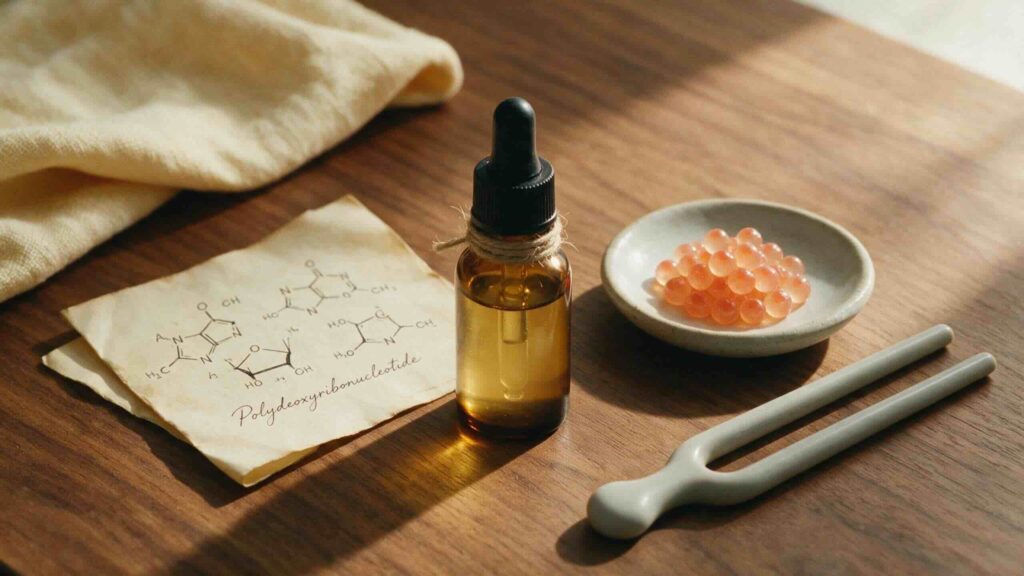
What PDRN Actually Is (Polydeoxyribonucleotide Explained)
PDRN stands for polydeoxyribonucleotide, a naturally occurring nucleotide polymer derived from salmon DNA. If that sounds intimidating, the simplified version is this: it is a chain of building blocks your cells normally produce themselves, extracted from salmon and standardised into a form that can be applied topically or injected for therapeutic purposes.
Salmon-derived DNA fragments are processed ingredients. Their origin does not establish that every formula is allergy-free or suitable for every person. Check the ingredient list and product instructions, especially if you have relevant allergies.
PDRN has been used in two contexts historically. First, in regenerative medicine and plastic surgery, administered as injections to accelerate tissue repair, reduce inflammation, and improve surgical outcomes. Second, in Asian medical aesthetics, particularly Korea and Japan, where pharmaceutical-grade PDRN serums emerged as professional skincare products available through dermatologists and clinics. It was not until the early 2020s that PDRN began appearing in mainstream consumer beauty products in Western markets.
PDRN vs PN: what the labels actually mean
You may see “PN” listed on ingredient labels, which stands for polynucleotides, a broader category that includes PDRN. Some brands use polynucleotides generically, while others specifically identify PDRN. For this guide we are focusing on PDRN specifically because it has the most published research and clinical evidence. When evaluating a product claiming to contain polynucleotides, check the INCI list to see if PDRN is specifically identified.
Concentrations and ingredient descriptions vary between products. Check the current label rather than assuming a standard percentage or comparing an injectable dose directly with a cosmetic serum.
How PDRN Differs From Peptides
PDRN and peptides are different ingredient categories. Comparing their biological mechanisms can be useful, but it does not establish which finished cosmetic will work better. See peptides for anti-aging.
Peptides are signalling molecules
Peptides are short chains of amino acids. When applied topically, their primary function is signalling. They send messages to skin cells that essentially say “produce more collagen” or “strengthen your barrier.” Popular peptide examples include copper peptides, signal peptides, and hexapeptides. We have discussed this in our copper vs signal peptides comparison if you want the deeper detail.
Peptides work slowly. Results typically require 4 to 12 weeks of consistent use because they are telling your cells to initiate long-term changes. They are also ingredient-dependent. Not all peptides do the same thing, and efficacy profiles vary widely.
PDRN is a substrate and repair fuel
PDRN research describes effects involving adenosine A2A signalling and nucleotide salvage pathways. These mechanisms have been investigated in wound-healing and experimental settings; a topical cosmetic must still deliver its ingredients effectively to produce a measurable benefit.
The sources checked here do not establish that PDRN cosmetics act faster than peptide cosmetics. Hydration and texture changes can also come from the rest of a serum formula.
Can you use both?
A formula may contain PDRN and peptides together. Adding two separate products is optional, and clinical superiority over either product alone has not been established by the studies cited here.
The Science of How PDRN Works on Skin
The most useful way to read PDRN research is to check the route of administration, condition studied and outcome measured before applying its conclusions to skincare.
Cellular nucleotide depletion and aging
Ageing affects many repair processes, but the checked sources do not substantiate the earlier claim that skin nucleotide synthesis falls by 15–20% per decade after 30. That figure should not guide a purchase.
Nucleotide salvage is one proposed explanation for PDRN activity in studied settings. It is a research mechanism, not proof that a cosmetic serum repairs cellular DNA in ordinary use.
Fibroblast activation
Some experimental studies describe fibroblast-related effects. Laboratory cell proliferation does not establish that a branded serum increases facial collagen or produces a particular wrinkle reduction.
Anti-inflammatory signalling
Anti-inflammatory effects have been reported in experimental and therapeutic PDRN research. Whether a cosmetic helps reactive skin depends on the whole formula; PDRN does not make a product irritation-free.
Wound healing and barrier repair
Much of the literature concerns wounds, therapeutic administration or injections. A 2025 systematic review of aesthetic polynucleotide injections included nine studies of low or moderate quality. These findings do not establish equivalent results from over-the-counter serums.
For everyday barrier care, a tolerated moisturiser remains the starting point. Do not use a cosmetic PDRN product to treat an open wound or replace aftercare prescribed following a procedure. See skin barrier repair.
Best PDRN Products Ranked
The selections below include a PDRN serum and separate hydration, peptide and device options. Companion products are not automatically PDRN products, and the cited research does not validate every listing.
PDRN · The Best-Value Entry Point
Medicube PDRN Pink Peptide Serum
A PDRN cosmetic option to consider by its current ingredient list, texture and instructions. The research cited here does not establish clinical equivalence to injections or superiority over other serums.
View on Amazon →
Companion Product · Check the Exact Reedle Shot Formula
VT Cica Reedle Shot 100 Essence
A separate companion product, not verified here as containing PDRN. Check the exact version and directions. Do not treat a tingling or spicule-containing cosmetic as routine aftercare for reactive or recently treated skin.
View on Amazon →
Companion Moisturiser · Collagen Jelly Cream
Medicube Collagen Jelly Cream
A companion moisturiser. The Collagen Jelly Cream and Medicube products explicitly named PDRN are distinct products; do not assume this listing contains PDRN. Check the current label.
View on Amazon →
Companion Hydration · Snail Mucin Essence
COSRX Advanced Snail 96 Mucin Essence
A snail secretion filtrate essence offered as an optional hydration step. It is not a PDRN product, and added synergy with a PDRN serum has not been established by the cited studies.
View on Amazon →
Peptide Companion · The Multi-Peptide Layer
The Ordinary Buffet + Copper Peptides 1%
Not PDRN specifically but an excellent multi-peptide formula that complements PDRN beautifully. Includes copper peptides combined with amino acids and additional peptides. As we discussed in our copper peptides comparison, this concentration of copper provides solid benefits without excessive metallic minerals. The pick for layering under or after PDRN serums to provide peptide signalling support.
View on Amazon →
Peptide Companion · The Comprehensive Signalling Formula
Augustinus Bader Multipeptide Advanced Serum
Combines multiple distinct peptide types (signal peptides, neurotransmitter-mimetic peptides, and enzyme-promoting peptides) in an elegant, minimalist formula. Excellent value for a professional-grade peptide serum. Designed to work with the skin’s natural repair mechanisms, complementary to PDRN. The pick for comprehensive peptide signalling support at reasonable cost, or as a base to layer PDRN under.
View on Amazon →
Peptide Companion · Verify the Exact Formula
Peptide Booster
A peptide companion listing. Verify the brand and exact formula on the destination page before buying; the references here do not establish this as an Olaplex product or a PDRN treatment.
View on Amazon →
Device · The At-Home Amplifier
Medicube Age R Booster Pro Device
An optional device with different modes and usage instructions. Follow the current manufacturer manual for each mode; general PDRN or light-therapy research does not establish that using this device with a serum improves its results.
View on Amazon →
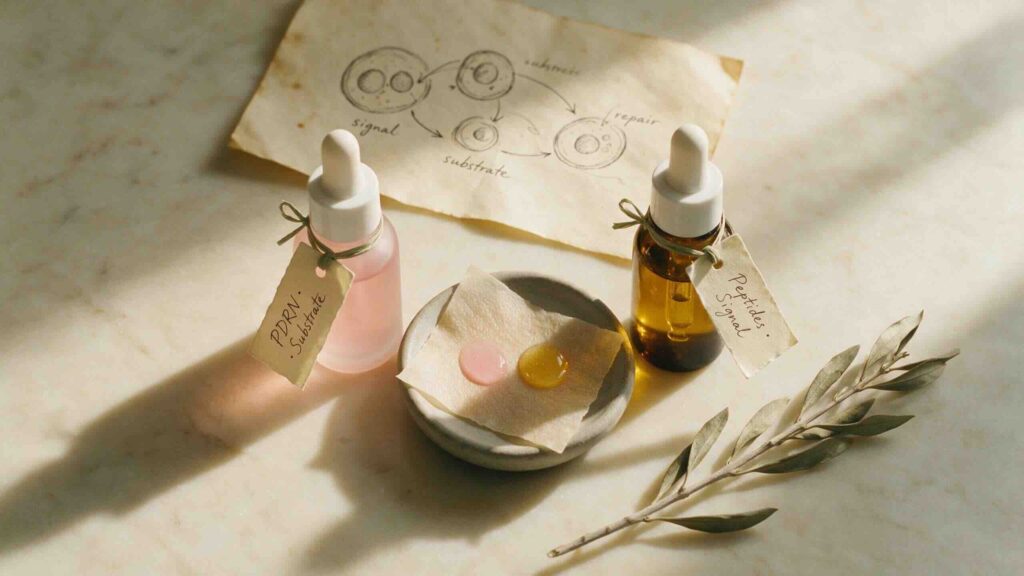
PDRN + Peptides: The Layering Framework
The idea of combining PDRN and peptides is biologically interesting, but that is different from evidence of superior cosmetic results. One well-tolerated product may be enough.
Think of the published mechanisms as reasons for further research. They are not a demonstration that buying both categories produces more collagen or improves recovery.
A practical, optional routine:
- Cleanser and toner as normal.
- Optional hydrating product, if needed and tolerated.
- Apply the PDRN cosmetic according to its label.
- A separate peptide serum is optional; check compatibility first.
- Moisturiser and SPF in the morning, or additional treatments in the evening.
Layer according to the product instructions and texture. There is no established highest-molecular-weight-first rule, nor a universal requirement to apply PDRN to damp skin.
Compatibility with other actives
Compatibility is a property of the finished formulas. Check each label before combining PDRN cosmetics with retinoids, vitamin C or exfoliating acids. Introduce one change at a time and stop a product that causes persistent irritation.
There is no universal pH or waiting-time rule for all PDRN cosmetics. Follow any manufacturer restriction. After a procedure, use only products approved by the treating clinician.
Is PDRN Worth the Hype? The Age-Based Honest Assessment
Every trending ingredient is touted as revolutionary. So is PDRN actually worth attention, or another trend destined for obscurity?
What to assess if you try a PDRN cosmetic:
- Texture: note any change without assuming it proves collagen regeneration.
- Hydration: assess comfort, softness and dryness.
- Tolerance: pause if stinging, redness or irritation persists.
- Procedure aftercare: follow the treating clinician’s directions.
- Firmness: do not assume an injection-study outcome will occur with a serum.
What PDRN does not do. PDRN is not a retinol replacement. It will not dramatically reduce deep wrinkles or provide the cellular turnover acceleration of actual retinoids. It is not an instant fix. If you are hoping for visible results within days, you will be disappointed. It is a supportive, foundational ingredient that works best over time and in combination with other strategies. PDRN is also not appropriate as monotherapy for active acne, severe sun damage, or advanced photoaging. It is a maintenance and improvement ingredient, not a rescue option.
Value proposition by age
Ages 30 to 40: PDRN is optional. Prioritise a comfortable basic routine and sun protection.
Ages 40 to 50: Consider your actual concern and the evidence for the complete product. Age alone does not make PDRN necessary.
Ages 50+: The cited research does not establish a special age threshold for benefit. Discuss procedure aftercare with the treating clinician.
How to Add PDRN to Your Routine (Realistic Timeline)
PDRN is gentle but your skin still needs an adjustment period. Start with 3 to 4 applications per week for the first two weeks, gradually moving to daily use if desired. This applies whether you are using a standalone PDRN serum or a combination product. There is no benefit to forcing daily use immediately. Consistency over time matters more than intensity.
Realistic timeline for results:
- Early use: assess tolerance before adding other products.
- Over the following weeks: observe hydration and texture under similar conditions.
- Later review: assess whether the product adds enough benefit to justify its cost.
- If concerns persist: seek advice rather than repeatedly adding actives.
There is no validated rule for extending a results timeline by 50% when use is less frequent. Follow the label and judge comfort and visible changes without treating a calendar as a guarantee.
The Bottom Line
PDRN is an interesting area of research, but evidence for cosmetic serums remains more limited than marketing often suggests. A product can be a pleasant moisturising addition without being proven to regenerate skin.
If you want to try the listed Medicube PDRN serum, start with that single addition. Snail mucin or a separate moisturiser is optional. The Collagen Jelly Cream is a companion moisturiser here, not verified as a PDRN treatment. See Medicube PDRN Pink Peptide Serum, COSRX snail mucin essence, Medicube Collagen Jelly Cream.
Sources
Research context: These sources cover ingredients, skin biology or specific tested treatments. Results depend on the formulation, delivery method and population studied. Product selections are editorial curation; these references are not head-to-head tests of the products listed.
- Colangelo MT, et al. (2020). The effects of polydeoxyribonucleotide on wound healing and tissue regeneration: a systematic review of the literature. Regen Med. PubMed 32757710 Includes laboratory, animal and clinical wound-healing evidence; does not establish results for cosmetic PDRN serums.
- Lampridou S, et al. (2025). The Effectiveness of Polynucleotides in Esthetic Medicine: A Systematic Review. J Cosmet Dermatol. PubMed 39645667 Nine studies of low or moderate quality, involving injections; not topical serum evidence.
- Galeano M, et al. (2021). Polydeoxyribonucleotide: A Promising Biological Platform to Accelerate Impaired Skin Wound Healing. Pharmaceuticals (Basel). PubMed 34832885 Review of wound-healing applications using different routes; not proof of a branded facial serum.
Additional reading: peptides for anti-aging complete guide, best peptide serums ranked, copper vs signal peptides, best K-beauty anti-aging products, skin barrier repair, and collagen loss after 40.
Affiliate Disclosure: This post contains affiliate links, which means we may earn a small commission if you make a purchase through these links at no extra cost to you. We only recommend products we've researched and believe offer real value. Our opinions remain our own and are not influenced by any brand or compensation.