Created using AI; curated by Glow Protocol. AI tools support research, product comparisons and writing. Our recommendations are editorial selections. How we work.
Quick answer
There is no universal waiting time that makes every vitamin C and peptide combination compatible. Follow the exact product instructions. For The Ordinary Multi-Peptide + Copper Peptides 1%, separate vitamin C and copper peptides into different routines; a short pause between layers does not override the manufacturer’s restrictions.
Background guidance: The Ordinary: copper-peptide directions.
Updated : Opening answer clarified and its supporting references checked; jump navigation added. Check current price, size and seller on the retailer listing.

Affiliate Disclosure: This post contains Amazon affiliate links. If you purchase through our links, we earn a small commission at no extra cost to you. We only recommend products we have researched and believe in.
Vitamin C and Peptides Layering for Women 30+: The Order That Works
Vitamin C and peptides are common options in a routine for visible signs of ageing. Vitamin C supports normal collagen formation and can help with uneven tone. Some topical peptide formulations have shown benefits for the appearance of fine lines, although the evidence varies by peptide and finished formula.
The first question is whether your particular products are compatible. There is no single application order or waiting time that makes every vitamin C and peptide combination work. Check the instructions on both products before deciding whether to layer them or use them at different times of day.
This is the layering framework we use inside Glow Protocol: which goes first, how long to wait, how the AM and PM routines differ, and which specific products layer well together without pilling or destabilising. If you want the standalone breakdown of each ingredient before you dive in, see our vitamin C serum guide and our best peptide serums ranked.
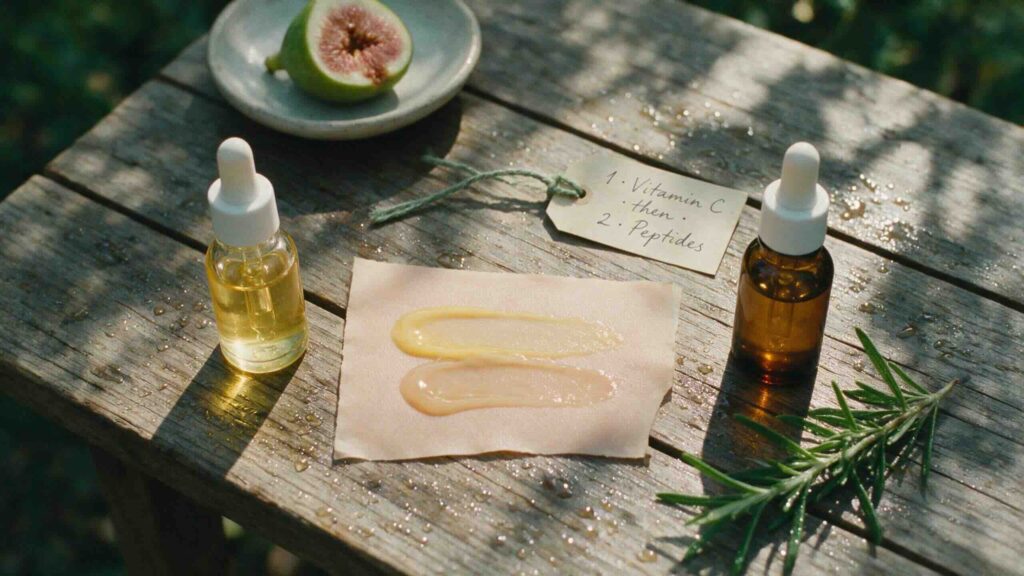
How Vitamin C and Peptides Work Together
Vitamin C and peptides have different roles in skincare. That gives a reason to consider both, but it does not prove that any two bottles will be compatible or more effective together.
Vitamin C: antioxidant, brightener, collagen stabiliser
Vitamin C is an antioxidant and a cofactor in collagen synthesis. Topical studies have reported improvements in some signs of photodamage and uneven pigmentation, but the result depends on the formulation, concentration and delivery to the skin. Ingredient research cannot predict the outcome from every vitamin C serum.
Stability depends on the whole formulation, packaging and storage. Vitamin E and ferulic acid can improve the stability and photoprotective performance of particular vitamin C formulas; they are not mandatory ingredients in every effective vitamin C product. Follow the product’s storage and expiry instructions.
Peptides: collagen and elastin production
Peptides are short chains of amino acids. The two main categories in anti-aging skincare are copper peptides (GHK-Cu) which actively participate in tissue repair, and signal peptides (like Matrixyl) which tell fibroblasts to increase collagen and elastin output. We break down the differences in our copper peptides vs signal peptides comparison.
Laboratory findings and small clinical studies suggest that certain peptides may support changes relevant to skin appearance. Evidence for a named peptide should not be treated as proof that every serum containing it rebuilds collagen or produces a visible result within a fixed number of weeks.
What the combination evidence can tell us
Using both ingredients can be a reasonable preference, but the sources below do not establish a universal added benefit from layering a separate vitamin C serum with a peptide serum. Compatibility and tolerability come before adding another step.
How to Use Vitamin C and Peptides in Your Routine
Follow product instructions first. For products that are compatible, texture can help guide a practical order: lighter serums usually go before richer creams. This is a usability guide, not proof that one sequence guarantees better absorption.
AM routine (the full sequence)
Step 1: Cleanser. Start with clean skin. A gentle, pH-balanced cleanser removes overnight oil and surface debris.
Step 2: Toner or essence (optional). If you use a hydrating toner, this is where it goes. Skip if your skin is very oily or reactive.
Step 3: Vitamin C serum. Use the amount and application method on the label. Do not assume every formula should go on damp skin. Introduce a new product gradually and reduce use if it irritates your skin.
About waiting. The cited absorption research concerns specific vitamin C formulations; it does not establish a 60 to 120 second pH reset between skincare layers. Let a product settle if that helps prevent pilling, and follow any timing instructions supplied by its manufacturer.
Step 4: Peptide serum, if compatible. Layer only if the instructions for both products allow it. Keep The Ordinary Multi-Peptide + Copper Peptides 1% in a separate routine from vitamin C. Using vitamin C in the morning and that peptide serum in the evening avoids the combination.
Step 5: Lightweight hydrator, if needed. A humectant serum can add hydration, but it is optional when your moisturiser already meets that need.
Step 6: Eye cream (optional). The under-eye area is thinner and often benefits from a dedicated formula.
Step 7: Moisturiser. A ceramide-based moisturiser locks the routine in. If you need a solid daily option, see our best ceramide moisturiser guide.
Step 8: Broad-spectrum sunscreen. Finish the morning routine with sunscreen and follow its directions for amount and reapplication. UV exposure contributes to photoageing and pigmentation. Vitamin C and peptides are not inherently photosensitising as ingredient classes, and neither replaces sunscreen.
PM routine and separate versus combined use
A simple evening routine is cleanser, a compatible peptide product if desired, and moisturiser. More frequent use or extra layers do not automatically mean better results.
Conservative split (recommended if you are new to actives):
- AM: vitamin C serum, moisturiser, SPF
- PM: peptide serum or cream, moisturiser
One active per time of day is easier to tolerate and easier to troubleshoot if irritation appears.
Optional layering for compatible formulas:
- AM: vitamin C, compatible peptide serum if desired, moisturiser, SPF
- PM: a peptide product and moisturiser as needed
Use this approach only when the product instructions allow the combination. It does not apply to The Ordinary copper peptide serum with vitamin C, and using both ingredients twice daily has not been shown here to provide a universal maximum benefit.
Timing notes that make the difference
Wait time. There is no evidence in the cited studies for a universal 60 to 120 second interval, or for the claim that vitamin C stops working after ten minutes. Follow the label and allow layers to settle when needed for comfort or pilling.
Skin feel. Persistent stinging, redness or tightness is a reason to simplify the routine. A product feeling dry does not demonstrate that an incompatible combination has become compatible.
Before moisturiser. Follow your serum’s instructions. You do not need to impose an unsupported five to ten minute delay on every routine.
If you want the complete layering framework across cleanser, actives, treatments and SPF, our skincare layering order guide walks through every step.

Best Vitamin C Products to Layer with Peptides
Texture can affect how comfortably products sit together. The options below are possible routine components; they have not all been tested together, and no-pilling claims cannot be guaranteed across combinations.
Vitamin C · The Layering Workhorse
Timeless 20% Vitamin C + E Ferulic Serum
A vitamin C option for the morning routine. Follow its instructions for application, storage and expected colour: a yellow tint alone does not confirm freshness. Use The Ordinary copper peptide serum at a different time of day. Texture and pilling depend on the products used alongside it.
View on Amazon →
Vitamin C · The Sensitive Skin Option
The Ordinary Ascorbyl Glucoside Solution 12%
A vitamin C derivative option to consider if pure L-ascorbic acid does not suit your skin. Derivatives differ in evidence and delivery, so do not assume equivalent results or universal compatibility. Follow the current formula instructions and introduce it gradually.
View on Amazon →
Vitamin C · The High-Concentration Value Pick
The Ordinary Vitamin C Suspension 23% + HA Spheres 2%
A concentrated vitamin C suspension. Follow its directions and assess tolerance; a high percentage does not guarantee a better result. Using it in the morning with peptides in the evening keeps the routine simpler.
View on Amazon →
Premium Vitamin C · The Mid-Range Pick
Drunk Elephant C-Firma Fresh Vitamin C Serum
A fresh-mix vitamin C option for the morning slot. Assess the current formula instructions before adding a peptide layer. The sources listed here do not establish that this product layers better than the other options.
View on Amazon →
Premium Vitamin C · The Investment Formula
SkinCeuticals C E Ferulic Serum
A vitamin C, vitamin E and ferulic acid option. Research on this ingredient combination does not establish superiority over every budget serum, guarantee no pilling or predict your brightening result over 12 weeks. Follow the formula’s directions.
View on Amazon →
Best Peptide Products to Layer with Vitamin C
Choose a peptide product by its formulation and instructions. Copper peptide products may have different compatibility restrictions from other peptide serums. Using separate morning and evening routines is a practical option.
Copper Peptide · The Budget Anti-Aging Pick
The Ordinary Buffet + Copper Peptides 1%
Now named Multi-Peptide + Copper Peptides 1%. Keep it in the evening if vitamin C is in your morning routine. The manufacturer advises avoiding use together with direct acids, retinoids and strong antioxidants such as vitamin C. Waiting 60 to 120 seconds does not remove this restriction.
View on Amazon →
PDRN Peptide Hybrid · The Hydration-Forward Layer
Medicube PDRN Pink Peptide Serum
A peptide-containing option to assess for hydration and comfort. Evidence from injected PDRN or laboratory experiments should not be treated as proof of the same benefits from a topical cosmetic. Check the current formula instructions before combining it with another active.
View on Amazon →
Multi-Peptide · The Hydration + Signal Formula
SkinCeuticals H.A. Intensifier with Advanced Peptide Complex
Check the exact product name and current ingredient list before choosing a hydration serum. A hyaluronic acid product is not automatically a peptide treatment, and the cited research does not verify the peptide content or vitamin C compatibility of this particular listing.
View on Amazon →
Premium Signal Peptide · The Everyday Booster
Paula’s Choice Peptide Booster
A peptide option for a routine that permits the combination. Follow the current product instructions rather than a fixed wait after vitamin C. The sources below do not establish that all signal peptide products are gentler than copper peptides.
View on Amazon →
Premium Peptide Cream · The PM Occlusive Layer
Drunk Elephant Protini Polypeptide Cream
A cream option that can occupy the moisturiser step. A separate peptide serum is optional. More peptide layers do not automatically improve results; choose the amount and combination your skin tolerates.
View on Amazon →
Results Timeline: What to Expect from Vitamin C + Peptides
Weeks 1 to 2: assess tolerance
Use the first few weeks to assess comfort and tolerance. Do not assume new breakouts, burning or persistent redness are a necessary adjustment phase. Pause an irritating product and seek professional advice if symptoms persist.
Weeks 3 to 6: observe early changes
Some people notice changes in hydration or appearance during the first several weeks, while others do not. The cited research does not justify universal percentages for brightness or fine-line improvement from the combinations listed here.
Weeks 7 to 12: review your routine
Studies assess particular formulations over particular periods. Around two to three months can be a practical review point for a routine you tolerate, but it is not a guarantee of visible change. Look for changes in:
- Changes in overall tone, if any
- Changes in the appearance of dark spots
- Changes in fine-line appearance
- Changes in perceived firmness
- Changes in texture and hydration
These are observations to track, not promised outcomes. Compare photographs in the same lighting and keep the rest of the routine consistent where possible.
Weeks 13 to 24: reassess value and comfort
Continued use may help maintain a result, but there is no universal month-four vitamin C plateau or guarantee that peptides will make deep lines disappear by month six. Reassess whether the product is useful, comfortable and worth its cost.
Common Layering Mistakes to Avoid
Mistake 1: ignoring product compatibility
Treating a short wait as a compatibility fix is the mistake. Check both labels first. If either advises separating the products, use different routines; waiting a minute or two is not a substitute.
Mistake 2: stacking three actives at once
Adding several new products together makes irritation harder to trace. Introduce one change at a time. If you use The Ordinary copper peptide serum, keep retinoids and vitamin C in separate routines in line with its instructions.
Mistake 3: skipping or under-applying SPF
UV exposure can worsen pigmentation and visible ageing even when your routine includes antioxidants or peptides. Use broad-spectrum sunscreen as directed, together with shade and protective clothing. The reason is UV protection, not a blanket claim that these two ingredients cause photosensitivity.
Mistake 4: using oxidised vitamin C
A marked change in colour, smell or texture may indicate that a formula has changed. Colour alone does not prove freshness or potency. Follow the manufacturer’s guidance on storage, expected colour and expiry rather than applying a universal replacement schedule.
Mistake 5: not committing long enough to see results
Give a well-tolerated product a fair assessment using its instructions and realistic expectations. Some studies run for several months, but their timelines do not guarantee the same result from another formula. Do not continue an irritating product simply to reach a target date.
Sample Routines at Three Price Points
Budget routine (~$70 total)
Morning: cleanser, Timeless 20% Vitamin C + E Ferulic ($26), optional hydrator, moisturiser and broad-spectrum SPF 50. Follow the serum’s application instructions.
Evening: cleanser, The Ordinary Buffet + Copper Peptides 1% ($27), lightweight hydrator, moisturiser.
The listed active pair totals approximately $53 at the prices shown. This is a routine example, not a tested package or a promise of a particular result by week 12. Prices and how long a bottle lasts vary.
Mid-range routine (~$180 total)
Morning: cleanser, Drunk Elephant C-Firma Fresh Vitamin C Serum ($40), Paula’s Choice Peptide Booster ($59) only if the current instructions allow this combination, optional hydrator, moisturiser and SPF 50.
Evening: cleanser, Medicube PDRN Pink Peptide Serum ($19), hydrating essence, ceramide moisturiser or peptide-rich cream.
This example places vitamin C in the morning and a peptide product in the evening. The optional morning peptide layer is not essential. Assess each formula individually for comfort, particularly if your skin is sensitive.
Premium routine (~$350 total)
Morning: cleanser, SkinCeuticals C E Ferulic ($182), Paula’s Choice Peptide Booster ($59) only if the current instructions allow this combination, optional hydrator, moisturiser and SPF 50.
Evening: cleanser, The Ordinary Buffet + Copper Peptides 1% ($27), Drunk Elephant Protini Polypeptide Cream ($72).
This example keeps The Ordinary copper peptide serum separate from morning vitamin C. A higher total price does not establish greater brightening or firmness benefits. Keep only the steps your skin tolerates and you find useful.
Sensitive Skin or Compromised Barrier
If your skin is sensitive, introduce one product at a time and check its instructions. A vitamin C derivative may suit some people better than pure L-ascorbic acid, but neither derivatives nor signal peptides are universally irritation-free.
For irritated or barrier-compromised skin, simplify to gentle cleansing, moisturising and sun protection. Do not assume a copper peptide serum is a treatment for a damaged barrier. Reintroduce optional actives only when comfortable. Our best ceramide moisturiser guide provides options to consider.
Vitamin C + Peptides vs Other Anti-Aging Combinations
Vitamin C + peptides vs vitamin C + retinol
Retinoids have a more established evidence base for some signs of photoageing than many cosmetic peptides, but can cause irritation. Which product fits depends on your tolerance and goals. Do not assume that a vitamin C and peptide combination is always superior or suitable for everyone.
Vitamin C + peptides vs vitamin C + niacinamide
Niacinamide has evidence for benefits including barrier support and improvements in some signs of facial ageing. The sources below do not establish that peptide products universally outperform niacinamide for firmness. An additional serum is optional.
Vitamin C + peptides vs vitamin C alone
Vitamin C itself has a role in collagen synthesis; describing it as unrelated to collagen would be inaccurate. Adding a peptide product is a preference to assess by formulation, tolerance and cost, not a required step for every routine.
The Bottom Line
Vitamin C and selected peptide formulations can have a place in skincare, but the strength of evidence and compatibility vary. Start with the instructions for the actual products you own.
A simple approach is vitamin C in the morning, peptides in the evening, moisturiser as needed and daily sun protection. Add same-routine layering only when the product instructions allow it. There is no proven stopwatch rule or universal percentage improvement to expect.
The starter pair we recommend most often: Timeless 20% Vitamin C + E Ferulic ($26) in the AM and The Ordinary Buffet + Copper Peptides 1% ($27) in the PM. Under $55 for the pair. Give it 12 weeks before assessing.

Sources
- Pinnell SR, et al. (2001). Topical L-ascorbic acid: percutaneous absorption studies. Dermatologic Surgery. PubMed 11207686. Pig-skin absorption study; informs formulation, not a waiting interval between skincare layers.
- Pullar JM, Carr AC, Vissers MCM (2017). The Roles of Vitamin C in Skin Health. Nutrients. PubMed 28805671. Review of vitamin C biology and the limits of topical evidence.
- Lupo MP, Cole AL (2007). Cosmeceutical peptides. Dermatologic Therapy. PubMed 18045359. Review of peptide categories and their developing evidence base.
- Gorouhi F, Maibach HI (2009). Role of topical peptides in preventing or treating aged skin. International Journal of Cosmetic Science. PubMed 19570099. Review of studied topical peptides; not a test of every product listed here.
- Bissett DL, Oblong JE, Berge CA (2005). Niacinamide: A B vitamin that improves aging facial skin appearance. Dermatologic Surgery. PubMed 16029679. A 12-week study of 5% niacinamide in 50 women; not a direct comparison with peptides.
- Fitzpatrick RE, Rostan EF (2002). Double-blind, half-face study comparing topical vitamin C and vehicle for rejuvenation of photodamage. Dermatologic Surgery. PubMed 11896774. Ten participants using a specific formula for 12 weeks; results cannot be assigned to every vitamin C serum.
- Lin FH, et al. (2005). Ferulic acid stabilizes a solution of vitamins C and E and doubles its photoprotection of skin. Journal of Investigative Dermatology. PubMed 16185284. Evidence for a particular antioxidant formula, not a substitute for sunscreen.
- The Ordinary. Multi-Peptide + Copper Peptides 1%: official usage and compatibility instructions. Checked 5 September 2026. Manufacturer guidance for this product; not independent clinical evidence.
Additional reading: complete vitamin C serum guide, best peptide serums ranked, copper peptides vs signal peptides, complete skincare layering order guide, and best ceramide moisturiser.
Affiliate Disclosure: This post contains affiliate links, which means we may earn a small commission if you make a purchase through these links at no extra cost to you. We only recommend products we've researched and believe offer real value. Our opinions remain our own and are not influenced by any brand or compensation.